Showing posts with label nsfnet. Show all posts

Sunday, April 30, 2017

1995 :: April 30 :: NSFNET Decommissioned

April 30th, 1995 marked the end of the wildly successful NSFNET.  NSFNET was born out of the desire to expand the Internet community beyond a Department of Defense playground, extending it to the full academic community.  It ended with the successful privatization of the Internet, transferring backbone services to commercial networks, and establishing key commercial Internet interconnection sites.

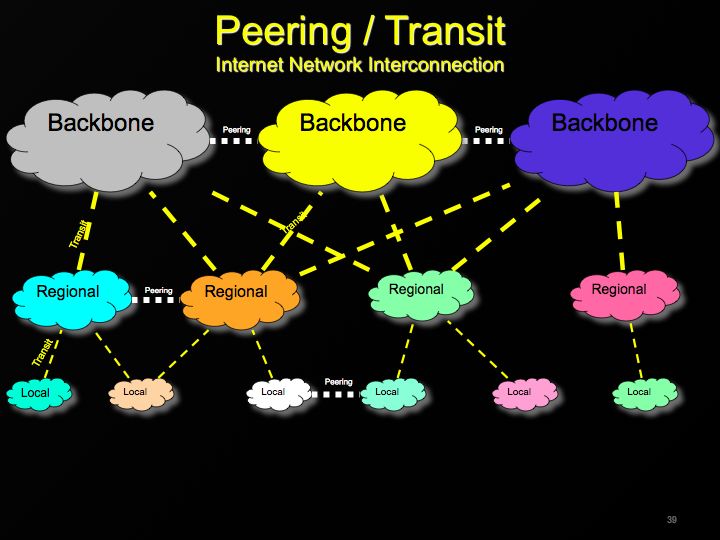
NSFNET gave us the early commercial topology of the Internet, with Tier 1 backbones, Tier 2 regional networks, and Tier 3 local networks. NSFNET gave us our first dedicated backbone and the first mbps backbone.  It also gave us the crucial Network Access Points, known today as Internet eXchange Points.  The contractors that bid for the opportunity to build and operate NSF's network learned from their experience and launched into the information economy as the leading commercial Internet networks. A government investment of millions of dollars had a Return on Investment of an entire new economy.


In 1995, MERIT published the NSFNET Final Report, in which it was stated:
"Infrastructures, for purposes such as transportation and communication, have long been vital to national welfare. They knit together a country's economy by facilitating the movement of people, products, services, and ideas, and play important roles in national security." p. 4.
The report concluded:
"Since the earliest days of the telegraph and the telephone, history tells us that the arrival of each new communications medium has been accompanied by grandiose claims of its potential benefits to society. In order to take advantage of the exciting opportunities afforded by today's technology, it is imperative that policy makers examine the development of the NSFNET and the Internet. We are still far away from a truly open, interoperable, and ubiquitous global information infrastructure accessible to all, "from everyone in every place to everyone in every other place, a system as universal and as extensive as the highway system of the country which extends from every man's door to every other man's door," in the words of Theodore Vail, president of AT&T in 1907. However, the Internet has brought us a giant step closer to realizing the promise of high-speed networking, one of the most revolutionary communications technologies ever created. As part of this phenomenon, the NSFNET backbone service provided a model for future partnerships as well as a legacy of technology for the world." p. 43.

Friday, December 09, 2016

Origins of Settlement Free Peering

Internet culture stood as an antithesis to Bell telephone culture. In the early 1960s, Paul Baran, who was concerned about the vulnerability of U.S. communications, advocated that the Department of Defense migrate to a distributed packet-switched network that could survive failure and still get a “Go; No-Go” command to the field. Bell-trained DOD engineers dismissed packet-switched communications as an idea that could not possibly work. In 1971, Larry Roberts, having successfully demonstrated the viability of his packet-switched network experiment, attempted to give ARPANET to AT&T; AT&T was not interested. In the meantime, AT&T had refused to sell private lines to nascent data networks, refused to allow foreign devices (i.e., modems) to their network, and refused to interconnect their network with nascent rivals. Those seeking telecommunications services in order to build computer networks became frustrated, and serious question arose concerning whether AT&T’s telecommunications services would meet the needs of growing computer networks. 

Thus emerged a cultural rivalry between Nethead and Bellhead cultures. In the eyes of the Netheads, Bellheads were about perpetuating a century-old communications network monopoly that followed a command-and-control model of central operation which stunted innovation, while Netheads were all about innovation, building a network that fostered the cool things transpiring at the end. Netheads wanted nothing of the Bellhead model. [Greenstein 2015 at 38 ("most had an almost visceral dislike for" Ma Bell)] [Mayo (quoting Bob Taylor, "Working with AT&T would be like working with Cro-Magnon man. I asked them if they wanted to be early members so they could learn technology as we went along. They said no. I said, Well, why not? And they said, Because packet switching won’t work. They were adamant.").] 

In the 1980s, Netheads had to resolve how to interconnect networks. Netheads wanted to interconnect ARPANET with an NSF sponsored CSNET, but what should be the terms and who should pay whom? One model before them was the byzantine Bell accounting scheme which one engineer described as so complicated it was akin to drinking coffee one molecule at a time; a marvelous feat of engineering if not utterly pointless. [Moore 1999] [Jacobson 1999 (discussing how Internet culture is different than BellHead culture and the implications for the future of the internet)] [Kleinrock 1994 at 67 (bemoaning the additional cost and complexity of accounting necessary for usage-based pricing); [MacKie-Mason 1993 at 14 (describing the cost of phone company style billing and accounting as applied to the packet-switched Internet as “astronomical”).] Netheads' incentive was to grow network effect and continue innovation at the ends. To achieve that incentive, they wanted the lowest possible barriers to the expansion of the network. The solution was settlement-free interconnection, devoid of complicated Bell accounting. A paper by Lyman Chapman and Chris Owens describes how the arrangement came to be:
In modern terms, we would say that the customers of one ISP (ARPAnet) could not communicate with the customers of another ISP (CSNet), because no mechanism existed to reconcile the different Acceptable Use Policies of the two networks. This disconnect persisted as both sides assumed that any agreement to exchange traffic would necessarily involve the settlement of administrative, financial, contractual, and a host of other issues, the bureaucratic complexity of which daunted even the most fervent advocates of interconnection—until the CSNet managers came up with the idea that we now call “peering,” or interconnection without explicit accounting or settlement. A landmark agreement between NSF and ARPA allowed NSF grantees and affiliated industry research labs access to ARPAnet, as long as no commercial traffic flowed through ARPAnet.
[Chapin 2005 at 9] [Norton Chap. 8]

NSF followed CSNET's example for interconnection settlements; interconnections between NSFNET and regional networks was on a settlement-free basis.  [MacKie-Mason 1993 at 18 (“The full costs of NSFNET have been paid by NSF, IBM, MCI and the State of Michigan”).]

Commercial networks emerged in the early 1990s, but they could not exchange traffic through the academic NSFNET. On the one hand, Advanced Network Services(ANS), the contractor that operated the NSFNET, established a commercial backbone service and offered to sell interconnection to nascent commercial networks. ANS had all of the NSFNET clients as end-users including regional networks and academic networks; ANS as the largest network could leverage network effect. But the other commercial networks were not interested in paying ANS for the right to access end-users or helping ANS become the AT&T-monopoly of the Internet. Instead they established the Commercial Internet eXchange (CIX) and exchanged traffic on a settlement-free basis. For these early commercial networks, connectivity was paramount and growth of access services was king. [Brock, Economics of Interconnection at ii ("Commercial Internet service providers agreed that interchange of traffic among them was of mutual benefit and that each should accept traffic from the other without settlements payments or interconnection charges. The CIX members therefore agreed to exchange traffic on a "sender keep all" basis in which each provider charges it own customers for originating traffic and agrees to terminate traffic for other providers without charge.").] First UUNET, PSINET, and CERFNET joined CIX. Then Sprint joined. Soon most of the Internet could be reached through CIX. Connectivity grew network-effect which grew the value of the access service that these commercial networks were selling to end-users. CIX become the model of commercial interconnection, while ANS became isolated. [Greenstein 2015 at 81 ("Just a little less than a year later, CIX essentially had everyone except ANS. By the time Boucher held his hearing, ANS had become isolated, substantially eroding their negotiating leverage with others. By June 1992 ANS's settlement proposals no longer appeared viable. In a very public surrender of its strategy, it agreed to interconnect with the CIX on a seemingly short-term basis and retained the right to leave on a moment's notice.)] [Noam 2001 at 63 (""Soon the relative use by the commercial and nonprofit sectors kept shifting, and the power over interconnection moved to the former. By 1993, approximately 80 percent of all Internet sites could be accessed outside the NSFNET structure. CIX blocked ANS traffic from routing through the CIX router, thus depriving ANS users of connectivity to CIX members. Humbled, ANS joined CIX in 1994"")] [Srinagesh at 143 ("In October 1993, CIX, apparently without warning, blocked ANS traffic from transiting the CIX router. At this point, ANS (through its subsidiary CO-RE) joined the CIX and full connectivity was restored.")]. In 1994, ANS' assets were sold off to AOL. [History, Advanced Network Services (2004)] [Salus 1995 at 200]  

In the late 1990s, academic and government networks focused on research, development, and innovation, not commercial competition; they followed settlement-free peering as a simple accounting scheme for interconnection. Commercial backbone providers adopted settlement-free peering as a means of rapidly growing their business plans.

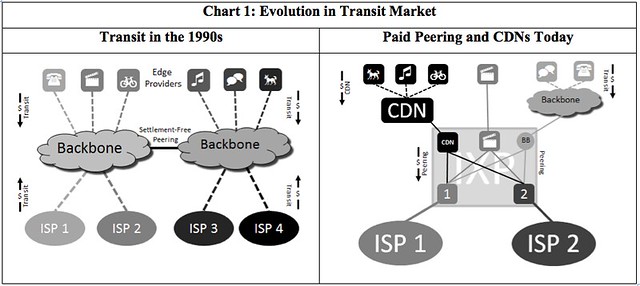
Access networks, which needed to provide full Internet service to their customers, interconnected with and paid transit to commercial backbone providers. Controversy swirled during the late 1990s as the commercial backbones matured their business plans, converting smaller networks that were dependant on the backbone networks' services from settlement-free peers into paying transit customers. Appeals for intervention reached the FCC, which declined to intercede, finding the Internet backbone market competitive.

Tuesday, December 06, 2016

Historic Evolution of Internet Interconnection

In the beginning was ARPANET. ARPANET was an end-to-end packet-switched network. ARPANET was The Network, thus interconnection was not a tremendous concern. 

ARPANET’s success begat ALOHANET, SATNET, PRNET and other packet switched networks. It was clear that ARPANET's network protocol would have to be revised in order to facilitate interconnection. In 1972, Vint Cerf and Bob Kahn released A Protocol for Packet Network Interconnection. The design objective of the Internet was to enable interconnection between otherwise incompatible networks, promoting the research and innovation occurring at the edges, and leveraging "network effect." IP made interconnection easy and coordination unnecessary. According to Bob Kahn,
The idea of the Internet was that you would have multiple networks all under autonomous control. By putting this box in the middle, which we eventually called a gateway, it would allow for the federation of arbitrary numbers of networks without the need for any change made to any particular network. So if BBN had one network and AT&T had another, it would be possible to just plug the two together with a [gateway] box in the middle, and they wouldn't have to do anything to make that work other than to agree to let their networks be plugged in.
[SEGALLER, NERDS 2.0.1: A BRIEF HISTORY OF THE INTERNET at 111]

The Internet reflected a culture where connectivity was paramount. With each interconnection of an additional network, the value of the Internet grew. [Carpenter, Architectural Principles of the Internet, IETF RFC 1958,  Sec. 2.1  ("the goal is connectivity, the tool is the Internet Protocol, and the intelligence is end to end rather than hidden in the network. The current exponential growth of the network seems to show that connectivity is its own reward.")] [THE INTERNET'S COMING OF AGE, COMPUTER SCIENCE AND TELECOMMUNICATIONS BOARD, NATIONAL RESEARCH COUNCIL 35 (2001) ("the value placed on connectivity as its own reward favors gateways and interconnections over restrictions on connectivity")] [REALIZING THE INFORMATION FUTURE: THE INTERNET AND BEYOND, COMPUTER SCIENCE AND TELECOMMUNICATIONS BOARD, NATIONAL RESEARCH COUNCIL 3 (1994) (setting forth vision for Open Data Networks, stating in first principle that network should "permit[] universal connectivity.")] [David Clark, A Cloudy Crystal Ball: Visions of the Future, Presentation at the IETF, Slide 4 (July 1992) ("Our best success was not computing, but hooking people together").]

In 1985, the National Science Foundation concluded that the Internet was good, and sought to expand its reach to the greater academic community. Instead of providing the entire end-to-end network, NSF elected to supply a crucial piece: the first dedicated nationwide Internet backbone. The NSFNET interconnected with regional networks, and the regional networks interconnected with local networks. In so doing, NSFNET offered long-distance transit as well as traffic exchange between networks.

Commercial networks concluded that the Internet was good. Commercial traffic, however, could not be exchanged across NSFNET. Therefore, the early commercial networks established the Commercial Internet eXchange (CIX) and exchanged traffic on a settlement-free basis. For these early commercial networks, connectivity was paramount and growth of access services was king. [Brock, Economics of Interconnection at ii ("Commercial Internet service providers agreed that interchange of traffic among them was of mutual benefit and that each should accept traffic from the other without settlements payments or interconnection charges. The CIX members therefore agreed to exchange traffic on a "sender keep all" basis in which each provider charges it own customers for originating traffic and agrees to terminate traffic for other providers without charge.").]

The US Government concluded that the Internet was good, and sought to make it available to all. NSF was tasked with privatizing the Internet. In order to be successful, NSF had to establish a means for emerging commercial networks to exchange traffic. Following the CIX model, NSF built four Internet exchange points, known as NAPs, in Washington, D.C., New York, Chicago, and San Jose. [National Science Foundation Solicitation 93-52, Solicitation for Network Access Point Manager, Routing Arbiter, Regional Network Providers, and Very High Speed Backbone Network Services Provider for NSFNET and NREN Program (May 6, 1993) (setting forth NSF's plan for privatizing NSFNET).] [GREENSTEIN, HOW THE INTERNET BECAME COMMERCIAL at 82 (NAPs were modeled on CIX and "helped the commercial Internet operate as a competitive market after the NSFNET shut down.").]


In 1995, NSF decommissioned the NSFNET and the commercial Internet was born in its image. There were Tier 1 backbone networks (WANs) that provided nationwide or global service, Tier 2 networks (MANs, Metro) that provided regional service, and Tier 3 networks (LANs, Local) that provided access service. Traffic from one end-user to another end-user would travel up the topology from Tier 3 networks to be exchanged at the Tier 1 level, and then travel back down. Within networks was robust capacity moving traffic. [See David Young, Why is Netflix Buffering? Dispelling the Congestion Myth, VERIZON PUBLIC POLICY BLOG (July 10, 2014) (diagramming Verizon network with backbone, metro and local networks)] Between networks was interconnection where capacity could be constrained. Interconnection capacity constituted an aggregation of all traffic from the different end-users, services, and firms to which a network provider offered service. It could become a traffic pinch-point. In order to avoid congestion, interconnection partners would have to cooperate. [See KLEINROCK, REALIZING THE INFORMATION FUTURE: THE INTERNET AND BEYOND at 183 ("Because the network is not implemented as one monolithic entity but is made of parts implemented by different operators, each of these entities must be separately concerned with achieving good loading of its links, avoiding congestion, and making a profit. The issue of sharing and congestion arises particularly at the point of connection between providers. At this point, the offered traffic represents the aggregation of many individual users, and thus cost-effective sharing of the link can be assumed. However, if congestion occurs, one must eventually push back on original sources. Options include pricing and technical controls on congestion; there may be other mechanisms for shaping consumer behavior as well.”)]

Early academic and government networks focused on research, development, and innovation, not commercial competition; they developed a simple accounting scheme for interconnection: settlement-free peering. Early commercial backbone providers adopted settlement-free peering as a means of rapidly growing their business plans. Access networks, which needed to provide full Internet service to their customers, interconnected with and paid transit to commercial backbone providers.

The Internet interconnection market would then undergo seismic evolution. By 2010, large access providers had reestablished a strong position in the network ecosystem, and leveraged network effect and interconnection to implement strategic goals. Broadband Internet access service providers were able to reverse the flow of interconnection settlement fees, going from transit customers to gatekeepers, charging paid peering for access to their end-users. The interconnection market had departed from the characteristics of the early commercial Internet, where backbone networks were king and the market was hyper-competitive, and returned to traditional consolidated network market economics.  [See generally WU, THE MASTER SWITCH: THE RISE AND FALL OF INFORMATION EMPIRES (discussing how communications markets go through cycles of innovation and disruption, competition, and then consolidation and market power).]


Wednesday, December 19, 2007

Who was the true father of the Internet?


Pop quiz: Who said:
It is from this paper that the rumor was started that the Internet was created by the military to withstand nuclear war. This is totally false. Even though this Rand work was based on this premise, the ARPANET and the Internet stemmed from the MIT work of Licklider, Kleinrock and Roberts, and had no relation to Baran's work.
We've been focusing on history lately. On November 29 & 30, in Washington DC was an NSFNET Celebration. It was an oral history project. Lots of the primary folk from the primary organizations (NSF, MERIT, IBM, MCI) were present, retelling the NSFNET Story. It was fascinating. It was, like so many things, like looking a picture in black and white, and then seeing the same picture in color. So much was added to the history. Things like - the "network of network?" - that was NSFNET. NSFNET established the network hierarchy and "tiers." Where NSF's "cooperative agreements" came from and how that created the foundation of future policy struggles. This was not, after all, a simple R&D and transfer of technology project that NSF funded. This was, as the NSFNET Final Report stated, communications infrastructure, vital to the success of our economy and culture.

All this led to significant revisions to CT's history section. Take a look; give feedback!

BTW, the lead-in quote was by Larry Roberts, the head of ARPANET in the late 1960s, who has a pretty decent first hand perspective on why he built the ARPANET (aka Internet) the way that he did.