Sunday, July 08, 2007

Stealth Trademarks: Ad Keywords

Finally, the situation which is the goldmine (actually it is more like a copper mine, as in, it generates a few pennies every day) for small publishers like Cybertelecom: advertising generated by search engine companies based on keywords. The search engine company will let an advertiser bid on trigger-terms – any trigger-terms. The advertiser’s ads can appear in one of two ways: First, when those trigger-terms are typed into the search engine, the ads can appear on the search engine results page, normally designated as paid-for search results. Second, when a third-party website has embedded advertisements from the search engine and is somehow related to a trigger-term, an advertiser’s ad can appear in a little advertisement box (see the Google Ads on the left column of this blog).

Neat! So if an individual is searching for the AcmeNetLaw website and types that trigger-term into a search engine, I could use Acme’s trademark as a trigger-term to get an ad for Cybertelecom to appear! If the individual visit’s the AcmeNetLaw website, and the AcmeNetLaw website has those embedded search ads, my Cybertelecom advertisement could appear (well not really, Google Ads provides a tool to block advertisements from competitors appearing on my website – If AcmeNetLaw fears Cybertelecom, it can block CT). Does this opportunity stumble over trademark law?

Before we go forward, let’s go backwards to the video tape. What constitutes a Lanham Act trademark violation? To prevail on a trademark infringement claim for a registered trademark, a Plaintiff must establish that:

(1) he has a valid mark that is entitled to protection under the Lanham Act;

(2) defendant used the mark;

(3) in commerce;

(4) in connection with the sale or advertising of goods or services; and

(5) without plaintiff's consent.

Okay, you metaphysicians, if the use of the trigger-term is stealth – is it “used in commerce”? Trademark law is all about consumer protection. We want to prevent consumers from being confused about products and services. When a consumer has come to expect a lousy burger and fries from ACME Burger Joint, we want the consumer to always get that same lousy burger and fries wherever they see the ACME Burger Joint trademark. There would be a conundrum if ZETA Veggie Burger Joint used the ACME trademark and slipped people nutritious delicious tofu burgers. The key to trademark violations is the visible identification of the trademark with an imposter’s product or service. So, like the fallen tree, if a trademark is used in the forest and no one is there to visually identify it, is it “in use”? If not, the trademark violation claim fails. A lot of the cases turn on this metaphysical point, and as with the previous cases we have reviewed, the courts are not at all settled on how they want to come out on this one. Let’s look at two recent cases, one where the court finds that the trademark is used in commerce, and one where the court does not so find.

The first case from this year is quite interesting because, while it does in fact find that the trademark is in use in commerce, it still, nevertheless, finds for the defendant. JG Wentworth SSC Ltd v Settlement Funding LLC, No 06-0597 (EDPa Jan 4 2007). In this case, Plaintiff Wentworth is a finance company that provides cash now in exchange for something of value in the future – like if you win the lottery and would get it in 10 payments over the next 10 years – Wentworth would give you cash now for that future value. Defendant Settlement Funding apparent does pretty much the same thing. Both parties have websites and, according to the allegations, Defendant used Plaintiff’s trademark “JG Wentworth” as a trigger term for Google Ads (there is also a metatag argument in this case, but we dealt with metatags in the first article in this series). Claiming that Defendant was taking unfair advantage of the value Plaintiff had bestowed in its trademark, Plaintiff sued.

The court is not perfectly clear why it comes down in favor of “in use.” It reviews a bunch of non-binding cases from other jurisdictions that conclude that stealth trademarks are not in use - brought up by defendant - and some conflicting non binding cases that conclude that they are. And the court basically brushes it all aside stating that defendant is unpersuasive. The court simply lines up on the side of the “in use” cases, stating

But like [those cases], I recognize that defendant’s use of plaintiff’s marks to trigger internet advertisements for itself is the type of use consistent with the language in the Lanham Act which makes it a violation to use “in commerce” protected marks “in connection with the sale, offering for sale, distribution, or advertising of any goods or services,” or “in connection with any goods or services.”

Okay, why? The court acknowledges that it lines up with those cases, but it doesn’t really specify why that line of cases is more persuasive.

The court is more articulate on the next criteria, whether there is any “confusion.” Now, it is important to understand what is going on here. This is not a bait-and-switch thing where the consumer is asking for an ACME Lousy Burger and getting a ZETA Tofu Burger instead. This is a computer user typing “JG Wentworth” into Google, and getting a result page where “JG Wentworth” is likely the top result – go ahead and see what the results page would look like by clicking here (but promise to come on back). In addition to Plaintiff’s link, a whole bunch of other stuff comes up too. But it’s all there. Consumer is not getting one product in place of another – consumer is getting what they asked for… and some other stuff too.

Think about it differently. You go to a grocery store. You ask the clerk for ACME Lousy Frozen Burgers. And when you go to the shelf, there are the ACME Burgers along with ZETA Tofu Burgers. Has ZETA committed a trademark violation for being on the same shelf as ACME. No. So if you see a Google results page that has the ACME Burgers, and a listing for ZETA burgers right next to it, would you be any more confused?

At no point are potential consumers “taken by a search engine” to defendant’s website due to defendant’s use of plaintiff’s marks in meta tags. Rather, as in the present case, a link to defendant’s website appears on the search results page as one of many choices for the potential consumer to investigate. As stated above, the links to defendant’s website always appear as independent and distinct links on the search result pages regardless of whether they are generated through Google’s AdWords program or search of the keyword meta tags of defendant’s website.

Wentworth at 14.

It seems like the court wants to dodge the “in use” question for the “confusion” question. The “in use” analysis is a muffled flip-of the coin – on the one hand here is a bunch of cases, on the other hand here are some different cases and (flip), ah, I chose the former over the later. Where the court is persuasive is the critique of confusion. Whatever it is that is going on, the consumer is getting what they are asking for. The defendant is not engaged in counterfeiting; the defendant is not engaged in bait-and-switch. The defendant’s listing is simply listed on the result page as a “sponsored link” off on the side, or in a shaded box, where plaintiff’s link is front and center. Only a fool (or a lawyer, ah but I repeat myself) would be confused in this situation.

A more recent case Site Pro-1 v Better Metal, Inc., 06-CV-6508 (ILG) (RER) (EDNY May 9th, 2007), returned to the issue of “in use.” This case involved two parties that (according to the court decision) were involved in the sale of equipment used to construct wireless telecom towers. Plaintiff complained that defendant had placed “site” “pro” and “1” in metatags on its website, and purchased a sponsored search at Yahoo! based on those terms. Defendant responded, “yeah, so?! We aint ‘used’ the your trademark.” The court did a nice review of precedent and stated “The key question is whether the defendant placed plaintiff’s trademark on any goods, displays, containers, or advertisements, or used plaintiff’s trademark in any way that indicates source or origin. In other words, does the consumer perceive the trademark and is the consumer thereby confused. It was undisputed that the use of the trigger-terms was entirely stealth – that the terms did not appear on defendant’s products or website in any way. As such, the court ruled, plaintiff’s claim that defendant is up to bad things fails.

Ah, but wait! Before I could finish this post, yet another case crosses my desk: Fragrancenet.com, Inc. v FrangrenceX.com, Inc., No. 06-CV-2225 (JFB) (AKT) (EDNY June 12, 2007). This case is so much like all the others that I will not bother to hit the auto-replay button for you. The decision is very well written and reviews most of the recent precedent. But the judge takes the analysis one step further. Plaintiff tries to make a fuss based on a New York theory of Passing Off. The court pummels this attempt, stating that this is not a case of Defendant trying to pass off its products as plaintiffs. Rather, this is a case where a consumer uses a trigger-term, and is presented with what the consumer is asking for, along with alternatives, and in a competitive capitalistic market, we like alternatives and choice!

In the world outside the Internet, individuals in search of a company or product are not blinded to competitive products. In other words, it is not unlawful to strategically place billboards or even store locations next to billboards or store locations of competitors. For example, an individual in search of a McDonald’s restaurant will often be confronted with a Burger King restaurant. As long as Burger King did not mislead the consumer under false pretenses to its location, the mere fact that it decided to place itself in close proximity to a McDonald’s, in an effort to potentially draw customers in search of fast food, is not “passing off.”

Slip p. 7. If you ask for a Coke, and are told you can have a Coke, a Pepsi, a rootbeer, or an iced tea, the court approvingly says, this is not confusion, this is the presentation of alternatives. Likewise the use of trigger-terms that produce desired results in search engines along with choices is not confusion - it is the presentation of alternatives.

The outcome of this line of cases if obviously very important. Currently search engines advertising companies can sell any trigger-word available, whether it is someone’s trademark or not. If this type of stealth trademark usage violates the Lanham Act, what type of liability would search engine companies have in these situations and what measures would they be forced to take in order to avoid this liability? It could create a substantial challenge for them to know that a trigger-term is a trademark, especially since pursuant to trademark law, the use of the term in one context could pose a violation where the use of the term in another context might not.

Personally I sort of agree with the Wentworth court here in rejecting the if-you-cant-see-it-its-not-in-use court decisions. The rule appears to be (a) for a trademark to be “in use,” it must be perceived, and (b) to be perceived means visually to see the mark. But seeing a trademark with one’s eyeballs is not the only way to perceive a trademark. I can perceive a trademark by hearing it. I can perceive a trademark by feeling it (particularly if I am blind and am reading Braille). In order to perceive it, I may require the use of some artificial device such as glasses, a hearing aid, or a camera. So why cant I “perceive” a trademark through the means of a computer? Has not a computer become an extension of my mental abilities akin to the primitive glasses and hearing aids? In an attempt to find a thing, I can look for it, I can feel for it, I can listen for it, or, perhaps, I can use my computer. The courts struggle with this line of cases and rightly so. A disruptive technology is taking old law to an entirely new place and the judges lack a solid footing on which to stand. The archaic suggestion that data in the virtual world is beyond human perception, if taken to be true, would fundamentally disorient and divorce the virtual world from the legacy world. We must reconceive our notions of perception and comprehend to degree to which computational power is becoming an amplification and extension of our abilities. To request that a computer find a trigger-term, and to have the computer present results means the computer as our agent perceived that trigger-term somehow associated with those results. We have perceived it.

However, Wentworth is right that this is not the end of the analysis. Getting beyond the metaphysics of perception is the obvious question of confusion; no one is confused here. As the court in Fragrancenet.com indicates, the presentation of alternatives is not confusion. As individuals’ general online experience matures, individuals’ know that search engines presents, if they are lucky, the trigger-term desired, and anything else associated with that trigger term. We may not know exactly what caused the paid-for ads to appear; we don’t care. We know there is a clear difference between the top results which hopefully contain our target, and the promises of fame and fortune in the advertisers box. We are not confused.

----

Read Our Disclaimer – All Facts are As Alleged or Reported – Some Are Entirely Fictitious -- Made from 100% Recycled and Organic Bits.

Tuesday, June 12, 2007

Stealth Trademarks: Pop-Up Ads

Another neat trick is the use of trademarks as trigger-terms that result in pop-up ads (I understand that Cerberus, the dog that guards the gates of Hades, has been reassigned to guard a special room where resides the inventors of pop-up advertising, spam, spyware and telemarketers). According to court accounts, some firms have created adware with databases of trigger-terms. When computer users type those trigger-terms into search engines, or when they access certain domain names, or however else these ingenious people might devise to trigger a response, a pop-up ad gloriously appears sharing news of valuable opportunities.

In reviewing these cases, the courts have considered the following theories and facts: trademark law and initial interest confusion, the fact that the adware program may have been voluntarily downloaded by the computer user, the fact that the popup ad makes no alteration or change to the underlying website, and the fact that the popup ad may not have the trademark term in it.

First, let’s see one where defendant loses: Newsweek Interactive Co., LLC, et al. v. The Gator Corp., (E.D. Va. 2002) In this case the court provides a one page order granting a motion for preliminary injunction against defendant. In other words, procedurally this is typically at the beginning of the litigation, where the plaintiff is arguing (a) I am really likely to win this case and (b) as long as defendant is doing these things, I feel pain. The court has not considered the case in depth and the court is not necessarily presenting a detailed finding of fact. In this case, Defendant, the pop-up company, loses. Note why: The Court says the Defendant is enjoined from:

  1. Causing its pop-up advertisements to be displayed on any website owned by or affiliated with the Plaintiffs without the express consent of the Plaintiffs;
  2. Altering or modifying, or causing any other entity to alter or modify, any part of any website owned by of affiliated with the Plaintiffs, in any way, including its appearance or how it is displayed…

The court believes that plaintiff’s websites are being mushed (and we have seen in the precedent of the framing cases that if you take someone else’s website and mush it, courts don’t like this).

Most likely you, the reader, are more familiar with how pop-ups work than this judge. When a pop-up appears, is it displayed on the webpage you are attempting to visit? Does it alter or modify that webpage? No! As annoying as pop-ups may be, the judge has his facts wrong. A pop-up is a fully separate browser window that pops-up and annoys you; it is its own webpage. And you sit there playing whack-a-popup, trying to close those things. It is not on the webpage you are attempting to see, nor does it alter it in any way. This distinction will become important in the next set of cases. By the way, Defendant Gator, now known as Claria Corp., reportedly subsequently settled many of these suits out of court.

Next is a set of cases known as the WhenU cases. WhenU apparently distributed adware that caused pop-ups to appear with third-party advertisements. When a website was visited, pop-ups would appear, sometimes from that website’s competitor. The pop-ups appear based on an algorithm WhenU employs to determine what might be relevant to the computer user (in other words, the advertiser does not have the opportunity to buy keywords). When a pop-up appeared, it indicated that it was from WhenU, and it did not include a trademark from the original webpage. Plaintiffs became quite bothered as pop-up ads from competitors magically appeared when people accessed their webpages. There had to be something untoward about this – so plaintiffs complained of trademark violations.

In these cases, the courts – and there have been several of them – have consistently found in favor of WhenU, concluding that the WhenU program was downloaded voluntarily by the computer user (usually bundled with something else the computer users downloaded – gotta read those user agreements to see what you are downloading!), that the WhenU program did not interact with third party webpages or their webservers, but instead interacted with its own webservers and the computer users’ screen. WhenU’s program, the court found, did not use plaintiff’s trademarks as trigger words, but instead triggered pop-ups based on domain names that are visited (which, as we know, can be identical with plaintiff’s trademark). In the frame around the pop-up, WhenU was identified, along with a “?” that, when clicked on, provided information about WhenU and the advertisements. Read the court decisions in 1-800 Contacts, Inc. v. WhenU.Com and Vision Direct, Inc., 309 F. Supp. 2d 467 (S.D.N.Y. 2003) rvsrd 414 F.3d 400, slip p. 21 (2d Cir. 2005) where the judges do a careful and extensive review of how pop-ups work.

In order to find a trademark violation, the court would have to find that defendant WhenU used a trademark in commerce without consent. WhenU has taken plaintiff’s domain name and included it in its own database, invisible to the computer user. The domain name (and if it is a trademark of plaintiff, the trademark) is not reproduced in the pop-up advertisement. The advertiser whose ad appears in WhenU’s service does not get to buy the trademark as a keyword. The trigger word is in WhenU’s database as a domain name and not as a trademark. In this case, the use of the trigger term is stealth and thus, according to the court, cannot constitute “use in commerce”:

A company’s internal utilization of a trademark in a way that does not communicate it to the public is analogous to an individual’s private thoughts about a trademark. Such conduct simply does not violate the Lanham Act, which is concerned with the use of trademarks in connection with the sale of goods or services in a manner likely to lead to consumer confusion as to the source of such goods or services.

1-800 Contacts, Inc. v. WhenU.Com and Vision Direct, Inc., 309 F. Supp. 2d 467 (S.D.N.Y. 2003) rvsrd 414 F.3d 400, slip p. 21 (2d Cir. 2005).

In one of the WhenU cases, Quicken had become displeased with WhenU’s practices and sued. However, the Court had to politely point out, as above, that not only did WhenU not interact with or alter plaintiff’s website, but also that Quicken had a division that took advantage of WhenU’s services. D’oh! Wells Fargo & Co. v. WhenU.com, 293 F.Supp. 2d 734 (E.D. Mich. 2003). See also U Haul Int'l, Inc. v. WhenU.com, Inc. , 279 F. Supp. 2d 723 (E.D.Va. 2003).

Here’s the scoreboard so far: with metatags, where the use of the trademark cannot be seen, inserting a trademark into the metatags is bad! With pop-ups, where the use of a trademark (only its not a trademark, it’s a domain name which is similar to a trademark, which seems a lot like a trademark…) cannot be seen, it’s stealth and therefore not “in use in commerce.”

Next time we consider whether “Do No Evil” Google has violated its prime directive by allowing advertisers to purchase trademarks as keyword trigger-terms for Google Ads.

Read Our Disclaimer – All Facts are As Alleged or Reported

Friday, June 01, 2007

Calendar of Events

Here is a calender of upcoming Net Law and Policy events. To have your event included on the calendar, contact us.

Thursday, May 31, 2007

Stealth Trademarks: The Use of Trademarks As Ad Keywords, In Metatags, And In Pop-Ups

Is it wrong for me to use your trademark? Is it wrong for me to use your trademark to attract traffic to my website, if no one sees me using your trademark?

This is a contentious issue that the courts have struggled with. Of course, the use of trademarks in domain names has been explosively contentious, driving DNS policy. The use of a trademark in a domain name is a very visible use of the mark, in an environment where the supply of available opportunities to use the mark is limited (there are only so many dot-coms after all; there is dot-com, dot-biz, dot-ccTLDs, dot-org, dot-edu, dot…. Well, okay there are more opportunities now then there use to be and there would be a lot more opportunities if ICANN would approve more gTLDs). The DNS-Trademark contention has led to the creation of the Uniform Dispute Resolution Policy, the AntiCybersquatter Protection Act, the Fraudulent Online Identity Sanctions Act, lots of trademark litigations, and lots of activity before the World Intellectual Property Organization (WIPO).

But here we deal with the stealth use of trademarks. No human sees them. No human is getting confused by the ALPHA trademark that appears super-glued to BETA’s product.

There are three different models of stealth trademarks: metatags, keywords for search engines, and pop-ups. These models are very closely related, as are the legal proceedings that struggled with them.

Let’s start with the easy model: metatags. And by “easy,” here I mean the courts have a sort of rough consensus on outcome. In these cases, website owners insert trademark terms into the metatags of their webpages. After search engine spiders crawl and index these pages, the metatags will act as trigger-terms, causing the webpage in question (at least in theory) to appear in search results when that trademark is typed into a search engine (rumor has it that a lot of search engines now simply ignore metatags). The courts have generally thought that this use of metatags does not constitute playing nice.

Courts needed to find a confusion between plaintiff’s invisible trademark and defendant’s products, and in order to do this, they have relied on something known as Initial Interest Confusion. This doctrine was well articulated in the case Brookfield Communications v West Coast Entertainment, 174 F.3d 1036 (9th Cir. 1999). Of course, everything was well articulated in Brookfield; dare read that case only if you have a pot of coffee and a lot of spare time on your hand.

In Brookfield, according to the court opinion, plaintiff Brookfield gathered and sold information concerning the entertainment industry. One of its products is a searchable database called “MovieBuff,” which it began to sell in 1993. In 1996, Brookfield attempted to register the domain name moviebuff.com but had been beaten to the punch by defendant. So Brookfield registered “moviebuffonline.com,” set up a website, and sold its MovieBuff software. In 1997, Brookfield registered “MovieBuff” as a trademark.

As for defendant, West Coast, a video rental store chain – it had registered the domain name moviebuff.com in 1996 and had launched its website moviebuff.com in 1998 (I will not confuse you with other facts such as West Coast had acquired a service mark for “The Movie Buff’s Movie Store” in 1991, had marketed goods and services since 1988 using the term “Movie Buff,” or that the court concluded that defendant’s “Movie Buff’s Movie Store” mark was different than plaintiff’s “MovieBuff” mark because of the spaces between the words – and therefore not prior – but that defendant’s moviebuff.com domain name was identical to plaintiff’s “MovieBuff” mark – ignoring that domain names can’t have spaces or “moviebuff.com” had four additional non identical symbols.).

In the 36 or so arguments of defendant’s that the court obliterated was the argument that, as the defendant registered the domain name moviebuff.com in 1996, and as this was prior to plaintiff’s registering the trademark MovieBuff in 1997, defendant wins on the ground of prior use. The court rejects this argument on exactly the same grounds that subsequent courts will reject this court’s holding: if it can’t be seen, it’s not “in use in commerce” as required for a trademark violation.

Registration with Network Solutions, however, does not in itself constitute "use" for purposes of acquiring trademark priority. The Lanham Act grants trademark protection only to marks that are used to identify and to distinguish goods or services in commerce -- which typically occurs when a mark is used in conjunction with the actual sale of goods or services. The purpose of a trademark is to help consumers identify the source, but a mark cannot serve a source-identifying function if the public has never seen the mark and thus is not meritorious of trademark protection until it is used in public in a manner that creates an association among consumers between the mark and the mark's owner.

Brookfield ¶ 7. If it can’t be seen, then it’s not “in use” - hold that thought until we get to the next scenarios.

So after about three hours of reading about how MovieBuff was prior to MovieBuff, but different than MovieBuff, and therefore the use of the domain name moviebuff.com was a trademark violation, you get to the tagged-on argument about metatags (in other words, defendant had not just lost by this point; defendant had been beaten into a pulp by the court). It is now firmly established in the court’s opinion that plaintiff can do no wrong and defendant can do no right. Obnoxious defendant (the one that had been using the phrase “Movie Buff” for five years prior to plaintiff’s use) dared to visibly label its goods and services with the domain name moviebuff. Now the court considers whether defendant can use a stealth trademark in its metagags as trigger-term for search engines. The public cannot see the mark; there is no visible association between the stealth-mark and the defendant’s good and services. But the defendant is evil! The Court must bend it so that defendant has been bad once again, and therefore articulates the doctrine of Initial Interest Confusion in terms of metatags:

Web surfers looking for Brookfield's "MovieBuff" products who are taken by a search engine to "westcoastvideo.com" will find a database similar enough to "MovieBuff" such that a sizeable number of consumers who were originally looking for Brookfield's product will simply decide to utilize West Coast's offerings instead. Although there is no source confusion in the sense that consumers know they are patronizing West Coast rather than Brookfield, there is nevertheless initial interest confusion in the sense that, by using "moviebuff.com" or "MovieBuff" to divert people looking for "MovieBuff" to its web site, West Coast improperly benefits from the goodwill that Brookfield developed in its mark.

There’s no source of confusion; defendant this time has no visible use of plaintiff’s mark; the not-confused consumer has a results page in front of the consumer with both MovieBuff and West Coast – not-confused customer can pick the product that the not-confused customer asked for, or something else - and there will always be something else on the search results page. Because this not-confused consumer might elect to visit some other website than plaintiff’s, this makes defendant, once again, evil – and the not-confused customer is mysteriously confused as legally required.

Bad cases make for bad law. It’s clear the court did not like defendant’s use of “MovieBuff” in its domain name and it’s clear that the courts grasp of the Internet was novice at best. Brookfield was really a strong trademark-domain name case, with a weak meta-tag issue tagged on. It was an afterthought – and this afterthought set the course that many other cases followed. See, e.g., Promatek Industries v. Equitrac Corp, 300 F.3d 808 (7th Cir. 2002); Eli Lilly & Co. v. Natural Answers, Inc., 233 F.3d 456, 464 (7th Cir. 2000)

Not all courts, however, have bought into the Brookfield inquisition. See Site Pro-1 v Better Metal, Inc., 06-CV-6508 (ILG) (RER) (May 9th, 2007). As time has progressed, the metaphysical contradiction that the non-visible use of a trademark in one place did not constitute “a use” where in another place it did was too perplexing.

Final lark: After what must have been a costly litigation, the moviebuff.com domain, at the time of this writing, is no longer a working website!

In the next scenario, someone gets the bad idea of using stealth trademarks as trigger-terms in order to cause pop-up ads to appear!

Wednesday, May 30, 2007

ISP Trade Associations


Recently we were asked for an up-to-date list of ISP Trade Associations (CIX, the original ISP trade association, pictured to the right, no longer exists). Our impression is that there are not a lot of them left. Perhaps the most active ones are the WISP trade associations. There are also a few associations that show up at ISPCON.

Here is the list of ISP Trade Associations that we could confirm still exist. Did we miss any?

Confirmed Active Trade Associations

Thursday, May 24, 2007

Net Tax Moritorium and DSL

Recently we heard about a locality that was attempting to tax the DSL part of Internet Service - and the question arose concerning whether the Internet Tax Freedom Act prevented this sort of thing. Well, interestingly enuf, the GAO just released a report on the Tax Freedom Act and here is what they had to say on the subject:

"Since its 1998 origin, the moratorium has always prohibited taxing the service of providing Internet access, including component services that an access provider reasonably bundles in its access offering to consumers. However, as amended in 2004, the definition of Internet access contains additional words. With words added in 2004 in italics, it now defines the scope of nontaxable Internet access as

“a service that enables users to access content, information, electronic mail, or other services offered over the Internet, and may also include access to proprietary content, information, and other services as part of a package of services offered to users. The term ‘Internet access’ does not include telecommunications services, except to the extent such services are purchased, used, or sold by a provider of Internet access to provide Internet access.” (italics provided)

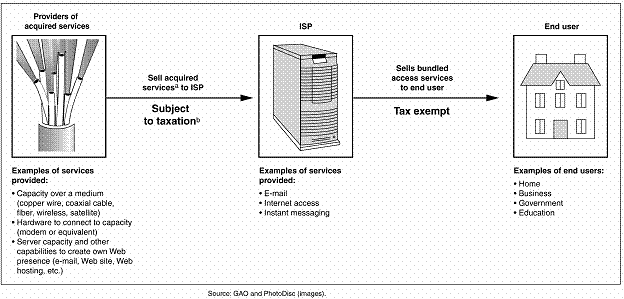
"As shown in the simplified illustration in figure 2, the items reasonably bundled in a tax-exempt Internet access package may include e-mail, instant messaging, and Internet access itself. Internet access, in turn, includes broadband services, such as cable modem and DSL services, which provide continuous, high-speed access without tying up wireline telephone service. As figure 2 also illustrates, a tax-exempt bundle does not include video, traditional wireline telephone service referred to as “plain old telephone service” (POTS), or VoIP. These services are subject to tax. For simplicity, the figure shows a number of services transmitted over one communications line. In reality, a line to a consumer may support just one service at a time, as is typically the case for POTS, or it may simultaneously support a variety of services, such as television, Internet access, and VoIP." [GAO 2007 p 8]

"Our reading of the 1998 law and the relevant legislative history indicates that Congress had intended to bar taxes on services bundled with access. However, there were different interpretations about whether DSL service could be taxed under existing law, and some states taxed DSL. The 2004 amendment was aimed at making sure that DSL service bundled with access could not be taxed." [GAO 2007 p 9]

Acquired Services

"Figure 3 shows how the nature and tax status of the Internet access services just described differ from the nature and tax status of services that an ISP acquires and uses to deliver access to its customers. An ISP in the middle of figure 3 acquires communications and other services and incidental supplies (shown on the left side of the figure) in order to deliver access services to customers (shown on the right side of the figure). We refer to the acquisitions on the left side as purchases of “acquired services.” For example, acquired services include ISP leases of high-speed communications capacity over wire, cable, or fiber to carry traffic from customers to the Internet backbone." [GAO 2007 p 10]

"Purchases of acquired services are subject to taxation, depending on state law, because the moratorium does not apply to acquired services. As noted above, the moratorium applies only to taxes imposed on “Internet access,” which is defined in the law as “a service that enables users to access content, information, electronic mail, or other services offered over the Internet.…” In other words, it is the service of providing Internet access to the end user—not the acquisition of capacity to do so—that constitutes “Internet access” subject to the moratorium.

"Some providers and state officials have construed the moratorium as barring taxation of acquired services, reading the 2004 amendments as making acquired services tax exempt. However, as indicated by the language of the statute, the 2004 amendments did not expand the definition of “Internet access,” but rather amended the exception from the definition to allow certain “telecommunication services” to qualify for the moratorium if they are part of the service of providing Internet access. A tax on acquired services is not a tax directly imposed on the service of providing Internet access.

"Our view that acquired services are not subject to the moratorium on taxing Internet access is based on the language and structure of the statute, as described further in the appendix. We acknowledge that others have different views about the scope of the moratorium. Congress could, of course, deal with this issue by amending the statute to explicitly address the tax status of acquired services." [GAO 2007 p 10]


Thursday, May 03, 2007

Tech Policy Podcasts

There was some blog chatter on good Internet policy
podcasts. Here is a list of some decent ones (I am
linking to the podcast webpage, not the feed, in case
there are multiple subscription options)

American Public Media: Future Tense
http://www.publicradio.org/columns/futuretense/

CERT
http://www.cert.org/podcast

BBC Digital Planet
http://news.bbc.co.uk/1/hi/technology/4849402.stm

CNET News
http://podcast.news.com/

NPR Technology
http://www.npr.org/templates/topics/topic.php?topicId=1019&ft=2&f=1019

PRI The World
http://www.theworld.org/?q=taxonomy/term/6

NPR: Justice Talking
http://www.justicetalking.org/

Internet Caucus
http://www.netcaucus.org/

Free Press Media Minute
http://www.freepress.net/mediaminutes/

This Week in Tech TWiT
http://www.twit.tv/

Learn Outloud (aggregation library site)
http://www.learnoutloud.com/

What are you listening too?

=~=~=~=~=~=~=~=~=~=~=~=~=~=~=~=~=~=~=~=~=~=~=
Cybertelecom :: Federal Internet Law & Policy

www.cybertelecom.org

Washington hOCKEY Wiki
wockey.stikipad.com
News Tryouts Clubs Leagues Pickup Rinks Info

Wednesday, April 11, 2007

By the Muddy Waters of Internet Jurisdiction

As you may have heard, the Internet is an information revolution. It is a global market place of ideas that creates the opportunity for anyone anywhere to publish to everyone everywhere. [ACLU v Reno] It also creates the opportunity for anyone to be sued by everyone everywhere. Oh goody!

There are great stories of a reporter in New York City, writing an article which was hosted on a web server in New Jersey, getting hauled into court in Australia. [Dow Jones v Gutnick] Stories like this are enough to cause one to fear the slings and arrows of outrageous Internet fortune, and head for the safe refuge of the couch where the only risk is whether your TIVO captured all four showings of the Simpsons today.

It hardly seems fair. If I, in Texas, want to inform the world of the benefits of mixing Mentos and diet coke, why should I be subject to suit in Ohio, a state in which I have never dared set foot. Mine is just a passive website; if someone in Ohio should read it, follow my example, and cause diet coke to explode all over the basement, should I have to face lawsuit in a state I can’t even find on a map?

Fortunately, recently there has been a plethora of Internet jurisdiction cases that provide perfect clarity on this troubling question; and by perfect clarity I of course mean that the waters are as murky as the mighty Mississippi that blocks the path between Ohio and Texas.

Our story starts in 1954, which would be 15 B.I. (Before Internet) for you young’uns, and an international shoe. Now if I am in Ohio, and you are in Ohio, it’s a pretty easy case that an Ohio court has jurisdiction over the both of us. But what if I am in Texas, and you, in Ohio, want to sue me on the grounds of my lousy hockey playing. In 1954, the Supreme Court stated that a court can have jurisdiction over me, an out-of-state defendant, if I have certain “minimum contacts” with the forum state "such that the maintenance of the suit does not offend traditional notions of fair play and substantial justice." International Shoe Co. v. Washington, 326 US 310, 316 (1945). Then a few years later we learn that this jurisdiction can be specific or general. Specific is where the jurisdiction over me, the defendant, relates specifically to my lousy hockey playing (specifically to the cause of action). General jurisdiction is where I have had “continuous and systematic” ties with the forum state, Ohio, such as say going to school for the last four years at Oberlin – a fact not directly related to my lousy hockey playing (or maybe it is!?!).

If you know this much, you can get an A in first year law school civil procedure; I got a C.

So what about the Internet which is present everywhere all-the-time? If I write a blog in Texas, hosted on a server in New York City, about hockey that is read in Ohio, do I have to face the man in Ohio?

The answer is something called the “Calder Test.” Only some courts call it the “Effects Test.” And other courts call it the “Sliding Scale Test.” You see, we are already off to a bad start. Our story is about Hockey so we will call it the Icing Test.

In the Icing Test, the courts have set out a sliding scale for the effect that a website might have in a forum, as set forth by the Supreme Court in Calder v. Jones. At one end of the scale are those passive websites that have no interactivity that just present information…. Has anyone ever seen one of these?? Even my website, Cybertelecom, which is about the most amateur site in the world, has an email link, a Google Search Button, Google Ads, an RSS feed, and displays a secret message to visitors from Canada. There are court cases which conclude that the mere presence of an email link makes a website “interactive.” So one end of the scale is “passive websites,” but then according to court cases, these websites only exist in mythology. Muddy water.

At the other end of the Sliding-Scale-Effects-Icing test are websites which engage in commercial transactions over the Internet. In these cases, the courts state, “jurisdiction is almost always proper.” Cybersell, Inc. v. Cybersell Inc, 130 F3d 414, 415 (9th Cir 1997). “Almost”? If these cases are “almost always” proper, do we ever get to a point where it is “always always” proper? Is there an end to this scale that gives a definitive answer? Or do we just have more muddy water?

Well maybe it would help if we look at the facts of some of the recent cases (then again, maybe not).

In Columbia Pictures Industries, Inc., v Fysh, Case No 5:06-CV-37, Sec. III.A (WDMi Feb. 16, 2007), Columbia Pictures tried in Michigan to sue Fysh, who was apparently in England where he ran a website that distributed copyrighted material. Fysh’s website reportedly had indexed hash files of movies and television programs that visitors could download, and visitors could upload their own hash files. And visitors could login! The web server of the site was located in Michigan. So it was clear in the Michigan court’s mind that “Defendant's website was interactive to such a degree that it is clear he specifically intended interaction with Michigan residents.”

As you read over these cases, think to yourself about Web2.0. These court cases traditionally deal with judges that are struggling with the notion of website owners subject to jurisdiction everywhere - and that being bad. Judges have attempted to draw this magical line in the sand called “interactive websites.” These are judges who have dealt primarily with Web1.0 where some amateurish websites simply presented information, and other interactive sites sell any book in all of creation. But what about Web2.0, where interactivity of all participants is the norm? What about my hockey blog post in Texas that permits comments, RSS feeds, trackbacks, digs, and has embedded videos. However much the judges wanted to stick fingers in the dyke and hold back universal jurisdiction at “passive websites,” the whole thing comes tumbling down with the interactivity of Web2.0. Under the rules of Web1.0, the blogger, attempting to simply present passive information, could be subject to jurisdiction everywhere all the time.

Anyway, on to the next beacon of clarity: Optimal Beverages Co., Inc., v United Brands Co., Inc., Civil Action No H-06-1386 , Sec. IV (SDTex Feb. 27, 2007). This case involved conflicting diesel. Plaintiff Optimal Beverages out of Houston had an energy drink “Deezel” that it sells nationwide and for which it has a trademark. In the other corner, Defendant United Brands out of California has an energy drink “Diesel” that it also sells nationwide - where nationwide apparently does not include Texas. As seems to be the way in these situations, plaintiff sued defendant.

The Texas court took note that the Defendant has no presence in Texas, and that there was no evidence that Defendant sold its drink in Texas, or that there was any confusion between brands in Texas. The court did note that Defendant’s website was one of those interactive websites where one can come, review defendant’s products, and place orders for defendant’s drinks. Pursuant to the Sliding-Scale-Effects-Icing test, this seems like one of those interactive websites that could be sufficient to get sued everywhere all the time, almost.

This is a case of general jurisdiction, not specific jurisdiction. If it were specific, defendant’s presence in Texas would have to be directly related to the cause of action. But defendant’s only presence in Texas is the website – no one has bought drinks in Texas and apparently no one in Texas is confused (at least with regard to the Diesel drink). So jurisdiction must be general. And defendant has no presence in Texas, hasn’t sold drinks in Texas, and Texas is not confused. The court reviews the Sliding-Scale-Effects-Icing test and some precedent, but comes back to the fact that no one in Texas has bought drinks, and concludes that it has no general long arm jurisdiction over defendant.

This case seems to elucidate the word “almost.” Here we learn that “almost” seems to mean that the existence of the interactive website is irrelevant where the court can look at real word evidence of “minimum contacts.” Interactive or not, this case turned on whether anyone anywhere in the real world of Texas had bought one Diesel Drink.

Well, what if the defendant had one sale in the forum state? This next case reportedly involves an MP3-FM Transmitter thingy for which Plaintiff claimed a patent. Netalog, Inc. v Tekkeon, Inc., No 1:05CV00980 (MD NC Feb. 15, 2007). Defendant allegedly (if I forget to use the word “allegedly,” just assume everything is “allegedly” and I have no idea if it is true – and don’t wanna get sued) had an interactive website and sold an infringing device in the forum of North Carolina. This is a specific jurisdiction case where an infringing product has been sold and delivered in the forum, and therefore the alleged patent infringement occurred in North Carolina. Based on that one sale from the interactive website, this court concluded that the defendant purposefully directed activities at the forum.

What’s the difference between defendant Tekkeon and defendant United Brands? One sale. Is this the factor that helps elucidate “almost” – indicating when interactive websites may be subject to jurisdiction and when they might not? Well, what if the defendant had 17 sales in the forum state? Would that make things clearer?

In this last case – actually decided in 2002 but cited frequently in the collection of recent cases - Plaintiff Oliver “Buck” Revell believed that he had been defamed by Hart Lidov on an online bulletin board operated by Columbia University School of Journalism. Defendant Lidov apparently wrote a lengthy article concerning the bombing of Pan Am Flight 103 which exploded over Scotland. The troubling part of the article was an accusation of conspiracy and cover-up against Plaintiff and one-time Associate Deputy Direct of the FBI Revell. Once again, according to the way these things go, plaintiff sued defendant. Once again, the forum was Texas.

Plaintiff argued that defendant Columbia University ran a highly interactive website where the public can subscribe to the Columbia Journalism Review (17 Texans had subscribed to the journal - but this has nothing to do with this cause of action), purchase advertising (which has nothing to do with this cause of action), or submit an application for admission (which again has nothing to do with this cause of action). Where the interactive website has nothing to do with the cause of action, this falls under “general jurisdiction.” For “general jurisdiction” contacts to be sufficient, they must constitute “continuous contacts” with the forum of the court. Once again citing the rule and looking at a bunch of precedent, the court comes to the gut conclusion that this is just not purposeful continuous contacts and does not qualify for long arm jurisdiction.

Okay, but part of the website was the bulletin board where the offending article was published. What about specific jurisdiction based on the harm caused by that article? First, we have to take off the table the subscribing to the journal, the ordering advertisements, and the submission of applications. They have nothing to do with the cause of action and therefore cannot substantiate a finding of specific jurisdiction. This leaves a “passive” bulletin board website where articles are posted. It is interactive, that’s true, because people can post articles. But the court notes that the article written by the defendant contains no reference to Texas, does not refer to Texas activities of Revell, does not rely upon Texas sources, and it’s not directed at readers in Texas. The Court specifically references the Calder test, concludes that this activity was not aimed at Texas, and therefore the court lacks jurisdiction.

Boy there are so many things you could say about these cases, and the handful of others I did not even get to. See Sayeedi v. Walser, 2007 NY Slip Op 27081 (Civil Court of the City of New York, Richmond County Feb. 27, 2007) (one sale on eBay didn’t constitute minimum contacts to support jurisdiction). An online presence can subject a defendant to litigation anywhere – even if defendant prevails on a motion to dismiss for lack of jurisdiction – the defendant still had to deal with the litigation. Texas (a technology state) seems resistant to over-extending long arm jurisdiction to out of state websites; other states seem to have less of a problem with it. Where the jurisdictional analysis involves a mix of real world and virtual world facts, courts seem to emphasize the meat-space facts. And finally, a jurisdictional analysis which barely gave clarity with Web1.0 gives nothing but muddy water for Web2.0.

Wednesday, March 07, 2007

Carterfone??

Recently SKYPE filed a petition with the FCC in which SKYPE asked that the FCC's Carterfone rules be applied to wireless telecommunications services. Translating this into English, SKYPE is asking the FCC to rule that a subscriber can attach any telephone handset they want to the wireless telephone network. Case in point, recently Steve Jobs announced the release of Apple's new iPhone. Problem? The iPhone can only be used with the Cingular network. You can't use your Cingular phone on a non-Cingular network, and you can't use your non-Cingular handset on the Cingular network. SKYPE wants the FCC to change that.

But what's all this about Carterfone? To understand Carterfone, we have to use the WAYBACK Machine and go all the way back to the 1950s. Actually, it would be a good idea to take the WAYBACK Machine all the way back to the 1870s.

In 1876, Elisha Gray of Oberlin College (my alma mater) filed a patent for his invention, the telephone. Unfortunately for Elisha and my college's endowment fund, Elisha was too late; Alexander Graham Bell had not two hours earlier filed his own patent for a telephone.

The relevant part of this story is - what did Bell patent? Did he patent a telephone network? Did he patent telephone service? No, he patented the device at the end of the copper wire, the telephone device itself. With this invention, and with the help of a few friends like JP Morgan and Theodore Vail, Bell Telephone grew into a nationwide telephone service monopoly. Bell acquired Western Electric to build its phones, and only sold Bell phones to Bell telephone companies. The Bell business plan involved deriving revenue from telephone sets, local telephone service, and long distance telephone service.

The telephone network was a marvelous invention. It carries data (normally in the form of voice) from here to there. So fabulous was this network that it inspired inventors – those who followed in the footsteps of Bell – who thought they might build a better mousetrap.

In the 1930s, Pastor invented an "autodialer." Push a button and the device would automatically dial your favorite phone number for you (aka one touch dialing). He offered to license his patent to AT&T, but AT&T wasn't interested. Having no one else to sell to, Pastor brought an antitrust claim against Bell. The Court thought that AT&T had no obligation to negotiate with Pastor, but at any rate, it wasn't their problem. These types of complaints should be raised before the appropriate regulatory body (like the FCC).

In the 1950s, the Jordaphone Corporation had a pretty cool device, an answering machine. This time Jordaphone did bring its complaint to the FCC. But the FCC wasn't too interested. AT&T reportedly made no showing that the answering machine would harm its network, but the FCC reasoned that 99% of telephone calls stay inside a state (are intrastate) and therefore this is a state regulatory body issue. Punt.

Then in 1956... Well actually this part of the story starts in the 1920s. Observing the need to have a private conversation, and that people would cup their hands over the handset so that people could not hear the conversation, an inventor said "I can solve that problem" and invented a little plastic scope-like attachment that would go over the handset and make the conversation private. Hush a Phone happily sold this cool little invention for 20 years until an AT&T lawyer had lunch (I guess AT&T lawyers have lunch once every 20 years – har har). The AT&T lawyer walks down the street, sees the Hush a Phone for sale in a store window, fears for the safety of the telephone network, and sues. AT&T argues that this violates their tariff which states that that nothing can be attached to the network. AT&T alleged no specific harm to its network. Nevertheless, the FCC ruled in favor of AT&T, making a slippery slope argument that the unrestricted use of "foreign attachments" could harm telephone service, networks, and personnel.

Well the Hush a Phone Corporation thought this odd since the device had been used for 20 years without the collapse of the network. Therefore Hush a Phone did something that was unheard of at the time; they challenged an FCC order in federal court. The appellate court was simply baffled that AT&T had no problem with people cupping their hands around a handset, but took offense at achieving exactly the same effect by use of the Hush a Phone. The Court concluded that both the FCC and AT&T had engaged in an unwarranted interference with a "telephone subscriber's right reasonably to use his telephone in ways which are privately beneficial without being publicly detrimental." The monopoly which started with a telephone device had seen its first sign of erosion.

The problem with Hush a Phone is that it only permitted the attachment of non electrical devices. What about electrical devices? Carter his this idea of how to patch a telephone handset together with a radio and create a device that would connect the telephone service with a radio system. This might be useful, for example, in connecting people on boats with the telephone service. AT&T was again afraid that this might cause the collapse of the telephone network, and sent notes to their customers saying that if they used a Carterfone, AT&T would cut off service. Carterfone sued. The courts referred the case to the FCC. The FCC looked in its own WAYBACK machine, back to Hush-a-Phone, and concluded that as long as Carterfone did not harm the network, it was permissible. After all, AT&T was selling a device that did almost exactly the same thing, and if the AT&T device would not cause the collapse of the network, then probably the Carterfone was okay too.

The boundaries of AT&T's market power had shifted. A company that had been built on a telephone equipment patent now faced competition in "customer premises equipment." People could now attach anything they wanted to the network. Well almost. It would take until 1975 and the promulgation of Part 68 for these rules to be fully realized. In explaining its policy objectives for Part 68, the FCC stated
We determined in Docket No. 19528 and elsewhere that the public benefits from diversity in the supply of terminal equipment and that consumers for this further reason should have the option of furnishing their own terminals, including main stations. Among these benefits as found in Docket No. 20003 (61 F.C.C.2d at 867), are the public's wider range of options as to terminal devices, competitive stimulus to innovation by telephone companies and independent suppliers, the availability of new equipment features, improved maintenance and reliability, improved installation features including ease of making changes, competitive sources of supply, the option of leasing or owning equipment, and competitive pricing and payment options. . . . We remain of the opinion that the proven and reasonably anticipated public benefits from the competitive supply of terminal equipment, including primary instruments, take precedence over the considerations urged by the telephone industry. If anything, this judgment is the more firm in light of potential developments in home and small business terminals and the heightened desirability of protecting the consumers' freedom of options in such circumstances. "
AT&T's business plan had shifted. Its business was based on a monopoly of both telephone sets and telephone service; after Carterfone, AT&T could no longer treat the telephone set market as its own entirely.

One year after the Carterfone decision, the good folks at the Department of Defense ARPA and UCLA were on the move. Using their newly established rights under Carterfone, these folks plugged a telephone line into something called an IMP (a precursor to a router) and put the ARPANet (the precursor to the Internet) online. Not only did Carterfone impact AT&T's business plan, it was also a necessary precondition to the building of the Internet and the attaching of routers and modems at the ends of the telephone network.

[Note: to be clear, this post is expressing no opinion on the Merit's of the Skype petition – I have not even read it yet – this post is just a joy ride in the WAYBACK machine]

Thursday, November 02, 2006

Big Employer is Watching

Recently there was a great deal of excitement over a military case, US v. Long, that found that an employee had an expectation of privacy in her email. Finding an expectation of privacy, the court concluded that the reading of the defendant's email was in violation of the 4th Amendment and surpressed the emails as evidence. The problem in this case is the facts. Long's email account was password protected. But more importantly, the log-in banner that she clicked on every time said that the computer would be monitored only for administrative purposes, not legal or investigative.

It is a case of the Constitution versus a click. Courts have consistently found that the click wins - that employees can loose their expectation of privacy as a result of the log-in banner. In Long's case, the banner did not say that her expectations of privacy had gone poof. But where the lon-in banner does say poof, well then poof.

Compare, another recent court decision, US v Zeigler, handed down in August 2006. In this case the court stated,
Social norms suggest that employees are not entitled to privacy in the use of workplace computers, which belong to their employers and pose significant dangers in terms of diminished productivity and even employer liability. Thus, in the ordinary case, a workplace computer simply “do[es] not provide the setting for those intimate activities that the [Fourth] Amendment is intended to shelter from government interference or surveillance.” Employer monitoring is largely an assumed practice, and thus we think a disseminated computer-use policy is entirely sufficient to defeat any expectation that an employee might nonetheless harbor.
To the court, it is an objective test. And if an employee clicks on a little dealie that says "I aint got no privacy," then objectively speaking, the computer that the employee is using is the employers and the employee lacks a privacy expectation in it.

Read more about the Zeigler court's discussion of an expectation of privacy in the work place, the 4th Amendment, and the particular law that protects computer network communications, the Electronic Computer Privacy Act (ECPA).

Friday, October 27, 2006

ISP Record Retention


Once again the Federal government is making noise, attempting to persuade ISPs to retain their records. [CNET] ISP server logs maintain a virtual breadcrumb trail of every song you download, blog message you post, and political website you visit. This may be a good thing if you are The Man and you are trying to hunt down Mr. Bad-guy. This may be a bad thing is your country is confronted with a political regime that thinks the constitution is toilet paper and that Malthus and Hobbes were rigtht. The bad news is that ISPs do not tend to maintain this type of data. No, wait, that's the good news.

In our newly revised article Data Retention and Record Keeping, we review the state of US law and recent suggestions by the US Attorney General that ISPs "voluntarily" (as in, do it or we will hold up any future mergers for your company) retain such data.

Shuffling

Cybertelecom is attempting to make better use of blogs and rss feeds. To this end, this blog and feed is now the "Cybertelecom Blog," which will have articles about recent federal Internet policy and legal developments (such as the recent ADA lawsuit against Targer regarding the accessiblity of its website). Cybertelecom News has migrated to http://cybertelecomnews.blogspot.com/

This is all a part of our never ending quest to make Cybertelecom 123% better!

Tuesday, October 24, 2006

TAC Meeting Postponed

DA 06-2100
RELEASED: October 23, 2006

TECHNOLOGICAL ADVISORY COUNCIL (“TAC”) POSTPONES
MEETING SCHEDULED FOR WEDNESDAY, OCTOBER 25, 2006

The FCC's Technological Advisory Council meeting
scheduled for Wednesday, October 25, 2006 has been
postponed.

FOR FURTHER INFORMATION CONTACT: Julius Knapp at
202-418-2468,
TTY 202-418-2989, or email Julius.Knapp@fcc.gov.

=~=~=~=~=~=~=~=~=~=~=~=~=~=~=~=~=
Cybertelecom :: Federal Internet Law & Policy www.cybertelecom.org

Read Garrison Keillor, Congress' shameful retreat from American values, Chicago Tribune Oct 4 http://www.chicagotribune.com/news/opinion/chi-0610040035oct04,1,2100411.column?ctrack=1&cset=true

Monday, October 16, 2006

RFC :: FCC :: FCC Seeks Further Comment on AT&T Bell South Merger

http://hraunfoss.fcc.gov/edocs_public/attachmatch/DA-06-2035A1.pdf

More info see
http://www.cybertelecom.org/industry/att_bs.htm

DA 06-2035
October 13, 2006
APPLICATION FOR CONSENT TO TRANSFER OF CONTROL FILED
BY
AT&T INC. and BELLSOUTH CORPORATION COMMISSION SEEKS
COMMENT ON PROPOSALS SUBMITTED BY AT&T INC. AND
BELLSOUTH CORPORATION

WC Docket No. 06-74

Comments due: October 24, 2006

AT&T Inc. (“AT&T”) and BellSouth Corporation
(“BellSouth”) (collectively, “the Applicants”)
have filed a series of applications pursuant to
sections 214 and 310(d) of the Communications Act of
1934, as amended1 and section 2 of the Cable Landing
License Act.2 In these applications, the Applicants
seek Commission approval of the transfer of control to
AT&T of licenses and authorizations held directly
and indirectly by BellSouth.

On October 13, 2006, AT&T submitted a supplemental
filing, attached hereto, setting forth
proposals made by the Applicants at the request of
members of the Commission.3 The Commission
hereby seeks public comment this filing and the
proposals contained therein.

Interested parties must file comments no later than
October 24, 2006. Persons and entities that
file comments become parties to the proceeding. They
may participate fully in the proceeding, including
seeking access to any confidential information that
may be filed under a protective order, seeking
reconsideration of decisions, and filing appeals of a
final decision to the courts. All filings concerning
matters referenced in this Public Notice should refer
to DA 06-2035 and WC Docket No. 06-74.
. . . . .

=~=~=~=~=~=~=~=~=~=~=~=~=~=~=~=~=
Cybertelecom :: Federal Internet Law & Policy www.cybertelecom.org

Read Garrison Keillor, Congress' shameful retreat from American values, Chicago Tribune Oct 4 http://www.chicagotribune.com/news/opinion/chi-0610040035oct04,1,2100411.column?ctrack=1&cset=true

Friday, October 13, 2006

OECD Broadband Figures

Organisation for Economic Co-operation and Development

OECD Broadband Statistics to June 2006

This page is directly accessible at
www.oecd.org/sti/ict/broadband

Over the past year, the number of broadband
subscribers in the OECD increased 33% from 136 million
in June 2005 to 181 million in June 2006. This growth
increased broadband penetration rates in the OECD from
11.7 in June 2005 to 15.5 subscriptions per 100
inhabitants one year later. The main highlights for
the first half of 2006 are:

*
Northern European countries have continued their
advance with high broadband penetration rates. In June
2006, six countries (Denmark, the Netherlands,
Iceland, Korea, Switzerland and Finland) led the OECD
in broadband penetration, each with at least 25
subscribers per 100 inhabitants.
*
Denmark now leads the OECD with a broadband
penetration rate of 29.3 subscribers per 100
inhabitants.
* The strongest per-capita subscriber growth comes
from Denmark, Australia, Norway, the Netherlands,
Finland, Luxembourg, Sweden and the United Kingdom.
Each country added more than 6 subscribers per 100
inhabitants during the past year.
* Fibre to the home is becoming increasingly
important for broadband access, particularly in
countries with high broadband penetration. In Denmark,
Danish power companies are rolling out fibre to
consumers as they work to bury overhead power lines.
Municipal broadband projects are also expanding in
many northern European countries and throughout the
OECD. Telecommunciation operators in several OECD
countries have also begun or announced large
fibre-to-the-premises rollouts.
*
Japan leads the OECD in fibre-to-the-premises
(FTTP) with 6.3 million fibre subscribers in June
2006. Fibre subscribers alone in Japan outnumber total
broadband subscribers in 22 of the 30 OECD countries.
*
The total number of ADSL subscriptions in Korea
and Japan have continued to decline as more users
upgrade to fibre-based connections.
*
DSL continues to be the leading platform in 28
OECD countries. Cable modem subscribers outnumber DSL
in Canada and the United States.
*
The United States has the largest total number
of broadband subscribers in the OECD at 57 million. US
broadband subscribers now represent 36% of all
broadband connections in the OECD, up from 31% in
December 2005.
*
Canada continues to lead the G7 group of
industrialized countries in broadband penetration.
*
The breakdown of broadband technologies in June
2006 is as follows:
o DSL: 63%
o Cable modem: 29%
o Other technologies (e.g. satellite, fibre
and fixed wireless) : 8%

Released: 13 October 2006

=~=~=~=~=~=~=~=~=~=~=~=~=~=~=~=~=
Cybertelecom :: Federal Internet Law & Policy www.cybertelecom.org

Read Garrison Keillor, Congress' shameful retreat from American values, Chicago Tribune Oct 4 http://www.chicagotribune.com/news/opinion/chi-0610040035oct04,1,2100411.column?ctrack=1&cset=true

Thursday, October 12, 2006

FCC MEETING CHANGE: Bell South Merger and Broadband Industry Practices Items to be Heard at FRIDAY FCC MEETING

http://hraunfoss.fcc.gov/edocs_public/attachmatch/DOC-267857A1.doc

DELETION OF AGENDA ITEMS
FROM OCTOBER 12, 2006, OPEN MEETING

AND

FCC TO HOLD AN ADDITIONAL OPEN MEETING,
FRIDAY, OCTOBER 13, 2006, AT 11:00 A.M.

The following items have been deleted from the list of
Agenda items scheduled for consideration at the
Thursday, October 12, 2006, Open Meeting and
previously listed in the Commission’s Notice of
Thursday, October 5, 2006. These items will be
considered at an additional Open Meeting scheduled for
Friday, October 13, 2006, at 11:00 a.m. in the
Commission Meeting Room, TW-C305, at 445 12th Street,
SW, Washington, DC.

4 WIRELINE COMPETITION
TITLE: AT&T Inc. and BellSouth Corporation
Application for Transfer of Control (WC Docket No.
06-74)
SUMMARY: The Commission will consider a Memorandum
Opinion and Order regarding the transfer of control
application of AT&T and BellSouth.
5 WIRELINE COMPETITION
TITLE: Broadband Industry Practices
SUMMARY: The Commission will consider a Notice of
Inquiry regarding broadband industry practices.

The prompt and orderly conduct of Commission business
permits less than 7-days notice be given.
-FCC-

=~=~=~=~=~=~=~=~=~=~=~=~=~=~=~=~=
Cybertelecom :: Federal Internet Law & Policy www.cybertelecom.org

Read Garrison Keillor, Congress' shameful retreat from American values, Chicago Tribune Oct 4 http://www.chicagotribune.com/news/opinion/chi-0610040035oct04,1,2100411.column?ctrack=1&cset=true

Tuesday, October 10, 2006

FTC Report: Should Municipalities Provide Wireless Internet Service?

For Release: October 10, 2006
http://www.ftc.gov/opa/2006/10/muniwireless.htm

Should Municipalities Provide Wireless Internet
Service?
FTC Staff Report Provides Guidance to Promote
Competition

Improving consumer access to broadband Internet
service is an important goal for federal, state, and
local governments. The possibility of competitive
risks arising from municipal participation in wireless
Internet service, however, calls for a careful
analysis by policymakers considering if, and to what
extent, a municipality should involve itself in such
service, according to a report prepared by Federal
Trade Commission staff.

The report, “Municipal Provision of Wireless
Internet,” offers guidance for policymakers
considering these questions. According to Maureen K.
Ohlhausen, Director of the FTC s Office of Policy
Planning, “Many leaders in the U.S. acknowledge that
broadband Internet service is crucial to the American
people and our economy. However, municipal provision
of wireless Internet service raises important
competition issues that policymakers should consider
when determining whether and how municipalities should
provide that service.”

Rather than attempt to provide a one-size-fits all
answer for every municipality, the report sets forth a
decision-tree framework with a variety of options,
recognizing that the potential benefits and risks of
municipal involvement in wireless Internet may vary
with a municipality s circumstances, such as the
availability of broadband in the area and possible
improvements in providing government services through
increased broadband access.

Guiding this approach is a concern for competition
principles, and the decision-tree framework seeks to
reduce the possible competitive harms arising from a
municipality operating as both a market participant
and a regulator. By identifying a range of operating
models, the framework outlines a variety of options
that offer reduced competitive risks while still
achieving benefits from increased broadband access.
The report also discusses process considerations, such
as transparency and accountability, that can improve
the decision-making process overall.

The report describes the various wireless Internet
technologies currently in use or under development,
identifies a range of operating models that have been
used to provide or facilitate wireless Internet
service, summarizes the major arguments for and
against municipal participation, and describes various
types of legislative proposals related to municipal
Internet service.

The report is the first publicly released work from
the FTC’s Internet Access Task Force, convened by
Chairman Deborah Platt Majoras in August 2006. Led by
Ohlhausen with participants from throughout the
agency, the Task Force seeks to enhance the FTC’s
expertise in the area of Internet access, which has
become an important public issue. The Task Force
currently is studying the so-called “net neutrality”
issue.

The FTC and its staff have engaged in advocacy related
to competition in the cable industry and the
allocation of radio bandwidth spectrum before state
and federal entities. The FTC also has reviewed
numerous cable industry mergers, and mergers involving
providers of Internet technology and content. To
prepare the report, FTC staff researched technologies,
legislative proposals, and case studies of
municipalities that have deployed, or are in the
process of deploying, wireless Internet systems.

The Commission vote to authorize the staff to file the
report was 5-0, with Commissioner Jon Leibowitz
issuing a separate concurring statement that can be
found as a link to this press release on the FTC’s Web
site.

MEDIA CONTACT:

Office of Public Affairs
202-326-2180

STAFF CONTACT:

Maureen K. Ohlhausen,
Office of Policy Planning
202-326-2632

(FTC File No. V06-0021)

(http://www.ftc.gov/opa/2006/10/muniwireless.htm)

=~=~=~=~=~=~=~=~=~=~=~=~=~=~=~=~=
Cybertelecom :: Federal Internet Law & Policy www.cybertelecom.org

This is the 100th Anniversary of Gandhi's Satyagraha Movement. See 100 Years of Non Violence http://www.nyc-dop.com/gandhi/