Tuesday, January 31, 2017


Friday, January 27, 2017
Thursday, January 26, 2017
Tuesday, January 24, 2017
Monday, January 16, 2017
Saturday, January 14, 2017
Monday, January 09, 2017
How a Plaintiff Was Undeceived and Lost at Spam Litigation . . . What Nobody Told You About!
Back in 2003 there was a race to pass spam legislation. California was on the verge of passing legislation that marketers disdained. Thus marketers pressed for federal spam legislation which would preempt state spam legislation. The Can Spam Act of 2003 did just that... mostly.
According to the Can Spam Act preemption-exception:
This chapter supersedes any statute, regulation, or rule of a State or political subdivision of a State that expressly regulates the use of electronic mail to send commercial messages, except to the extent that any such statute, regulation, or rule prohibits falsity or deception in any portion of a commercial electronic mail message or information attached thereto.
15 USC s 7707(b)(1). The preemption-exception is big because California affords a private right of action, where the Can Spam Act does not. The Can Spam Act is enforced by state and federal authorities only.
This is where today's plaintiff, in Silverstein v. Keynetics, Inc., Dist. Court, ND California 2016, attempted to hang his coat.
According to the court, "Plaintiff is a member of the group 'C, Linux and Networking Group' on LinkedIn, a professional networking website. Through his membership in that group, he received unlawful commercial emails that came from fictitiously named senders through the LinkedIn group email system. The emails originated from the domain "linkedin.com," even though non-party LinkedIn did not authorize the use of its domain and was not the actual initiator of the emails." The emails themselves contained marketing links that led, allegedly, to defendants' businesses.
Plaintiff alleged that the names in the 'from' field of the emails were false or deceptive. According to Plaintiff, "the 'from' names include 'Liana Christian,' 'Whitney Spence,' 'Ariella Rosales,' and 'Nona Paine,' none of which identify any real person associated with any defendant. Further, Plaintiff alleges that the emails 'claim to be from actual people' and that all of the false 'from' names deceive the emails' recipients 'into believing that personal connection could be made instead of a pitch for Defendants' products.'"
A reading of the Can Spam Act would appear to be clear. The Can Spam Act preempts state causes of action "except to the extent that any such statute prohibits [either] falsity or deception." If the email is either false or deceptive, it would seem, Plaintiff could proceed. In the case at hand, the information in the 'from' field would appear to be false.
The Judge in the Silverstein decision, however, hangs her hat on a previous 9th Circuit decision in Gordon v. Virtumundo, 575 F.3d 1040 (9th Cir. 2009). In Gordon, defendant sent out marketing emails from domain names that it had registered such as "CriminalJustice@vm-mail.com," "PublicSafetyDegrees@vmadmin.com," and "TradeIn@vm-mail.com." These were in fact defendant's domain names. While the 'from' field may not have clearly identified who defendant was, the information was not false nor was it deceptive. Furthermore, according to the court, the WHOIS database accurately reflected to whom the domain names were registered. Therefore, at best, the 'from' field information was incomplete, but not false or deceptive. As a result, the Can Spam Act preempted litigation under state law.
The Gordon court elaborated that it is insufficient for the information in the spam to be merely problematic. It had to be materially problematic. The Gordon court looked at the words "false" and "deceptive," and other language of the Can Spam Act, and said, "we know those words. Those words refer to 'traditionally tortious or wrongful conduct.'" Recognizing the Internet as a trans-border medium of communication, Congress had attempted to solve the patchwork of inconsistent state spam laws that were arising and establish a nationwide legal standard. It would be logically incongruous, the court argued, for Congress to erect a nationwide standard only to leave it vulnerable to a collage of immaterial exceptions emanating from state laws. The exceptions would undo the nationwide playing field for conducting business. Thus, immaterial information inaccuracies that are insufficient to in fact deceive a plaintiff are therefore insufficient to sustain a preemption-exception.
Plaintiff's claim, therefore, does not fit within the Can Spam Act preemption-exception.
Sunday, January 08, 2017
1982 :: Jan. 4 :: US Postal Service Launches ECOM, its Email Service
The time was 1977. The country is in a tailspin. Saturday Night Live is singing carols about killing Gary Gilmore for Christmas. President Carter takes the Oval Office and pardons Vietnam War draft evaders. The Clash releases their debut album. And the USPS is scared.
The USPS has learned about this thing called electronic mail and electronic transactions. It occurs to the USPS that if everyone were to use these electronic thingies, First Class mail would get wiped out and so would all that revenue.
While there is disagreement on how fast EMS and EFT may develop, it seems clear that two-thirds or more of current mainstream could be handled electronically, and that the volume of USPS - delivered mail is likely to peak in the next 10 years. Any decline in the volume of mail has significant implications for future postal rates, USPS service levels, and labor requirements.
A key policy issue requiring congressional attention is how USPS will participate in the provision of EMS services, both in the near term and in the longer term. If USPS does not attract and keep a sizable share of the so-called Generation II EMS market (electronic input and transmission with hardcopy output) and conventional (especially first-class) mail volume declines, USPS revenues will probably go down, with the likelihood of an unfavorable impact on rates and/or service levels. If USPS does develop a major role in the Generation II EMS market, and if Generation II EMS costs are low enough, the effect on USPS rates and/or service could be favorable. [USPS, p. ix, 1982]
After some careful strategic planning, the USPS launched an attack on email with a classic pincer movement: on the left flank, the USPS initiated its own email service known as E-COM on January 4, 1982; [USPS, p. 3 1982] [USPS 2008] on the right flank, the USPS considered banning all private email service.
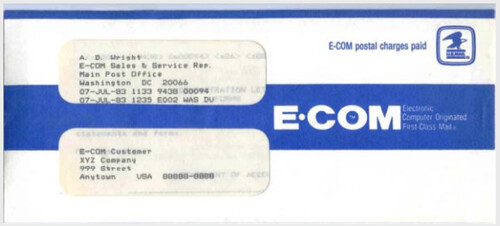
E-COM was a simple concept. The USPS would set up a network where a message would originate electronically. It would then be sent to one of a handful of participating postal offices that had terminals, where it would be printed out.
After arriving at the serving Post Office, the messages were processed and sorted by ZIP Code, then printed on letter-size bond paper, folded, and sealed in envelopes printed with a blue E-COM logo. [USPS 2008]
The hard copy of the message would then be delivered to its destination - essentially in the same manner and with the same speed as first class mail. [ECPA 1985 Report p 45] [USPS, p. 3 1982 (stating that the service was initiated January 1982)]
Before E-COM could get off the ground, it was mired in controversy. [CATO] [USPS, p. 3 1982] The US Postal Commission, the Department of Justice, the Department of Commerce, private companies, and even the FCC, objected. The first objection was that it was against government policy for a government agency to compete with the private sector. [USPS p. 17 1982] Private commercial email services were nascent and promising, and did not think much of a government monopoly using its government bank role to pay for a competing email service. The FCC said, "we have jurisdiction over all wireline and wireless services. That jurisdiction has been interpreted broadly. And there is no dispute that the transmission of a message over a communications network is communications, under the Communications Act, and under our jurisdiction." "Not only that," the FCC was heard to say, "but its common carriage." The FCC stated:
With respect to the relevant judicial decisions defining the nature of common carriage, we note that none of the parties to this proceeding appears to dispute that ECOM service would constitute a common carrier offering if it were to be provided by an entity other than the Postal Service. We also conclude independently that ECOM is a quasi-public offering of a for-profit service which affords the public an opportunity to transmit messages of its own design and choosing. Based on those judicially defined criteria, we find that, in offering ECOM, the Postal Service is engaging in a common carrier activity.
[In re Request for declaratory ruling and investigation by Graphnet Systems, Inc., concerning the proposed E-COM service, FCC Docket No. 79-6 (Sept 4, 1979)] In other words, before E-COM could get launched, the FCC said, "if you are going to do this, then you are under our jurisdiction, and you are going to have to file a tariff for the offering of your common carriage service." The FCC said that email, whether from the USPS or privately offered, is a form of common carriage - they don't say that anymore.
The USPS would not accept "no" for an answer, tinkered with its network in order to weasel out of FCC jurisdiction, and launched E-COM in 1982. A message was priced at 26¢ - and for each email message, the USPS was said to lose around $5 [CATO]. They had apparently estimated that the service would be a raging success; it was not and, with the low message volume, the cost per message was rather high. If you used the service, you had to send at minimum 200 messages. [USPS 2008] The service was one directional; if you got an error message, you would receive it in the mail two days later. When the E-COM messages were printed out, it would take two days more to be delivered. And it cost the same as First Class mail.
In fiscal year 1984, 23 million E-COM messages were sent. E-COM service had 1,046 certified customers, 528 of whom were communication carriers. That year, the Postal Rate Commission responded to the Postal Service's 1983 request for a 31-cent rate for the first page by recommending a rate of 52 cents for the first page and 15 cents for the second page of E-COM messages. The Governors of the Postal Service, who decide rates and postal policies but can overrule a Postal Rate Commission decision only by a unanimous vote, rejected the Commission's recommended decision and asked for reconsideration. The Commission responded in June with a recommendation of a 49-cent rate for the first page and 14 cents for the second page. The Governors rejected these rates as well, essentially because they priced E-COM out the market, and recommended that the Postal Service dispose of the E-COM system by sale or lease to a private firm or firms. [USPS 2008]For some reason, E-COM was a failure (one Senator called it a turkey). On September 3, 1985, three years after service was initiated, USPS terminated the service and tried to sell it off. [Aide p 8] [ECPA Report 1985 p 46] [USPS 2008]
Friday, January 06, 2017
The Frustration with FISA :: Judge Criticizes FISA Obsessive Over Classification Coupled with Media's Shallow Reporting
Every now and again you read an opinion which is fascinating in and of itself. In USA v. Wright, Judge William Young of D Mass vents about FISA appellate review, taking swipes first at the government's "obsessive over classification" as well as "media's shallow reporting" which, in the judge's opinion, negates the vital role courts have played overseeing FISA order requests. While the judge praises the work of the courts patrolling the boundaries of the Fourth Amendment, the judge likewise highlights the problem of non-adversarial proceedings in ensuring that individuals are properly defended.
It's a short decision and its worth of a read in its whole. Okay, I highlighted the goodies for you.
Criminal Action. No. 15-10153-WGY.
December 28, 2016.
It's a short decision and its worth of a read in its whole. Okay, I highlighted the goodies for you.
UNITED STATES OF AMERICA,
v.
DAVID WRIGHT, Defendant.
United States District Court, D. Massachusetts.
David Daoud Wright, Defendant, represented by Jessica Diane Hedges, Hedges & Tumposky, LLP & Michael L. Tumposky, Hedges & Tumposky.
Nicholas Alexander Rovinski, Defendant, represented by William W. Fick, Fick & Marx LLP & Cara McNamara, Federal Public Defender Office.
USA, Plaintiff, represented by B. Stephanie Siegmann, U.S. Attorney's Office & Gregory R. Gonzalez, U.S. Department of Justice.
ORDER AND MEMORANDUM
WILLIAM G. YOUNG, District Judge.
After a comprehensive and thorough review of the classified materials filed in this case, this Court rejects each of the contentions raised by the defendant Wright and denies each of his motions (ECF Nos. 87, 103, 104, 105, 106) challenging such investigatory procedures. This action thus confirms the denial of the motions to suppress (ECF Nos. 103, 104, 105, 106) already provisionally denied after hearing.
In reaching this result, the Court has followed the better practice and conducted its own de novo review, according no weight to the prior actions of the FISA judge(s). Although some courts have noted that "FISA warrant applications are subject to `minimal scrutiny by the courts,' . . . upon . . . challenge," United States v. Abu-Jihaad, 630 F.3d 102, 130 (2d Cir. 2010) (quoting United States v. Duggan, 743 F.2d 59, 77 (2d Cir. 1984)), others have applied a heightened scrutiny — reviewing the FISA Court's probable cause determinations de novo, see, e.g., United States v. Turner, 840 F.3d 336, 340 (7th Cir. 2016); United States v. Rosen, 447 F. Supp. 2d 538, 545 (E.D. Va. 2006) . The reasoning for applying a more stringent standard is persuasive, "especially given that the review [of a FISA warrant application] is ex parte and thus unaided by the adversarial process." Rosen, 447 F. Supp. 2d at 545 (collecting Fourth Circuit precedents applying de novo review to FISA materials). The certifications in the FISA application(s), however, are presumed valid. See id.
It is appropriate to remark that this de novo review reveals that the government attorneys here have throughout acted with scrupulous regard for the rights of the defendant Wright and have conducted themselves with utmost fidelity within the limited powers accorded them under the Foreign Intelligence Surveillance Act, 50 U.S.C. §§ 1801-85.[1] It is equally appropriate to observe that almost no one will believe me.
Why this sad state of affairs? It is an amalgam of the government's seemingly obsessive over classification coupled with the media's shallow reporting and an equally shallow public awareness of or interest in what is actually happening.
First over classification — no one disputes the government's appropriate interest in the classification of actual intelligence data. Here, however, the government has thrown a cloak of secrecy over the most basic procedures of the FISA Court. The result has not been to enhance the authority of that court but rather to call its judgments into question and to treat its important functions with a certain disdain. See, e.g., Mystica M. Alexander & William P. Wiggins, A Domestic Consequence of the Government Spying on Its Citizens: The Guilty Go Free, 81 Brook. L. Rev. 627 (2016); Scott A. Boykin, The Foreign Intelligence Surveillance Act and the Separation of Powers, 38 U. Ark. Little Rock L. Rev. 33 (2015); Maxwell Palmer, Does the Chief Justice Make Partisan Appointments to Special Courts and Panels?, 13 J. Empirical Legal Stud. 153 (2016); Karly Jo Dixon, Note, The Special Needs Doctrine, Terrorism, and Reasonableness, 21 Tex. J. C.L. & C.R. 35, 47-57 (2015). Reducing the classification of procedural safeguards imposed by the FISA Court would go a long way toward restoring confidence in its decisions.
Some months ago, I heard on the radio that the FISA Court had never turned down a government warrant application. "This can't be true," I thought, since over the past three years I had never once granted a single Title III wiretap application in the form sought by the government. "If it is," I thought, "that court is in the bag with the executive branch."
Now, having exercised judicial authority within FISA's precincts, I am prepared to acknowledge how shallow was my reaction. Here, in relevant part, is the actual report made by the Department of Justice pursuant to sections 107 and 502 of FISA:
During calendar year 2015, the Government made 1,499 applications[2] to the Foreign Intelligence Surveillance Court (hereinafter "FISC") for authority to conduct electronic surveillance and/or physical searches for foreign intelligence purposes. The 1,499 applications include applications made solely for electronic surveillance, applications made solely for physical search, and combined applications requesting authority for electronic surveillance and physical search. Of these, 1,457 applications included requests for authority to conduct electronic surveillance.
One of these 1,457 applications was withdrawn by the Government, The FISC did not deny any applications in whole, or in part. The FISC made modifications[3] to the proposed orders in 80[4] applications. Thus, the FISC approved collection activity in a total of 1,456 of the applications that included requests for authority to conduct electronic surveillance.
2016 Att'y Gen. Ann. Rep. 1-2. The government appears to refrain from formally submitting to the FISA Court applications it doubts that court will accept and, even then, 80 such formal submissions were substantially modified (probably narrowed). This is not so different from my own practice of reviewing draft warrant applications and sending them back to be narrowed where appropriate — all before formal application is made (and counted).
Not surprisingly, the press reports simplified things. Here is a representative sample: spy court rejected zero surveillance orders in 2015." Dustin Volz, U.S. spy court rejected zero surveillance orders in 2015, Reuters News, May 2, 2016, http://www.reuters.com/article/us-usa-cybersecurity-surveillance-idUSKCN0XROO9. In fairness, the seventh paragraph of this story stated "The court modified 80 applications in 2015, a more than fourfold increase from the 19 modifications made in 2014." Id. This crucial seventh paragraph, however, appears not to have made it onto the airwaves, thus eliminating the important nuance.
Reporting for the same year, the Administrative Office of the United States Courts says simply, "[Nationwide] [n]o wiretap applications were reported as denied in 2015." Admin. Office U.S. Courts, Wiretap Rep. 2015, Dec. 31, 2015, http://www.uscourts.gov/statistics-reports/wiretap-report-2015. It is only when one looks at the accompanying tables that it is revealed, for example, that of the 25 wiretap warrants authorized in 2015 in the District of Massachusetts, a full 40% were amended, i.e. almost certainly narrowed by the presiding judge. See id. at Wire 2.
While respecting privacy and national security concerns, the obligation appears to devolve upon the courts themselves to explain — both case by case and in the aggregate — how daily they patrol the boundaries of the Fourth Amendment to our Constitution. The press will not publish, broadcast, or analyze the fine print. To continue as we are is to deny our citizens an understanding of the doctrine of separation of powers and sap the vitality of fundamental constitutional values.
[1] Conferring this encomium does not mean I agree with each of the government's characterizations, especially their perception of the imminence of the threat posed by the defendant Wright and his co-conspirators. I do not. What is important, however, is the scrupulous care with which government attorneys have followed the established procedures. There is here no basis to consider the suppression of evidence.
[2] In keeping with the Department's historical reporting practice, the number of applications listed in this report refers to applications that were filed in signed, final form pursuant to Rule 9(b) of the Foreign Intelligence Surveillance Court Rules of Procedure. A "denial" refers to a judge's formal denial of any such an application; it does not include a proposed application submitted pursuant to Rule 9(a) of the Foreign Intelligence Surveillance Court Rules of Procedure for which the government did not subsequently submit a signed, final application pursuant to Rule 9(b).
[3] A "modification" includes any substantive disparity between the authority requested by the Government in a final application filed pursuant to Rule 9(b) and the authority granted by the FISC. It does not include changes made by the government after the submission of a proposed application submitted pursuant to Rule 9(a).
[4] In addition to the 80 orders modified with respect to applications made during the reporting period, the FISC modified one order for an application after first granting authorization. The FISC also modified one order for an application made in a prior reporting period during the current reporting period.
Sunday, January 01, 2017
1984 :: Jan. 1 :: Breakup of Ma Bell
MCI was an innovative long distance company that radicalized the telecommunications market. Started in the 1960s, the business plan was to use radio licenses to provide long distance service between Chicago and St. Louis. MCI's application to provide service was approved by the FCC in 1969. But AT&T and the BOCs didn't like this much, and refused to interconnect with MCI. MCI had difficulty negotiating interconnection with AT&T, hired special counsel skilled in negotiations, and brought the issue before the FCC. In 1973, AT&T threw a curveball by filing interconnection tarriffs in 49 state PUCs, transforming MCI's transaction costs from one interconnection agreement, to 49 different agreements in each jurisdiction. In 1974, AT&T disconnected MCI. Finally, frustrated, in 1974, MCI, along with the Department of Justice, filed an antitrust suit against AT&T. On June 13th, 1980, the Court ruled in favor of MCI, awarding MCI $1.8 billion in damages. Two years later, AT&T would negotiate with DOJ the resolution of their antitrust lawsuit, agreeing to the breakup of the Bell System. The terms of Consent Decree, breaking AT&T up into AT&T long distance and seven Regional Bell Operating Companies, went into effect Jan. 1, 1984.
Scholars have noted that the legal battle with AT&T cost $10m, whereas construction of the network cost $2m. Sterling, Bernt, Weiss, Shaping American Telecommunications, p.133 (2006) According to lore, MCI had more lawyers than land lines. It became known as "a law firm with an antenna on the roof." In 2005, one of the Regional Bell Operating Companies, SBC, would acquire AT&T Long Distance, and emerge from the ashes as a reborn AT&T.
MCI v. AT&T, 708 F.2d 1081 (7th Cir. 1983) recounts the history of the conflict between the two telecommunications services.
Tuesday, December 27, 2016
⚖ Can You Legally Disclose Illegally Intercepted Communications to the Author of the Communication?
CRIMINAL LAW 101 EXAM (You have 1.5 hours)
QUESTION: Is it a violation of the Wiretap Act to disclose your own email to yourself?
(Stop laughing) (Seriously, you are being graded on this)
FACTS: "The action arises from the [PLAINTIFF and DEFENDANT]'s acrimonious divorce. DEFENDANT accused PLAINTIFF of serial infidelity, so in discovery PLAINTIFF asked DEFENDANT for all documents related to that accusation. DEFENDANT complied and produced copies of incriminating emails between PLAINTIFF and several other women..."
CAUSE OF ACTION: "PLAINTIFF alleges that DEFENDANT violated the Wiretap Act by surreptitiously placing an auto-forwarding 'rule' on his email accounts that automatically forwarded the messages on his email client to her. He also claims that DEFENDANT's divorce lawyer violated the Act by 'disclosing' the intercepted emails in response to his discovery request. The district judge dismissed the suit on the pleadings."
On this final exam, we concern ourselves only with the later action regarding disclosing of emails.
RULE: 18 USC s 511(1)(c) prohibits the disclosure of intercepted communications:
Nope, it aint a violation of the Wiretap Act to disclose the contents of a communication to the communicator of that communication.
NOTE: 18 USC 2511(1)(c) specifically states anyone who "intentionally discloses, or endeavors to disclose, to any other person the contents of any wire, oral, or electronic communication" has violated the Act. Here we have a play with three actors. We have the communicator, the interceptor, and the "other." PLAINTIFF is the communicator. DEFENDANT is the interceptor. For this tragedy to work, there needs to be one more person. There needs to be the "other" (and DEFENDANT's ATTORNEY counts in this play as DEFENDANT and does not count as "other."). Lacking the "other," the tragedy is incomplete and the cause of action fails.
QUESTION: Is it a violation of the Wiretap Act to disclose your own email to yourself?
(Stop laughing) (Seriously, you are being graded on this)
FACTS: "The action arises from the [PLAINTIFF and DEFENDANT]'s acrimonious divorce. DEFENDANT accused PLAINTIFF of serial infidelity, so in discovery PLAINTIFF asked DEFENDANT for all documents related to that accusation. DEFENDANT complied and produced copies of incriminating emails between PLAINTIFF and several other women..."
CAUSE OF ACTION: "PLAINTIFF alleges that DEFENDANT violated the Wiretap Act by surreptitiously placing an auto-forwarding 'rule' on his email accounts that automatically forwarded the messages on his email client to her. He also claims that DEFENDANT's divorce lawyer violated the Act by 'disclosing' the intercepted emails in response to his discovery request. The district judge dismissed the suit on the pleadings."
On this final exam, we concern ourselves only with the later action regarding disclosing of emails.
RULE: 18 USC s 511(1)(c) prohibits the disclosure of intercepted communications:
[A]ny person who- (c) intentionally discloses, or endeavors to disclose, to any other person the contents of any wire, oral, or electronic communication, knowing or having reason to know that the information was obtained through the interception of a wire, oral, or electronic communication in violation of this subsection; . . . shall be punished as provided in subsection (4) or shall be subject to suit as provided in subsection (5).
ANALYSIS: Getting past whether this was in fact an interception, is it disclosure? Couple problems, as the court points out:
- PLAINTIFF "already knew the contents of the intercepted emails."
- PLAINTIFF "invited their disclosure by requesting them in discovery in the divorce action" - the court suggests that requesting your own emails in discovery is tantamount to "consent" for disclosure of those communications.
- Then the Court pontificates, "to 'disclose' something means '[t]o make (something) known or public.'... [DEFENDANT's ATTORNEY] did not publicly disclose PLAINTIFF's emails, and their content was hardly unknown to PLAINTIFF. "
Nope, it aint a violation of the Wiretap Act to disclose the contents of a communication to the communicator of that communication.
NOTE: 18 USC 2511(1)(c) specifically states anyone who "intentionally discloses, or endeavors to disclose, to any other person the contents of any wire, oral, or electronic communication" has violated the Act. Here we have a play with three actors. We have the communicator, the interceptor, and the "other." PLAINTIFF is the communicator. DEFENDANT is the interceptor. For this tragedy to work, there needs to be one more person. There needs to be the "other" (and DEFENDANT's ATTORNEY counts in this play as DEFENDANT and does not count as "other."). Lacking the "other," the tragedy is incomplete and the cause of action fails.
Epstein v. Epstein, Court of Appeals, 7th Circuit 2016
Wednesday, December 21, 2016
⚖ Host of Facebook Group Immune from Liability for Third Party Content - But Would Host Be Liable if "Perpetuated" Content?!?
FACTS: "As is by now commonplace, Facebook groups are the soapbox for community organizers. In the present action, Plaintiff [pro se] alleges that one such group—the "Volusia County Moms" ("VCM")—mounted a public relations campaign to oust him from Port Orange. Specifically, on or about January 7, 2014, Plaintiff Howard Porter moved in with his uncle and father due to financial hardship. " On January 17, 2014, an anonymous post appeared on the VCM Facebook page stating that a registered sex offender had recently taken up residence across the street from Sugar Mill Elementary School... The ensuing Facebook discussion included comments addressing Plaintiff's criminal past. In particular, Defendant Nicole Sanchez commented that:
Defendant " Bodner seeks dismissal of the Complaint on the ground that she is immune from suit under the Communications Decency Act, 47 U.S.C § 230 "
RULE: "[T]he CDA grants immunity to a "provider or user of an interactive computer service" for "any information provided by another information content provider"—that is, information posted by someone else. See 47 U.S.C. § 230(c)"
ANALYSIS: "[B]ecause Sanchez, not Bodner, posted the Sanchez Response, the Court finds that the policy behind the CDA warrants blanketing Bodner with immunity under the CDA at least as to Plaintiff's defamation claim. See Almeida v. Amazon.com, Inc., 456 F.3d 1316, 1321 (11th Cir. 2006) (interpreting the CDA as having established "broad federal immunity"); see also Regions Bank v. Kaplan, No. 8:12-cv-1837-T-17MAP, 2013 WL 1193831, at *18 (M.D. Fla. Mar. 22, 2013) (stating that "[a] `provider' of an interactive computer service includes websites that host third-party generated content")."
CONCLUSION: Defendant Bodner Motion to Dismiss Granted
NOTE: Plaintiff attempts to defeat the § 230 immunity by arguing that "Bodner is not a passive host; instead she is a content provider due to her 'collaboration' with Defendants to further the Sanchez Response." The Court entertains this argument sufficiently to respond to and dispose of it. The Court states, "nothing in the Complaint can be read to ensnare Bodner in a scheme to perpetuate the Sanchez Response."
M'kay. This begs a big question. If Defendant Bodner did something to "perpetuate the Sanchez Response," would this abrogate the § 230 immunity? Fair Housing Council (9th Cir. 2008) establishes that, at the far end of the spectrum, where a defendant requires third parties to fill out fields on a form with answers that violate housing law, defendant has moved from host enjoying § 230 immunity to participant developing third parties' content. In this case, the Court recounts no authority for Plaintiff's argument nor does the Court cite authority when it disposes of said argument.
It makes one uneasy. "Perpetuating third party content" does not abrogate § 230 immunity. There is no caselaw that would support that. Sure, the Court is here giving a short answer to dispose of an argument. But the frontier of § 230 immunity is furiously contested. The frontier is identified as that land where defendant can be seen not just guiding a third-parties' hand, but forcing that hand into making statements as a condition for speaking. Playing the role of host, selecting content, promoting content, and dare say, "perpetuating" content, has not in and of itself given rise to liability.
Porter v. City of Port Orange, Dist. Court, MD Florida 2016
[Plaintiff] gave up some rights when he decided he wanted to do sexual acts on a [four] year old!! And thank God this was a set up and he got busted.[] Who knows what the pictures of his own son looked like or who he sold them too [sic]!!! Convicted sexual predators should not be allowed to be so close to a school with all these innocent children!!""As a result of the alleged 'false' statements made in the Sanchez Response and the attendant media coverage" Plaintiff sued for defamation. " In his defamation claims, Plaintiff singles out ... Jacqueline Bodner, the owner of the VCM office and Nicole Sanchez, the author of the Sanchez Response.
Defendant " Bodner seeks dismissal of the Complaint on the ground that she is immune from suit under the Communications Decency Act, 47 U.S.C § 230 "
RULE: "[T]he CDA grants immunity to a "provider or user of an interactive computer service" for "any information provided by another information content provider"—that is, information posted by someone else. See 47 U.S.C. § 230(c)"
ANALYSIS: "[B]ecause Sanchez, not Bodner, posted the Sanchez Response, the Court finds that the policy behind the CDA warrants blanketing Bodner with immunity under the CDA at least as to Plaintiff's defamation claim. See Almeida v. Amazon.com, Inc., 456 F.3d 1316, 1321 (11th Cir. 2006) (interpreting the CDA as having established "broad federal immunity"); see also Regions Bank v. Kaplan, No. 8:12-cv-1837-T-17MAP, 2013 WL 1193831, at *18 (M.D. Fla. Mar. 22, 2013) (stating that "[a] `provider' of an interactive computer service includes websites that host third-party generated content")."
CONCLUSION: Defendant Bodner Motion to Dismiss Granted
NOTE: Plaintiff attempts to defeat the § 230 immunity by arguing that "Bodner is not a passive host; instead she is a content provider due to her 'collaboration' with Defendants to further the Sanchez Response." The Court entertains this argument sufficiently to respond to and dispose of it. The Court states, "nothing in the Complaint can be read to ensnare Bodner in a scheme to perpetuate the Sanchez Response."
M'kay. This begs a big question. If Defendant Bodner did something to "perpetuate the Sanchez Response," would this abrogate the § 230 immunity? Fair Housing Council (9th Cir. 2008) establishes that, at the far end of the spectrum, where a defendant requires third parties to fill out fields on a form with answers that violate housing law, defendant has moved from host enjoying § 230 immunity to participant developing third parties' content. In this case, the Court recounts no authority for Plaintiff's argument nor does the Court cite authority when it disposes of said argument.
It makes one uneasy. "Perpetuating third party content" does not abrogate § 230 immunity. There is no caselaw that would support that. Sure, the Court is here giving a short answer to dispose of an argument. But the frontier of § 230 immunity is furiously contested. The frontier is identified as that land where defendant can be seen not just guiding a third-parties' hand, but forcing that hand into making statements as a condition for speaking. Playing the role of host, selecting content, promoting content, and dare say, "perpetuating" content, has not in and of itself given rise to liability.
Porter v. City of Port Orange, Dist. Court, MD Florida 2016
Tuesday, December 20, 2016
⚖ Silver v Quora, 10th Cir. Nov. 23, 2016 :: Plaintiff Cause of Action for Defamation Against Quora Dismissed Pursuant to 47 USC 230(c)
FACTS: "Silver is an investment banker, venture capitalist, and author of 33 books on entrepreneurship and finance who resides in New Mexico."
"Quora operates a question-and-answer website at www.quora.com that allows registered users to ask and answer questions on any topic."
"This lawsuit stems from a question on the website that solicited feedback on Silver: “Has anyone worked with or heard of David Silver at Santa Fe Capital?”... Silver claims two false, disparaging posts in response to this question damaged his reputation and caused him to lose potential clients and book publishers:
RULE: "Section 230 “creates a federal immunity to any state law cause of action that would hold computer service providers liable for information originating with a third party.” Ben Ezra, Weinstein, & Co. v. Am. Online Inc., 206 F.3d 980, 984-85 (10th Cir. 2000). It does so through the interplay of two key provisions. Under § 230(c)(1), “[n]o provider . . . of an interactive computer service shall be treated as the publisher or speaker of any information provided by another information content provider.” 47 U.S.C. § 230(c)(1). And under § 230(e)(3), “[n]o cause of action may be brought and no liability may be imposed under any State or local law that is inconsistent with this section.” Id. § 230(e)(3)."
ANALYSIS: "[T]he CDA bars Silver’s libel and defamation claims against Quora. ... 'The prototypical service qualifying for this statutory immunity' [is] 'an online messaging board (or bulletin board) on which Internet subscribers post comments and respond to comments posted by others.' Quora fits squarely within this prototype."
Silver v Quora, 10th Cir. Nov. 23, 2016
See also QUORA GETS EASY SECTION 230 WIN IN TENTH CIRCUIT–SILVER V. QUORA November 28, 2016 · by Eric Goldman Technology & Marketing Law Blog (Goldman has a screen capture of the Quora discussion)
"Quora operates a question-and-answer website at www.quora.com that allows registered users to ask and answer questions on any topic."
"This lawsuit stems from a question on the website that solicited feedback on Silver: “Has anyone worked with or heard of David Silver at Santa Fe Capital?”... Silver claims two false, disparaging posts in response to this question damaged his reputation and caused him to lose potential clients and book publishers:
- On September 7, 2012, Tessa Salton responded, “Your instincts are correct. He is not licensed or accredited any longer. A fraud.” Id. Her post included a link to an article in The Chicago Tribune, which reports on a $23 million damages award against Silver in an investment case. Id.
- On October 16, 2013, Neil MacAskill responded, “You are better off buying lottery tickets. One of our checks to him supposedly got lost so we sent him another. Then he cashed both and never did a thing for us. Said he built a business development plan but never delivered it. Save your money.” Id.
RULE: "Section 230 “creates a federal immunity to any state law cause of action that would hold computer service providers liable for information originating with a third party.” Ben Ezra, Weinstein, & Co. v. Am. Online Inc., 206 F.3d 980, 984-85 (10th Cir. 2000). It does so through the interplay of two key provisions. Under § 230(c)(1), “[n]o provider . . . of an interactive computer service shall be treated as the publisher or speaker of any information provided by another information content provider.” 47 U.S.C. § 230(c)(1). And under § 230(e)(3), “[n]o cause of action may be brought and no liability may be imposed under any State or local law that is inconsistent with this section.” Id. § 230(e)(3)."
ANALYSIS: "[T]he CDA bars Silver’s libel and defamation claims against Quora. ... 'The prototypical service qualifying for this statutory immunity' [is] 'an online messaging board (or bulletin board) on which Internet subscribers post comments and respond to comments posted by others.' Quora fits squarely within this prototype."
Silver v Quora, 10th Cir. Nov. 23, 2016
See also QUORA GETS EASY SECTION 230 WIN IN TENTH CIRCUIT–SILVER V. QUORA November 28, 2016 · by Eric Goldman Technology & Marketing Law Blog (Goldman has a screen capture of the Quora discussion)
Monday, December 19, 2016
You Cant Tell Your Customers to 'Shut Up' Anymore :: Consumer Review Fairness Act Signed into Law
Bad idea: Set up a business and provide poor goods or services; receive bad reviews online for your poor goods or services.
Worse idea: Instead of treating your customers' feedback as free expert advice and listening to their suggestions on how to improve your business, sue your customers - experience the Streisand Effect - resulting in increased media coverage highlighting your lousy goods, service, and treatment of customers. Ensure that negatives reviews of your business get the widest exposure possible.
Worser Idea: Attempt to solve this problem by telling your customers to shut-up. Insert a gag-clause in your terms of service so that it is a breach of contract for your customers to provide negative reviews of your service.
Jennifer Kulas Palmer testified before Congress about her negative experience with online business KlearGear.com. According to Palmer, in 2008 her husband ordered about $20 worth of Christmas gifts from KlearGear. When it did not arrive, they attempted to reach out to the company, but to no avail. Like so many consumers who have had a bad experience, they wrote a negative online review. Three years later, Palmer heard from KlearGear, claiming that Palmer had violated their Terms of Sale and that Palmer owed KlearGear $3500. Attorneys from Public Citizen represented the Palmers and filed a successful lawsuit against KlearGear. See Chris Morran, “KlearGear.com Ordered To Pay $306K To Couple Who Wrote Negative Review,” Consumerist, June 26, 2014; KlearGear must pay $306,750 to couple that left negative review Lawyer: CYRUS FARIVAR - 6/25/2014 Ars Technica; Jon Brodkin, It will soon be illegal to punish customers who criticize businesses online Ars Technica 11/29/2016.
If there was any doubt that this type of thing is a bad idea, in this year of divided and partisan politics, Congress unanimously voted to end attempts to silence customer reviews. The Consumer Review Fairness Act was signed into law by President Obama on December 14th.
According to the new law, 'form contracts' (those terms of service or standard forms shoved in front of customers to sign without ability to negotiate individual terms) are void if they prohibit customer reviews. Any such gag provisions are unlawful and are subject to enforcement by the Federal Trade Commission or the states. The Federal Trade Commission will be publishing best practices on how to comply with the Consumer Review Fairness Act.
All of this comes about in the context of the Good Samaritan provisions of the Communications Decency Act, 47 USC 230(c), which says that an online services are not liable for the third party content. This means that Yelp, TripAdvisor, Amazon, Google, and all the other review sites can encourage people to provide reviews of goods and services - without those online services becoming liable for those reviews. 47 USC 230(c) legally set the foundation for the interactive web where many third parties contribute without the host becoming liable for every utterance.
The Consumer Review Fairness Act establishes that you cannot tell consumers to shut up - it does not, however, protect consumers from liability for what they say. Businesses can, for example, still seek redress for defamatory reviews. Consumers can review but they may still be held responsible for their words.
Worse idea: Instead of treating your customers' feedback as free expert advice and listening to their suggestions on how to improve your business, sue your customers - experience the Streisand Effect - resulting in increased media coverage highlighting your lousy goods, service, and treatment of customers. Ensure that negatives reviews of your business get the widest exposure possible.
Worser Idea: Attempt to solve this problem by telling your customers to shut-up. Insert a gag-clause in your terms of service so that it is a breach of contract for your customers to provide negative reviews of your service.
Jennifer Kulas Palmer testified before Congress about her negative experience with online business KlearGear.com. According to Palmer, in 2008 her husband ordered about $20 worth of Christmas gifts from KlearGear. When it did not arrive, they attempted to reach out to the company, but to no avail. Like so many consumers who have had a bad experience, they wrote a negative online review. Three years later, Palmer heard from KlearGear, claiming that Palmer had violated their Terms of Sale and that Palmer owed KlearGear $3500. Attorneys from Public Citizen represented the Palmers and filed a successful lawsuit against KlearGear. See Chris Morran, “KlearGear.com Ordered To Pay $306K To Couple Who Wrote Negative Review,” Consumerist, June 26, 2014; KlearGear must pay $306,750 to couple that left negative review Lawyer: CYRUS FARIVAR - 6/25/2014 Ars Technica; Jon Brodkin, It will soon be illegal to punish customers who criticize businesses online Ars Technica 11/29/2016.
If there was any doubt that this type of thing is a bad idea, in this year of divided and partisan politics, Congress unanimously voted to end attempts to silence customer reviews. The Consumer Review Fairness Act was signed into law by President Obama on December 14th.
According to the new law, 'form contracts' (those terms of service or standard forms shoved in front of customers to sign without ability to negotiate individual terms) are void if they prohibit customer reviews. Any such gag provisions are unlawful and are subject to enforcement by the Federal Trade Commission or the states. The Federal Trade Commission will be publishing best practices on how to comply with the Consumer Review Fairness Act.
All of this comes about in the context of the Good Samaritan provisions of the Communications Decency Act, 47 USC 230(c), which says that an online services are not liable for the third party content. This means that Yelp, TripAdvisor, Amazon, Google, and all the other review sites can encourage people to provide reviews of goods and services - without those online services becoming liable for those reviews. 47 USC 230(c) legally set the foundation for the interactive web where many third parties contribute without the host becoming liable for every utterance.
The Consumer Review Fairness Act establishes that you cannot tell consumers to shut up - it does not, however, protect consumers from liability for what they say. Businesses can, for example, still seek redress for defamatory reviews. Consumers can review but they may still be held responsible for their words.
Sen. Thune's Statement During Senate Hearing
"Zero Stars: How Gagging Honest Reviews Harms Consumers and the Economy."
"Zero Stars: How Gagging Honest Reviews Harms Consumers and the Economy."
⚖ Pagan v. Google, DNH 2016 :: Defamation Cause of Action Dismissed per 47 USC 230(c)
FACTS: "Pagan's complaint names "Google Corporation" as the defendant and asserts that Google defamed him by publishing false information regarding his criminal record. Specifically, he states that Google published false information labeling him as a convicted sex offender for three counts of rape in New Hampshire. Pagan asserts that the information is incorrect, and he attributes the error to a communication problem in the New Hampshire courts."
RULE: "Google is afforded immunity under the Communications Decency Act of 1996 ("CDA"), 47 U.S.C. § 230, for the publication of defamatory content prepared or posted by others. O'Kroley v. Fastcase, Inc., 831 F.3d 352, 354-55 (6th Cir. 2016). The CDA provides that "[n]o cause of action may be brought" and "no liability may be imposed under any State or local law," 47 U.S.C. § 230(e)(3), for any claim that would treat a provider of an "interactive computer service" as the "publisher or speaker of any information provided" by someone else, 47 U.S.C. § 230(c)(1). See O'Kroley, 831 F.3d at 354-55 (claims against Google for third party content properly dismissed under CDA); Klayman v. Zuckerberg, 753 F.3d 1354, 1357 (D.C. Cir. 2014) (claims against Facebook properly dismissed under CDA)."
CONCLUSION: "[B]ased on the facts alleged in the complaint[, Google is] immune from plaintiff's defamation claims under the CDA, and, accordingly, those defamation claims should be dismissed."
Pagan v. GOOGLE CORPORATION, Dist. Court, D. New Hampshire 2016
RULE: "Google is afforded immunity under the Communications Decency Act of 1996 ("CDA"), 47 U.S.C. § 230, for the publication of defamatory content prepared or posted by others. O'Kroley v. Fastcase, Inc., 831 F.3d 352, 354-55 (6th Cir. 2016). The CDA provides that "[n]o cause of action may be brought" and "no liability may be imposed under any State or local law," 47 U.S.C. § 230(e)(3), for any claim that would treat a provider of an "interactive computer service" as the "publisher or speaker of any information provided" by someone else, 47 U.S.C. § 230(c)(1). See O'Kroley, 831 F.3d at 354-55 (claims against Google for third party content properly dismissed under CDA); Klayman v. Zuckerberg, 753 F.3d 1354, 1357 (D.C. Cir. 2014) (claims against Facebook properly dismissed under CDA)."
CONCLUSION: "[B]ased on the facts alleged in the complaint[, Google is] immune from plaintiff's defamation claims under the CDA, and, accordingly, those defamation claims should be dismissed."
Pagan v. GOOGLE CORPORATION, Dist. Court, D. New Hampshire 2016
Friday, December 09, 2016
Origins of Settlement Free Peering
Internet culture stood as an antithesis to Bell telephone culture. In the early 1960s, Paul Baran, who was concerned about the vulnerability of U.S. communications, advocated that the Department of Defense migrate to a distributed packet-switched network that could survive failure and still get a “Go; No-Go” command to the field. Bell-trained DOD engineers dismissed packet-switched communications as an idea that could not possibly work. In 1971, Larry Roberts, having successfully demonstrated the viability of his packet-switched network experiment, attempted to give ARPANET to AT&T; AT&T was not interested. In the meantime, AT&T had refused to sell private lines to nascent data networks, refused to allow foreign devices (i.e., modems) to their network, and refused to interconnect their network with nascent rivals. Those seeking telecommunications services in order to build computer networks became frustrated, and serious question arose concerning whether AT&T’s telecommunications services would meet the needs of growing computer networks.
Thus emerged a cultural rivalry between Nethead and Bellhead cultures. In the eyes of the Netheads, Bellheads were about perpetuating a century-old communications network monopoly that followed a command-and-control model of central operation which stunted innovation, while Netheads were all about innovation, building a network that fostered the cool things transpiring at the end. Netheads wanted nothing of the Bellhead model. [Greenstein 2015 at 38 ("most had an almost visceral dislike for" Ma Bell)] [Mayo (quoting Bob Taylor, "Working with AT&T would be like working with Cro-Magnon man. I asked them if they wanted to be early members so they could learn technology as we went along. They said no. I said, Well, why not? And they said, Because packet switching won’t work. They were adamant.").]
In the 1980s, Netheads had to resolve how to interconnect networks. Netheads wanted to interconnect ARPANET with an NSF sponsored CSNET, but what should be the terms and who should pay whom? One model before them was the byzantine Bell accounting scheme which one engineer described as so complicated it was akin to drinking coffee one molecule at a time; a marvelous feat of engineering if not utterly pointless. [Moore 1999] [Jacobson 1999 (discussing how Internet culture is different than BellHead culture and the implications for the future of the internet)] [Kleinrock 1994 at 67 (bemoaning the additional cost and complexity of accounting necessary for usage-based pricing); [MacKie-Mason 1993 at 14 (describing the cost of phone company style billing and accounting as applied to the packet-switched Internet as “astronomical”).] Netheads' incentive was to grow network effect and continue innovation at the ends. To achieve that incentive, they wanted the lowest possible barriers to the expansion of the network. The solution was settlement-free interconnection, devoid of complicated Bell accounting. A paper by Lyman Chapman and Chris Owens describes how the arrangement came to be:
In modern terms, we would say that the customers of one ISP (ARPAnet) could not communicate with the customers of another ISP (CSNet), because no mechanism existed to reconcile the different Acceptable Use Policies of the two networks. This disconnect persisted as both sides assumed that any agreement to exchange traffic would necessarily involve the settlement of administrative, financial, contractual, and a host of other issues, the bureaucratic complexity of which daunted even the most fervent advocates of interconnection—until the CSNet managers came up with the idea that we now call “peering,” or interconnection without explicit accounting or settlement. A landmark agreement between NSF and ARPA allowed NSF grantees and affiliated industry research labs access to ARPAnet, as long as no commercial traffic flowed through ARPAnet.
NSF followed CSNET's example for interconnection settlements; interconnections between NSFNET and regional networks was on a settlement-free basis. [MacKie-Mason 1993 at 18 (“The full costs of NSFNET have been paid by NSF, IBM, MCI and the State of Michigan”).]
Commercial networks emerged in the early 1990s, but they could not exchange traffic through the academic NSFNET. On the one hand, Advanced Network Services(ANS), the contractor that operated the NSFNET, established a commercial backbone service and offered to sell interconnection to nascent commercial networks. ANS had all of the NSFNET clients as end-users including regional networks and academic networks; ANS as the largest network could leverage network effect. But the other commercial networks were not interested in paying ANS for the right to access end-users or helping ANS become the AT&T-monopoly of the Internet. Instead they established the Commercial Internet eXchange (CIX) and exchanged traffic on a settlement-free basis. For these early commercial networks, connectivity was paramount and growth of access services was king. [Brock, Economics of Interconnection at ii ("Commercial Internet service providers agreed that interchange of traffic among them was of mutual benefit and that each should accept traffic from the other without settlements payments or interconnection charges. The CIX members therefore agreed to exchange traffic on a "sender keep all" basis in which each provider charges it own customers for originating traffic and agrees to terminate traffic for other providers without charge.").] First UUNET, PSINET, and CERFNET joined CIX. Then Sprint joined. Soon most of the Internet could be reached through CIX. Connectivity grew network-effect which grew the value of the access service that these commercial networks were selling to end-users. CIX become the model of commercial interconnection, while ANS became isolated. [Greenstein 2015 at 81 ("Just a little less than a year later, CIX essentially had everyone except ANS. By the time Boucher held his hearing, ANS had become isolated, substantially eroding their negotiating leverage with others. By June 1992 ANS's settlement proposals no longer appeared viable. In a very public surrender of its strategy, it agreed to interconnect with the CIX on a seemingly short-term basis and retained the right to leave on a moment's notice.)] [Noam 2001 at 63 (""Soon the relative use by the commercial and nonprofit sectors kept shifting, and the power over interconnection moved to the former. By 1993, approximately 80 percent of all Internet sites could be accessed outside the NSFNET structure. CIX blocked ANS traffic from routing through the CIX router, thus depriving ANS users of connectivity to CIX members. Humbled, ANS joined CIX in 1994"")] [Srinagesh at 143 ("In October 1993, CIX, apparently without warning, blocked ANS traffic from transiting the CIX router. At this point, ANS (through its subsidiary CO-RE) joined the CIX and full connectivity was restored.")]. In 1994, ANS' assets were sold off to AOL. [History, Advanced Network Services (2004)] [Salus 1995 at 200]
In the late 1990s, academic and government networks focused on research, development, and innovation, not commercial competition; they followed settlement-free peering as a simple accounting scheme for interconnection. Commercial backbone providers adopted settlement-free peering as a means of rapidly growing their business plans.
Access networks, which needed to provide full Internet service to their customers, interconnected with and paid transit to commercial backbone providers. Controversy swirled during the late 1990s as the commercial backbones matured their business plans, converting smaller networks that were dependant on the backbone networks' services from settlement-free peers into paying transit customers. Appeals for intervention reached the FCC, which declined to intercede, finding the Internet backbone market competitive.
1968 :: Dec. 9 :: Douglas Engelbart :: The Mother of All Demos
"The Mother of All Demos is a name given retrospectively to Douglas Engelbart's December 9, 1968, demonstration of experimental computer technologies that are now commonplace. The live demonstration featured the introduction of the computer mouse, video conferencing, teleconferencing, hypertext, word processing, hypermedia, object addressing and dynamic file linking, bootstrapping, and a collaborative real-time editor."
Tuesday, December 06, 2016
Historic Evolution of Internet Interconnection
In the beginning was ARPANET. ARPANET was an end-to-end packet-switched network. ARPANET was The Network, thus interconnection was not a tremendous concern.
ARPANET’s success begat ALOHANET, SATNET, PRNET and other packet switched networks. It was clear that ARPANET's network protocol would have to be revised in order to facilitate interconnection. In 1972, Vint Cerf and Bob Kahn released A Protocol for Packet Network Interconnection. The design objective of the Internet was to enable interconnection between otherwise incompatible networks, promoting the research and innovation occurring at the edges, and leveraging "network effect." IP made interconnection easy and coordination unnecessary. According to Bob Kahn,
The Internet reflected a culture where connectivity was paramount. With each interconnection of an additional network, the value of the Internet grew. [Carpenter, Architectural Principles of the Internet, IETF RFC 1958, Sec. 2.1 ("the goal is connectivity, the tool is the Internet Protocol, and the intelligence is end to end rather than hidden in the network. The current exponential growth of the network seems to show that connectivity is its own reward.")] [THE INTERNET'S COMING OF AGE, COMPUTER SCIENCE AND TELECOMMUNICATIONS BOARD, NATIONAL RESEARCH COUNCIL 35 (2001) ("the value placed on connectivity as its own reward favors gateways and interconnections over restrictions on connectivity")] [REALIZING THE INFORMATION FUTURE: THE INTERNET AND BEYOND, COMPUTER SCIENCE AND TELECOMMUNICATIONS BOARD, NATIONAL RESEARCH COUNCIL 3 (1994) (setting forth vision for Open Data Networks, stating in first principle that network should "permit[] universal connectivity.")] [David Clark, A Cloudy Crystal Ball: Visions of the Future, Presentation at the IETF, Slide 4 (July 1992) ("Our best success was not computing, but hooking people together").]
In 1985, the National Science Foundation concluded that the Internet was good, and sought to expand its reach to the greater academic community. Instead of providing the entire end-to-end network, NSF elected to supply a crucial piece: the first dedicated nationwide Internet backbone. The NSFNET interconnected with regional networks, and the regional networks interconnected with local networks. In so doing, NSFNET offered long-distance transit as well as traffic exchange between networks.
Commercial networks concluded that the Internet was good. Commercial traffic, however, could not be exchanged across NSFNET. Therefore, the early commercial networks established the Commercial Internet eXchange (CIX) and exchanged traffic on a settlement-free basis. For these early commercial networks, connectivity was paramount and growth of access services was king. [Brock, Economics of Interconnection at ii ("Commercial Internet service providers agreed that interchange of traffic among them was of mutual benefit and that each should accept traffic from the other without settlements payments or interconnection charges. The CIX members therefore agreed to exchange traffic on a "sender keep all" basis in which each provider charges it own customers for originating traffic and agrees to terminate traffic for other providers without charge.").]
The US Government concluded that the Internet was good, and sought to make it available to all. NSF was tasked with privatizing the Internet. In order to be successful, NSF had to establish a means for emerging commercial networks to exchange traffic. Following the CIX model, NSF built four Internet exchange points, known as NAPs, in Washington, D.C., New York, Chicago, and San Jose. [National Science Foundation Solicitation 93-52, Solicitation for Network Access Point Manager, Routing Arbiter, Regional Network Providers, and Very High Speed Backbone Network Services Provider for NSFNET and NREN Program (May 6, 1993) (setting forth NSF's plan for privatizing NSFNET).] [GREENSTEIN, HOW THE INTERNET BECAME COMMERCIAL at 82 (NAPs were modeled on CIX and "helped the commercial Internet operate as a competitive market after the NSFNET shut down.").]
 In 1995, NSF decommissioned the NSFNET and the commercial Internet was born in its image. There were Tier 1 backbone networks (WANs) that provided nationwide or global service, Tier 2 networks (MANs, Metro) that provided regional service, and Tier 3 networks (LANs, Local) that provided access service. Traffic from one end-user to another end-user would travel up the topology from Tier 3 networks to be exchanged at the Tier 1 level, and then travel back down. Within networks was robust capacity moving traffic. [See David Young, Why is Netflix Buffering? Dispelling the Congestion Myth, VERIZON PUBLIC POLICY BLOG (July 10, 2014) (diagramming Verizon network with backbone, metro and local networks)] Between networks was interconnection where capacity could be constrained. Interconnection capacity constituted an aggregation of all traffic from the different end-users, services, and firms to which a network provider offered service. It could become a traffic pinch-point. In order to avoid congestion, interconnection partners would have to cooperate. [See KLEINROCK, REALIZING THE INFORMATION FUTURE: THE INTERNET AND BEYOND at 183 ("Because the network is not implemented as one monolithic entity but is made of parts implemented by different operators, each of these entities must be separately concerned with achieving good loading of its links, avoiding congestion, and making a profit. The issue of sharing and congestion arises particularly at the point of connection between providers. At this point, the offered traffic represents the aggregation of many individual users, and thus cost-effective sharing of the link can be assumed. However, if congestion occurs, one must eventually push back on original sources. Options include pricing and technical controls on congestion; there may be other mechanisms for shaping consumer behavior as well.”)]
Early academic and government networks focused on research, development, and innovation, not commercial competition; they developed a simple accounting scheme for interconnection: settlement-free peering. Early commercial backbone providers adopted settlement-free peering as a means of rapidly growing their business plans. Access networks, which needed to provide full Internet service to their customers, interconnected with and paid transit to commercial backbone providers.
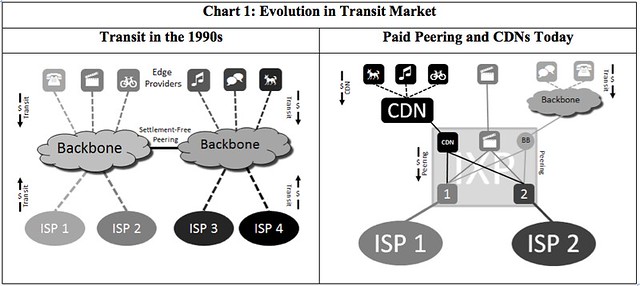
The Internet interconnection market would then undergo seismic evolution. By 2010, large access providers had reestablished a strong position in the network ecosystem, and leveraged network effect and interconnection to implement strategic goals. Broadband Internet access service providers were able to reverse the flow of interconnection settlement fees, going from transit customers to gatekeepers, charging paid peering for access to their end-users. The interconnection market had departed from the characteristics of the early commercial Internet, where backbone networks were king and the market was hyper-competitive, and returned to traditional consolidated network market economics. [See generally WU, THE MASTER SWITCH: THE RISE AND FALL OF INFORMATION EMPIRES (discussing how communications markets go through cycles of innovation and disruption, competition, and then consolidation and market power).]
ARPANET’s success begat ALOHANET, SATNET, PRNET and other packet switched networks. It was clear that ARPANET's network protocol would have to be revised in order to facilitate interconnection. In 1972, Vint Cerf and Bob Kahn released A Protocol for Packet Network Interconnection. The design objective of the Internet was to enable interconnection between otherwise incompatible networks, promoting the research and innovation occurring at the edges, and leveraging "network effect." IP made interconnection easy and coordination unnecessary. According to Bob Kahn,
The idea of the Internet was that you would have multiple networks all under autonomous control. By putting this box in the middle, which we eventually called a gateway, it would allow for the federation of arbitrary numbers of networks without the need for any change made to any particular network. So if BBN had one network and AT&T had another, it would be possible to just plug the two together with a [gateway] box in the middle, and they wouldn't have to do anything to make that work other than to agree to let their networks be plugged in.[SEGALLER, NERDS 2.0.1: A BRIEF HISTORY OF THE INTERNET at 111]
The Internet reflected a culture where connectivity was paramount. With each interconnection of an additional network, the value of the Internet grew. [Carpenter, Architectural Principles of the Internet, IETF RFC 1958, Sec. 2.1 ("the goal is connectivity, the tool is the Internet Protocol, and the intelligence is end to end rather than hidden in the network. The current exponential growth of the network seems to show that connectivity is its own reward.")] [THE INTERNET'S COMING OF AGE, COMPUTER SCIENCE AND TELECOMMUNICATIONS BOARD, NATIONAL RESEARCH COUNCIL 35 (2001) ("the value placed on connectivity as its own reward favors gateways and interconnections over restrictions on connectivity")] [REALIZING THE INFORMATION FUTURE: THE INTERNET AND BEYOND, COMPUTER SCIENCE AND TELECOMMUNICATIONS BOARD, NATIONAL RESEARCH COUNCIL 3 (1994) (setting forth vision for Open Data Networks, stating in first principle that network should "permit[] universal connectivity.")] [David Clark, A Cloudy Crystal Ball: Visions of the Future, Presentation at the IETF, Slide 4 (July 1992) ("Our best success was not computing, but hooking people together").]
In 1985, the National Science Foundation concluded that the Internet was good, and sought to expand its reach to the greater academic community. Instead of providing the entire end-to-end network, NSF elected to supply a crucial piece: the first dedicated nationwide Internet backbone. The NSFNET interconnected with regional networks, and the regional networks interconnected with local networks. In so doing, NSFNET offered long-distance transit as well as traffic exchange between networks.
Commercial networks concluded that the Internet was good. Commercial traffic, however, could not be exchanged across NSFNET. Therefore, the early commercial networks established the Commercial Internet eXchange (CIX) and exchanged traffic on a settlement-free basis. For these early commercial networks, connectivity was paramount and growth of access services was king. [Brock, Economics of Interconnection at ii ("Commercial Internet service providers agreed that interchange of traffic among them was of mutual benefit and that each should accept traffic from the other without settlements payments or interconnection charges. The CIX members therefore agreed to exchange traffic on a "sender keep all" basis in which each provider charges it own customers for originating traffic and agrees to terminate traffic for other providers without charge.").]
The US Government concluded that the Internet was good, and sought to make it available to all. NSF was tasked with privatizing the Internet. In order to be successful, NSF had to establish a means for emerging commercial networks to exchange traffic. Following the CIX model, NSF built four Internet exchange points, known as NAPs, in Washington, D.C., New York, Chicago, and San Jose. [National Science Foundation Solicitation 93-52, Solicitation for Network Access Point Manager, Routing Arbiter, Regional Network Providers, and Very High Speed Backbone Network Services Provider for NSFNET and NREN Program (May 6, 1993) (setting forth NSF's plan for privatizing NSFNET).] [GREENSTEIN, HOW THE INTERNET BECAME COMMERCIAL at 82 (NAPs were modeled on CIX and "helped the commercial Internet operate as a competitive market after the NSFNET shut down.").]
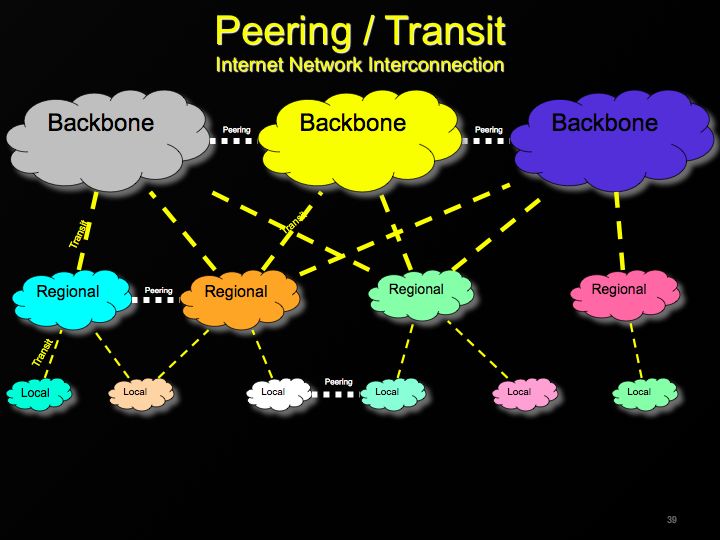
Early academic and government networks focused on research, development, and innovation, not commercial competition; they developed a simple accounting scheme for interconnection: settlement-free peering. Early commercial backbone providers adopted settlement-free peering as a means of rapidly growing their business plans. Access networks, which needed to provide full Internet service to their customers, interconnected with and paid transit to commercial backbone providers.
The Internet interconnection market would then undergo seismic evolution. By 2010, large access providers had reestablished a strong position in the network ecosystem, and leveraged network effect and interconnection to implement strategic goals. Broadband Internet access service providers were able to reverse the flow of interconnection settlement fees, going from transit customers to gatekeepers, charging paid peering for access to their end-users. The interconnection market had departed from the characteristics of the early commercial Internet, where backbone networks were king and the market was hyper-competitive, and returned to traditional consolidated network market economics. [See generally WU, THE MASTER SWITCH: THE RISE AND FALL OF INFORMATION EMPIRES (discussing how communications markets go through cycles of innovation and disruption, competition, and then consolidation and market power).]
Subscribe to:
Posts (Atom)