Showing posts with label ftc. Show all posts

Monday, April 30, 2018

FTC Warns Gator Group, Tinitell that Online Services Might Violate COPPA

Press Release "The staff of the Federal Trade Commission sent letters to two foreign companies that market electronic devices and apps that appear to collect geolocation data from children, warning that the companies may be in violation of the Children’s Online Privacy Protection Act (COPPA) Rule.
The letters were sent to China-based Gator Group Co., Ltd., and Sweden-based Tinitell, Inc., which both provide online services. Gator Group advertises an app and a device called the Kids GPS Gator Watch, which it markets as a “child’s first cell phone.” Tinitell has also marketed an app that works with a mobile phone worn like a watch, which is also designed for children. Although Tinitell has stopped selling the devices, they will continue to operate through September 2018. Copies of the letters were also sent to the Apple App Store and the Google Play Store, which make the apps available to consumers in their stores.
The FTC’s COPPA Rule requires companies collecting personal information from children under the age of 13 to post clear privacy policies and to notify parents and get their consent before collecting, using or sharing personal information from a child.
In its letters to the two companies, the FTC noted that even though they are based outside the United States, foreign companies are required to comply with COPPA when their services are directed to children in the United States or they knowingly collect information from U.S.-based children.
The online services offered by both companies appear to be directed to children and to collect precise geolocation information from children. The letters note that a review of both companies’ services reveal that they do not appear to provide direct notice of their collection practices and do not seek verifiable parental consent before collecting, using or disclosing personal information as required by COPPA.
The letters encourage the companies to review their online services, policies and procedures to ensure they are in compliance with COPPA."

FTC to Host Cryptocurrency Workshop on June 25

Press Release "The Federal Trade Commission will host a workshop in Chicago on June 25 to examine scams involving cryptocurrencies.
The “Decrypting Cryptocurrency Scams” workshop will bring together consumer groups, law enforcement, research organizations, and the private sector to explore how scammers are exploiting public interest in cryptocurrencies such as bitcoin and Litecoin and to discuss ways to empower and protect consumers.
Cryptocurrencies are digital assets that use cryptography to secure or verify transactions. They are not created by a government or central bank, but they can be exchanged for U.S. dollars or other government-backed currencies.
As consumer interest in cryptocurrencies has grown, so has interest from scammers, who are always looking for new ways to take advantage of consumers. Scams involving cryptocurrencies include deceptive investment and business opportunities, bait-and-switch schemes, and deceptively marketed mining machines. The FTC has worked to educate consumers about cryptocurrencies and hold fraudsters accountable.
The workshop, which is free and open to the public, will be held starting at 1 pm Central Time at DePaul University located at 1 East Jackson Blvd., Suite 8005, Chicago, IL 60604. Pre-registration is not required, but attendees are encouraged to register for the event at fintechseries@ftc.gov (link sends e-mail). This event will be webcast on the FTC’s website. A link will be posted on the event page on the day of the event."

Monday, March 20, 2017

In Which I Get Another Excuse to Babble About the "Enhanced Service" / "Telecom Service" Dichotomy :: FTC v. American eVoice

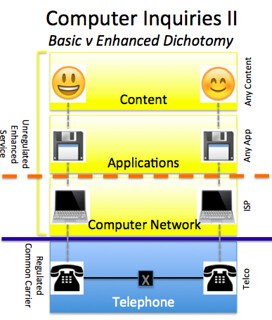
Time to brush the dust off your Computer II notebooks.  Are voicemail, electronic fax, and call forwarding enhanced services or telecom services?

Today's case: FTC v. American eVoice, Ltd, et al, CV-13-03-M-DLC (DC Montana Mar. 14, 2017). See also Stipulated Permanent Injunction.

The FTC brought an action against Defendants claiming that they were engaged in cramming, adding unwanted voicemail, electronic fax, and call forwarding services to consumers bills to the tune of $70 million. Slip at 3. The FTC concluded that this was a violation of Sec. 5 of the FTC Act, which prohibits "unfair or deceptive acts or practices in or affecting commerce." Slip at 3.


Defendants filed a motion to dismiss, arguing that they are common carriers and therefore exempt from FTC jurisdiction. This argument had been successful recently. In FTC v. ATT Mobility (9th Cir. Aug. 2016), the FTC had brought an action against ATT Mobility for data throttling (before the FCC's Open Internet order declaring Internet access service a telecommunications service). The 9th Circuit found that ATT Mobility had the status of a common carrier, therefore the FTC lacked jurisdiction over ATT Mobility. Specifically, Sec. 5 states that the FTC lacks jurisdiction over "common carriers subject to the Acts to regulate commerce."  The term "common carrier" is not defined in Sec. 5. The 9th Circuit conducted an extensive review, concluding that the language applied generally to firms that have the status of being a common carrier, and not specifically only to actions that constitute the provision of common carriage.  In other words, according to the holding of the 9th Circuit, the FTC lacks jurisdiction over ATT Mobility even if ATT Mobility is selling hot dogs out of a push cart because ATT Mobility has the status of common carriage for some other part of its business.

So are Defendants in the case at hand "common carriers" or not?

The Court cites to Computer II authority, for which it gets my thumbs up. But of course Computer II has been superseded by the Telecommunications Act of 1996 which codified definitions for an "information service" (a.k.a. "enhanced services") and a "telecom service." An "Information Service" is
the offering of a capability for generating, acquiring, storing, transforming, processing, retrieving, utilizing, or making available information via telecommunications, and includes electronic publishing... - 47 U.S.C. § 153(20)
By contrast, a "telecom service"
means the offering of telecommunications for a fee directly to the public 47 U.S.C. § 153(53)
And of course, "telecommunications"
means the transmission, between or among points specified by the user, of information of the user’s choosing, without change in the form or content of the information as sent and received. 47 U.S.C. § 153(50)
As the court states, telecom service is essentially a pipeline. It is the transmission layer of the communications service. It pretty much is someone saying "hi grandma" into a telephone network and "hi grandma" comes out the other end.

Anything more than that is an "information service." This is a bright line test. If "hi grandma" is spoken into the network and "Bonjour Grand-mère" comes out the other end of the network, you gots yourself "a change in the form or content of the information" sent.

The FCC and the courts have been deciphering the distinction between "information services" and "telecommunications services" for more than half a century. There is a bit of precedent here. What we know, according to the court, is that defendants offered "voicemail, electronic fax, and call forwarding." Have previous courts and the FCC passed on whether these are "information services"? Yes they have.


Service
Classification
Authority
Voicemail Information Service CPE Order 2001 ¶ 2; FWD MOOStevens Report, ¶ 73; BOC Petition Order 13770-774, App. A; Computer II Final Decision, ¶ 98; In re Southwestern Bell CEI Plan for the Provision of Voice Messaging Services, DA 88-1469, Memorandum Opinion and Order, 3 FCC Rcd. 6912, 65 Rad. Reg. 2d (PF) 527,  1 (September 29, 1988); Petition USTelecom2013 ¶ 20; Computer III Further NPRM 1998 ¶ 1
Electronic Fax Information Service (actually, the court does not describe what 'electronic fax' is so I am not 100% confident but....) :: Computer III Further NPRM 1998 ¶ 1; Review of Customer Premises Equipment and Enhanced Services Unbundling Rules in the Interexchange, Exchange Access and Local Exchange Markets, CC Docket No. 98-183, Further Notice of Proposed Rulemaking, para 1, n. 20 (October 9, 1998); MOO, Bell Operating Companies Joint Petition for Waiver of Computer II Rules, DA 95-36, 10 FCC Rcd 1724 n.3, 1995 FCC LEXIS 217 **2 (Jan 1995)
Call Forwarding Telecom Service Stevens Report, ¶ 73; Computer II Final Decision, ¶ 98

Whoops. That did not go as planned. "Call Forwarding" is a "Telecom Service"?? According to Computer II
We indicated that 'computer processing applications such as call forwarding, speed calling, directory assistance, itemized billing, traffic management studies, voice encryption, etc., may be used in conjunction with 'voice' service.'  The intent was to recognize that while POTS is a basic service, there are ancillary services [a.k.a. adjunct services] directly related to its provision that do not raise questions about the fundamental communications or data processing nature of a given service. Accordingly, we are not here foreclosing telephone companies from providing to consumers optional services to facilitate their use of traditional telephone service. - Computer II Final Decision, ¶ 98. 
Ah! So now we have to introduce one more concept: adjunct services. According to the FCC, adjunct services are services that may involve something that looks like an information service but facilitates the operation of the telecommunications service. Adjunct services take on the regulatory classification of the facilitated telecom service. Here is a simple example. If you call directory assistance to get a telephone number so that you can make a call, that's an adjunct service and therefore a telecom service. If however you call directory assistance with a reverse lookup, querying with a telephone number and asking for the name, that is an information service because that reverse lookup does not facilitate the operation of the telecom service (you already have the telephone number; getting the name doesn't help set up the call).

The policy behind this exception was that telecom services like ATT and the Baby Bells were prohibited from providing information services pursuant to the 1956 Consent Decree. The FCC wanted ATT to be able to offer services that facilitated operation of the telecommunications service - things like directory assistance, call forwarding, speed dialing, and caller ID. So the FCC classified these very telephone-like things as "adjunct-to-basic" services. The Telecommunications Act codified this as the Telecom Management Exception.

But an adjunct service must be adjunct to something. An adjunct service that is adjunct to nothing - this has no meaning. If ATT offers call forwarding, then this 'enhancement' facilitates the use of ATT's telecom service and therefore takes on the regulatory classification of ATT's telecom service (in other words, the "information service prohibition" would not have blocked ATT Mobility from offering this service). However, a company that just offers call forwarding but does not also offer a telecom service wasn't prohibited from offering information service in the first place and cannot offer an adjunct service to a non-existent telecom service. Thus, a stand-alone enhancement like call forwarding falls within the "information service" bucket and not the "adjunct service therefore telecom service" bucket. 

According to the court, "there is no evidence before the Court that the corporate Defendants operated a transmission pipeline" [a.k.a. telecom service]. Slip at 10. Unlike ATT Mobility which had the status of "common carrier" because some part of that company offers common carrier service (even though other parts of the company do not), no part of Defendants companies were found to offer "telecom service," thus Defendants do not fall within the FTC exception to jurisdiction over common carriers.

Oh, by the way, the Court noted a further problem with Defendants' claim to be "common carriers." According to the Court, they had not registered with the FCC as common carriers; they had not named an agent for service of process as a common carrier; they made no showing that they complied with common carrier obligations like paying into the universal fund. Slip at 11. Adding to the jurisprudence of the Duck Test, the Court concluded that these Defendants don't quack like a duck.

Defendants' Motion to Dismiss on the grounds that Defendants are common carriers outside the jurisdiction of the FTC dismissed.

Monday, December 19, 2016

You Cant Tell Your Customers to 'Shut Up' Anymore :: Consumer Review Fairness Act Signed into Law

Bad idea: Set up a business and provide poor goods or services; receive bad reviews online for your poor goods or services.

Worse idea: Instead of treating your customers' feedback as free expert advice and listening to their suggestions on how to improve your business, sue your customers - experience the Streisand Effect - resulting in increased media coverage highlighting your lousy goods, service, and treatment of customers.  Ensure that negatives reviews of your business get the widest exposure possible.

Worser Idea:  Attempt to solve this problem by telling your customers to shut-up. Insert a gag-clause in your terms of service so that it is a breach of contract for your customers to provide negative reviews of your service.

Jennifer Kulas Palmer testified before Congress about her negative experience with online business KlearGear.com.  According to Palmer, in 2008 her husband ordered about $20 worth of Christmas gifts from KlearGear.  When it did not arrive, they attempted to reach out to the company, but to no avail.  Like so many consumers who have had a bad experience, they wrote a negative online review.  Three years later, Palmer heard from KlearGear, claiming that Palmer had violated their Terms of Sale and that Palmer owed KlearGear $3500. Attorneys from Public Citizen represented the Palmers and filed a successful lawsuit against KlearGear. See Chris Morran, “KlearGear.com Ordered To Pay $306K To Couple Who Wrote Negative Review,” Consumerist, June 26, 2014; KlearGear must pay $306,750 to couple that left negative review Lawyer: CYRUS FARIVAR - 6/25/2014 Ars Technica; Jon Brodkin, It will soon be illegal to punish customers who criticize businesses online Ars Technica 11/29/2016.

If there was any doubt that this type of thing is a bad idea, in this year of divided and partisan politics, Congress unanimously voted to end attempts to silence customer reviews. The Consumer Review Fairness Act was signed into law by President Obama on December 14th.

According to the new law, 'form contracts' (those terms of service or standard forms shoved in front of customers to sign without ability to negotiate individual terms) are void if they prohibit customer reviews.  Any such gag provisions are unlawful and are subject to enforcement by the Federal Trade Commission or the states. The Federal Trade Commission will be publishing best practices on how to comply with the Consumer Review Fairness Act.

All of this comes about in the context of the Good Samaritan provisions of the Communications Decency Act, 47 USC 230(c), which says that an online services are not liable for the third party content.  This means that Yelp, TripAdvisor, Amazon, Google, and all the other review sites can encourage people to provide reviews of goods and services - without those online services becoming liable for those reviews. 47 USC 230(c) legally set the foundation for the interactive web where many third parties contribute without the host becoming liable for every utterance.

The Consumer Review Fairness Act establishes that you cannot tell consumers to shut up - it does not, however, protect consumers from liability for what they say.  Businesses can, for example, still seek redress for defamatory reviews. Consumers can review but they may still be held responsible for their words.   


Sen. Thune's Statement During Senate Hearing
"Zero Stars: How Gagging Honest Reviews Harms Consumers and the Economy."


Thursday, July 30, 2015

CT :: FTC Announces Workshop to Examine Online Lead Generation

Lead generators identify or cultivate consumer interest in a product or service, and sell the consumer “lead” information to third parties. For example, as consumers search the Internet for goods and services, they may express interest in specific topics, such as educational programs, mortgages, or small-dollar loans, and submit their personal information to the lead generator. The consumer leads sometimes contain sensitive personal and financial information that may travel through multiple online marketing entities before reaching the desired business.
The workshop, “Follow the Lead: An FTC Workshop About Online Lead Generation,” will gather a variety of stakeholders, including industry representatives, consumer advocates, and government regulators, to discuss consumer protection issues raised by the practices of the lead generation industry, such as:
  • How online lead generation works and its variations, depending on the industry,
  • What types of lead generation conduct may be unlawful under the FTC Act’s prohibition against unfair or deceptive practices,
  • Best practices for entities that generate and sell consumer leads, and
  • How consumers can avoid unlawful conduct in the online marketplace.
The FTC is seeking research, recommendations for discussion topics, and requests for panelists in advance of the workshop. Please email any relevant information to leadgen@ftc.gov(link sends e-mail) by August 25, 2015. The deadline to submit public comments about the workshop is December 20, 2015. Comments can be submitted electronically.
The workshop, which is free and open to the public, will be at the Constitution Center, 400 7th St., SW. The FTC will publish a detailed agenda at a later date. Reasonable accommodations for people with disabilities are available upon request. Requests should be submitted to Fawn Bouchard at Fbouchard@ftc.gov(link sends e-mail) or 202-326-2743. Requests should be made in advance and include a detailed description of the accommodations needed and contact information.

Thursday, June 13, 2013

FTC Announces New Date for Internet of Things Workshop: Nov. 19

FTC Press Release For Your Information: 06/13/2013 Workshop Will Take Place Nov. 19
The Federal Trade Commission has announced a new date for its planned workshop on the privacy and security of the Internet of Things. The workshop will now be held on Nov. 19, 2013, in Washington, D.C.
The workshop will address a wide variety of issues related to the ability of everyday devices to communicate with each other and with people, which is becoming more prevalent and is often referred to as the Internet of Things.
The Federal Trade Commission works for consumers to prevent fraudulent, deceptive, and unfair business practices and to provide information to help spot, stop, and avoid them.  To file a complaint in English or Spanish, visit the FTC’s online Complaint Assistant or call 1-877-FTC-HELP (1-877-382-4357).  The FTC enters complaints into Consumer Sentinel, a secure, online database available to more than 2,000 civil and criminal law enforcement agencies in the U.S. and abroad.  The FTC’s website provides free information on a variety of consumer topics.  Like the FTC on Facebook, follow us on Twitter, and subscribe to press releases for the latest FTC news and resources.
MEDIA CONTACT:
Jay Mayfield
Office of Public Affairs

202-326-2181
 
STAFF CONTACT:
Karen Jagielski
Bureau of Consumer Protection
202-326-2509

Monday, December 10, 2012

Safe Web Act extended until 2020

On Dec. 4th, President Obama signed into law HR 6131 extending the Safe Web Act until 2020.  The Safe Web Act was set to expire in 2013.  The Safe Web Act authorizes the Federal Trade Commission to engage in international enforcement efforts and information sharing.  Testifying before Congress in July, the FTC testified that
the agency has conducted more than 100 investigations with international components, such as foreign targets, evidence, or assets, and has filed more than 50 cases involving cross-border aspects since the Act's passage. The FTC has used the Act's provisions in many of these matters, and in related actions brought by other U.S. and foreign enforcement agencies. With these tools, the testimony states, the agency has stopped frauds costing American consumers hundreds of millions of dollars.
As the Internet is a global phenomenon, so is Internet fraud and crime.  In order to keep pace and enable international investigations and forensics, the Safe Web Act was necessary to authorize FTC activity.  Rep. Mary Bono Mack, sponsor of HR 6131, explained the origins of the Safe Web Act:
About a decade ago, the FTC began to highlight the growing problems it encountered in effectively combating Internet scams and fraud directed at American citizens by foreign operators, often times involving organized crime rings. By 2005, an estimated 20 percent of consumer complaints the FTC received involved fraud originating outside of the United States, costing American consumers hundreds of millions of dollars a year. In order to expand its ability to effectively fight online fraud, the FTC sent Congress legislative recommendations in 2005 seeking additional authorities.

As summarized by the FTC, the Safe Web Act achieves the following:
  • Broadening Reciprocal Information Sharing. (US SAFE WEB Act §§ 4(a), 6(a)) Allows the FTC to share confidential information in its files in consumer protection matters with foreign law enforcers, subject to appropriate confidentiality assurances. Similar to longstanding SEC, CFTC, and federal banking agency authority. Needed to allow the FTC to share information with foreign agencies to help them halt fraud, deception, spam, spyware and other consumer protection law violations targeting U.S. consumers. Also needed for the FTC to obtain, in return, foreign information required to halt such illegal practices.
  • Expanding Investigative Cooperation. (US SAFE WEB Act § 4(b) (adding FTC Act § 6(j))) Allows the FTC to conduct investigations and discovery to help foreign law enforcers in appropriate cases. Similar to longstanding SEC, CFTC, and federal banking agency authority. Needed to allow the FTC to obtain information for foreign agencies' actions to halt fraud, deception, spam, spyware, and other consumer protection law violations targeting U.S. consumers. Also needed to help the FTC to obtain, in return, foreign investigative assistance in FTC cases.
  • Obtaining More Information from Foreign Sources. (US SAFE WEB Act § 6(b)) Protects information provided by foreign enforcers from public disclosure if confidentiality is a condition of providing it. Similar to longstanding SEC and CFTC authority. Needed because, without it, some foreign law enforcers will not give the FTC information needed to halt fraud, deception, spam, and spyware.
  • Protecting the Confidentiality of FTC Investigations. (US SAFE WEB Act § 7) Safeguards FTC investigations in a defined range of cases by (1) generally protecting recipients of Commission CIDs from possible liability for keeping those CIDs confidential; (2) authorizing the Commission to seek a court order in appropriate cases to preclude notice by the CID recipient to the investigative target for a limited time; and (3) tailoring the mechanisms available to the Commission to seek delay of notification currently required by the Right to Financial Privacy Act ("RFPA") or the Electronic Communications Privacy Act ("ECPA"), to better fit FTC cases. Similar to longstanding RFPA, ECPA, and securities law provisions. Needed to prevent notice to investigative targets that are likely to destroy evidence or to move assets offshore or otherwise conceal them, precluding redress to consumer victims.
  • Protecting Certain Entities Reporting Suspected Violations of Law. (US SAFE WEB Act § 8) Protects a limited category of appropriate entities from liability for voluntary disclosures to the FTC about suspected fraud or deception, or about recovery of assets for consumer redress. Similar to longstanding protections for financial institutions making disclosures of suspected wrongdoing to federal agencies. Needed because liability concerns discourage third-party businesses from alerting the FTC to suspected law violations or recoverable assets.
  • Allowing Information Sharing with Federal Financial and Market Regulators. (US SAFE WEB Act § 10) Adds the FTC to RFPA's list of financial and market regulators allowed to readily share appropriate information. The list already includes the SEC and the CFTC. Needed to help the FTC track proceeds of fraud, deception, or other illegal practices sent through U.S. banks to foreign jurisdictions, so they can be recovered and returned to consumer victims.
  • Confirming the FTC's Remedial Authority in Cross-Border Cases. (US SAFE WEB Act § 3) Expressly confirms: 1) the FTC's authority to redress harm in the United States caused by foreign wrongdoers and harm abroad caused by U.S. wrongdoers; and 2) the availability in cross-border cases of all remedies available to the FTC, including restitution. Needed to avoid spurious challenges to jurisdiction in FTC cases and to encourage the full range of remedies for U.S. consumer victims in foreign courts
  • Enhancing Cooperation Between the FTC and DOJ in Foreign Litigation. (US SAFE WEB Act § 5) Permits the FTC to cooperate with DOJ in using additional staff and financial resources for foreign litigation of FTC matters. Needed because, without additional resources to freeze foreign assets and enforce U.S. court judgments abroad, fraudsters targeting U.S. consumers can more readily use the border as a shield against law enforcement.
  • Clarifying FTC Authority to Make Criminal Referrals. (US SAFE WEB Act § 4(b) (adding FTC Act § 6(k))) Expressly authorizes the FTC to make criminal referrals for prosecution when violations of FTC law also violate U.S. criminal laws. Similar to existing FTC authority to provide information to criminal authorities, a narrow express criminal referral provision in the FTC Act, and an SEC provision. Needed because foreign agencies that address consumer fraud and deception as a criminal (not civil) law enforcement issue would be more willing to share information if FTC has express authority to share information with criminal authorities.
  • Providing for Foreign Staff Exchange Programs. (US SAFE WEB Act § 9) Provides for foreign staff exchange arrangements between the FTC and foreign government authorities, and permits the FTC to accept reimbursement for its costs in these arrangements. Needed to improve international law enforcement cooperation in crossborder matters.
  • Authorizing Expenditure of Funds on Joint Projects. (US SAFE WEB Act § 4(b) (adding FTC Act § 6(l)), 4(c)) Authorizes the FTC to expend appropriated funds, not to exceed $100,000 annually, toward operating expenses and other costs of cooperative cross-border law enforcement projects and bilateral and multilateral meetings. Similar to SEC authority. Needed to allow the FTC to help support valuable international cooperative organizations and projects such as the website or consumer education programs of the International Consumer Protection and Enforcement Network (ICPEN) that foster the FTC's mission.
  • Leveraging FTC's Resources Through Reimbursement, Gift Acceptance, and Voluntary and Uncompensated Services (US SAFE WEB Act § 11) Authorizes the FTC to accept reimbursement for providing assistance to law enforcement agencies in the U.S. or abroad, and to accept gifts and voluntary services in aid of the agency's mission and consistent with ethical constraints. Similar to the authority of numerous regulatory agencies, including the SEC and the CFTC, and of the FTC and DOJ in the antitrust context, to accept reimbursements from foreign counterparts. Needed to assure that in appropriate circumstances a foreign agency bears the costs of FTC efforts on their behalf, and to enable the FTC to employ volunteers as our Canadian counterparts have done successfully for years.

Thursday, March 01, 2012

Workshop :: FTC Will Host Public Workshop to Explore Advertising Disclosures in Online and Mobile Media on May 30, 2012

"The Federal Trade Commission will host a day-long public workshop to consider the need for new guidance for online advertisers about making disclosures required under FTC law. The guidance will address technological advancements and marketing developments that have emerged since the FTC first issued its online advertising disclosure guidelines known as “Dot Com Disclosures” 12 years ago. 
 
The workshop, to be held on May 30, will cover revising the Dot Com Disclosures so they illustrate how to provide clear and conspicuous disclosures in the current online and mobile advertising environment. Any revisions will be consistent with the goals of the original guidelines and will continue to emphasize that consumer protection laws apply equally to online and mobile marketers, and to other media. The FTC began seeking input for revising the Dot Com Disclosures guidelines last year.  

"Topics may include:
  • How can effective disclosures be made on social media platforms and mobile devices – including when they are used in commercial texting – that limit the space available for disclosure?  For example, when consumers are paid or receive other benefits for providing an endorsement, how can they effectively disclose on platforms that allow only short messages or a simple sign of approval?
  • When can disclosures provided separately from an initial advertisement be considered adequate?  For example, if a consumer receives a location-based ad for a discounted cup of coffee on her mobile device because she is near a particular coffee shop, what terms must be disclosed in the mobile ad and what terms, if any, do not have to be disclosed until the consumer enters the coffee shop to make her purchase?
  • What are the options when using devices that do not allow downloading or printing the terms of an agreement?  For example, is providing consumers a means to send a copy of the agreement to themselves to read later an effective way to provide this information?
  • How can disclosures that are made in the original advertisement be retained when the advertisement is aggregated (for example, on dashboards) or re-transmitted (through, for example, re-tweeting)?  
  • What are the disclosure opportunities and limitations of hyperlinks, jump links, hashtags, click-throughs, layered disclosures, icons, and other similar options?  How should these options be evaluated in terms of placement and proximity?
  • How can short, effective, and accessible privacy disclosures be made on mobile devices?
  • What does the research show about how consumers’ use of mobile and other devices can affect the effectiveness of disclosures on particular devices or platforms?  And what does it show about the relationship between how consumers use mobile devices and their understanding of disclosures and advertising displayed on mobile devices?  What does the research show about how consumers make decisions based on that information?  Is there specific research on the effectiveness of disclosures on mobile devices, including layered disclosures and icons, and, if so, what are the implications of that research for disclosures such as offer terms and privacy practices?
The Commission also invites parties to submit suggestions for topics of discussion or original research.  In particular, the Commission invites the submission of realistic examples and mock-ups that can be used for illustration and discussion at the workshop. Individuals and organizations may submit requests to participate as panelists and may recommend topics for inclusion on the agenda.

  The requests and recommendations should be submitted electronically to dotcomdisclosuresworkshop@ftc.gov. Prospective panelists should submit a statement detailing their expertise on the issues to be addressed and contact information no later than March 30, 2012. Panelists will be selected based on expertise and the need to include a broad range of views.
Paper submissions should reference the Dot Com Disclosures Workshop both in the text and on the envelope, and should be mailed or delivered to: Federal Trade Commission, Office of the Secretary, Room H-135 (Annex P), 600 Pennsylvania Avenue, N.W., Washington, DC 20580.  The FTC requests that any paper submissions be sent by courier or overnight service, if possible, because postal mail in the Washington area and at the Commission is subject to delay due to heightened security precautions. The workshop is free and open to the public.  It will be held on Wednesday, May 30, 2012, at the FTC Conference Center at 601 New Jersey Avenue, N.W., Washington, DC.  Pre-registration is not required.  Members of the public and press who wish to participate but who cannot attend can view a live Webcast at FTC.gov.

Wednesday, October 05, 2011

FTC RFC :: Mail or Telephone Order Merchandise Rule :: AKA "Where's My Stuff?!?!?"

1999 was the year that ecommerce broke. It is also the year where ecommerce became the Grinch that stole Christmas. In 1998, ecommerce proved itself as a viable and compelling concept. As won-over companies scrambled to set up their online ventures in 1999, "mistakes were made." Online purchases by consumers who sought to avoid the Eight Ring of Hell - shopping malls - exploded. Some dot-coms were pleasantly surprised. Some were unpleasantly surprised. As automated orders poured in, it became apparent that cyber-Santa might not just be able to slide down the chimney on time - if at all. And while many of their webpages promised delivery by the time chestnuts were roasting on an open fire, it didn't happen. Some companies failed to tell their customers that there was not a snowball chance that they could deliver. Some companies continued to take orders even though they knew they had no inventory or knew they could not timely deliver. 

Failing to deliver on time for the holidays is one of those industry blunders that makes obsolete the theology of self-regulation. The FTC created a list, checked it twice, and made clear in a blizzard of terms that this was not to happen again. In one action, the FTC hit seven online retails with $1.5 million in fines for their failures to deliver products during the 1999 holiday season. 

There is a simple rule that the FTC wants online retails to understand: taking orders and not delivering is bad. Online sales, mail orders, or catalogue sales - it's all the same. The FTC described its Mail or Telephone Order Merchandise Rule [16 C.F.R. § 435.1] as follows:
The Rule requires that when you advertise merchandise, you must have a reasonable basis for stating or implying that you can ship within a certain time. If you make no shipment statement, you must have a reasonable basis for believing that you can ship within 30 days. That is why direct marketers sometimes call this the "30-day Rule."
If, after taking the customer’s order, you learn that you cannot ship within the time you stated or within 30 days, you must seek the customer’s consent to the delayed shipment. If you cannot obtain the customer’s consent to the delay -- either because it is not a situation in which you are permitted to treat the customer’s silence as consent and the customer has not expressly consented to the delay, or because the customer has expressly refused to consent -- you must, without being asked, promptly refund all the money the customer paid you for the unshipped merchandise.
That was over a decade ago.  A lot has changed, and the FTC believes it would be prudent to revisit and revise the rules. In the notice requesting comments on the proposed new rules, the FTC stated,
In 2007, the FTC sought public comment on how the Rule could be amended to address changes in technology and commercial practices. Based on a review of comments received, the FTC has concluded that the Rule continues to benefit consumers and will be retained. In addition, the Commission proposes the following amendments to the Rule:
  • Clarify that the Rule covers all orders placed over the Internet;
  • Revise the Rule to allow sellers to provide refunds and refund notices to buyers by any means at least as fast and reliable as first-class mail;
  • Clarify sellers’ obligations when buyers use payment methods not spelled out in the Rule, such as debit cards or prepaid gift cards;
  • Require that refunds be made within seven working days for purchases that were made using third-party credit, such as Visa or MasterCard cards. For credit sales where the seller is the creditor (such as merchants using their own store charge cards) the refund deadline would remain one billing cycle.
Comments must be received by December 14, 2011.  See the Federal Register Notice. for further information and instructions on how to file comments.

Saturday, June 11, 2011

FTC extends RFC Due Date "Dot Com Disclosures" August 10

In 2000, the Federal Trade Commission first published “Dot Com Disclosures: Information About Online Advertising,” providing advice to businesses doing business online. A lot has changed since that time, and the FTC is in the process of updating this publication. This week the FTC announced that it is extending the deadline for comments on the revised publication to August 10, 2011.

From the original May 26th notice:
The staff of the Federal Trade Commission is updating “Dot Com Disclosures: Information About Online Advertising,” the guidance document that advises businesses how federal advertising law applies to advertising and sales on the Internet. [Download “Dot Com Disclosures” here.] The online world has changed dramatically since the original guidance was published in 2000, and the FTC is seeking public comment about how it should be modified to reflect these changes. [Read staff invitation to submit comments here.]

Since the FTC staff published Dot Com Disclosures, mobile marketing has become a reality, the “App” economy has emerged, the use of “pop-up blockers” has become widespread, and online social networking has emerged and grown popular. In seeking public comment on possible revisions to the guidance document, the staff is interested in the technical and legal issues that marketers, consumer advocates, and others believe should be addressed.

The 2000 guidance emphasizes that the same consumer protection laws apply to marketers whether they operate online or not. It illustrates how online marketers should provide clear and conspicuous disclosures of information that consumers need to make informed online purchasing decisions. It also discusses how the traditional factors used to evaluate whether disclosures are likely to be clear and conspicuous apply in the context of online advertising.

In the June 10, 2011 notice, the FTC stated "At the request of a stakeholder, the comment deadline has now been extended for 30 days until August 10, 2011." Interested parties can submit comments by clicking on the following: [Submit comment electronically by clicking here.]

Monday, April 19, 2010

[EVENT] FTC to Host Public Roundtable to Review Whether Technology Changes Warrant Changes to the Children's Online Privacy Protection Rule

Press Release: "In light of rapidly changing technology such as the increased use of smartphones and other devices to access the Internet, the Federal Trade Commission will host a public roundtable, “Protecting Kids' Privacy Online: Reviewing the COPPA Rule,” on June 2, 2010 to explore whether to update the Children's Online Privacy Protection Rule. The Rule was enacted in 2000 and requires Web site operators to obtain parental consent before collecting, using, or disclosing personal information from children under 13. Roundtable topics will include:
  • Whether the Rule should be applied to emerging media such as mobile devices, interactive television, and interactive gaming;
  • Potential expansion of the Rule to cover more items of information that might be collected from children; and,
  • A review of the parental verification methods used by Web site operators.

"For a more detailed list of topics, see the Commission's March 24, 2010 request for public comment on the COPPA Rule, at http://www.ftc.gov/opa/2010/03/coppa.shtm .

"The roundtable will be held at the FTC Conference Center at 601 New Jersey Avenue N.W. in Washington, DC. It is free and open to the public. Pre-registration is not required. Members of the public and press who wish to participate but who cannot attend can view a live webcast at ftc.gov.

"Individuals and organizations may submit requests to participate as panelists and may recommend topics for inclusion in the agenda. The requests and recommendations should be submitted electronically to childrensprivacyroundtable@ftc.gov . Prospective panelists should submit a statement detailing their expertise on the issues to be addressed and contact information no later than May 5, 2010. Panelists will be selected based on expertise and the need to include a broad range of views.

. . . . .

MEDIA CONTACT: Office of Public Affairs
202-326-2180

STAFF CONTACT:
Phyllis Marcus or Mamie Kresses
Bureau of Consumer Protection
202-326-2854 or 202-326-2070

Friday, March 26, 2010

[RFC] FTC Seeks Comment on Children's Online Privacy Protections; Questions Whether Changes to Technology Warrant Changes to Agency Rule

Press Release March 24: "In light of rapidly evolving technology and changes in the way children use and access the Internet, the Federal Trade Commission is seeking public comment on the costs and benefits of an FTC rule designed to protect children online.

"The FTC’s Children’s Online Privacy Protection Act (COPPA) Rule became effective on April 21, 2000. COPPA imposes requirements on operators of Web sites or online services that are aimed at children under 13 years of age, or that knowingly collect personal information from children under 13. Among other things, the Rule requires that online operators notify parents and get their permission before collecting, using, or disclosing personal information from children. It also requires that the operators keep the information they collect from children secure, and prohibits them from requiring children to turn over any more personal information than is reasonably necessary to participate in activities on their Web sites.

"In 2005, the FTC initiated a congressionally required review of the Rule, and after considering extensive public comment decided to retain it without change. However, the Commission believes that changes to the online environment over the past five years, including children’s increasing use of mobile technology to access the Internet, warrant reexamining the Rule.

"In a Federal Register notice to be published shortly, the FTC poses its standard regulatory review questions and identifies several areas where public comment would be especially useful. Among other things, the FTC asks:

  • What implications for COPPA enforcement are raised by mobile communications, interactive television, interactive gaming, or other similar interactive media.
  • For input on the use of automated systems – those that filter out any personally identifiable information prior to posting – to review children’s Web submissions.
  • Whether operators have the ability to contact specific individuals using information collected from children online, such as persistent IP addresses, mobile geolocation data, or information collected in connection with behavioral advertising, and whether the Rule’s definition of “personal information” should be expanded accordingly.
  • Whether there are additional technological methods to obtain verifiable parental consent that should be added to the COPPA Rule, and whether any of the methods currently included should be removed.
  • Whether parents are exercising their right under the Rule to review or delete personal information collected from their children, and what challenges operators face in authenticating parents.
  • Whether the Rule’s process for FTC approval of self-regulatory guidelines – known as safe harbor programs – has enhanced compliance, and whether the criteria for FTC approval and oversight of the guidelines should be modified in any way.

"Copies of the Federal Register Notice and the public comments received will be posted on the FTC’s Web site at: http://www.ftc.gov/privacy/privacyinitiatives/childrens.html.

"The 90-day comment period will end on June 30, 2010. The Commission also will hold a public roundtable on the COPPA Rule review on Wednesday, June 2, 2010, at the FTC Conference Center, 601 New Jersey Avenue, N.W., Washington, DC.

"Interested parties can submit written comments electronically or in paper form, by following the instructions in the Invitation To Comment part of the “Supplementary Information” section. Comments in electronic form should be submitted using the following Web link: https://public.commentworks.com/ftc/2010copparulereview (and following the instructions on the web-based form). Comments in paper form should be mailed or delivered to: Federal Trade Commission, Office of the Secretary, Room H-135 (Annex E), 600 Pennsylvania Avenue, N.W., Washington, DC 20580.

Friday, January 08, 2010

[RFC] FTC Seeks Public Comment on Program to Keep Web Site Operators in Compliance With the Children's Online Privacy Protection Rule

The Federal Trade Commission is seeking public comment on proposed guidelines that are designed to help Web site operators comply with the FTC's Children's Online Privacy Protection Rule.

The proposed guidelines were submitted to the FTC by a non-profit organization known as iSAFE, Inc. under a provision aimed at industry self-regulation. This provision allows non-profit groups and companies to request FTC approval of proposed guidelines – known as safe harbor programs – that govern compliance with the Rule.

Web site operators participating in FTC-approved safe harbor programs are subject to the programs' disciplinary procedures. In cases where the FTC is considering legal action against a Web site operator, the agency takes into account the operator's response to safe harbor disciplinary procedures.

The Rule requires operators of Web sites that are directed at children under 13 years old and that collect personal information from them – as well as operators of general-audience Web sites that knowingly collect personal information from children under 13 – to notify parents and obtain their consent before collecting, using, or disclosing any such information. Since the Rule took effect on April 21, 2000, four groups – the Children's Advertising Review Unit of the Council of Better Business Bureaus, the Entertainment Software Rating Board, TrustE and Privo, Inc. – have received Commission approval for their safe harbor programs. In a Federal Register notice to be published shortly, the FTC seeks public comment about the proposed iSAFE guidelines; whether the guidelines provide “the same or greater protections for children” as those contained in the Children's Online Privacy Protection Rule; whether the mechanisms used to assess operators' compliance are effective; whether incentives for operators' compliance with the guidelines are effective; and whether the guidelines provide adequate means for resolving consumer complaints. The comment period will last for 45 days [after fed reg publication] . iSAFE's safe harbor application and the public comments received will be posted on the FTC's Web site at: http://www.ftc.gov/privacy/privacyinitiatives/childrens_shp.html .

NOTE: Publication of this Federal Register notice does not indicate Commission approval of the safe harbor application. The Commission has 180 days to review proposed self-regulatory guidelines and must set forth its conclusions in writing.

The Federal Trade Commission works for consumers to prevent fraudulent, deceptive, and unfair business practices and to provide information to help spot, stop, and avoid them. To file a complaint in English or Spanish, visit the FTC's online Complaint Assistant or call 1-877-FTC-HELP (1-877-382-4357). The FTC enters complaints into Consumer Sentinel, a secure, online database available to more than 1,700 civil and criminal law enforcement agencies in the U.S. and abroad. The FTC's Web site provides free information on a variety of consumer topics .

For Your Information: 1/6/2010

MEDIA CONTACT: Betsy Lordan
Office of Public Affairs
202-326-3707

STAFF CONTACT: Mamie Kresses or Phyllis Marcus
Bureau of Consumer Protection
202-326-2070 or 202-326-2854

Tuesday, November 03, 2009

FTC Investigating Virtual Worlds

Back in March, as a part of the appropriations process, Congress inserted the following curious language:

“The Committee is concerned about reports of explicit content that can be easily accessed by minors on increasingly popular virtual reality web programs. The Committee directs the FTC to issue a consumer alert to educate parents on the content that is available to children on virtual reality web programs. In addition, no later than 9 months after enactment of this Act, the Commission shall submit a report to the Appropriations Committee discussing the types of content on virtual reality sites and what steps, if any, these sites take to prevent minors from accessing content.”

House Report 110-920 - FINANCIAL SERVICES AND GENERAL GOVERNMENT APPROPRIATIONS BILL, 2009. According to reports, the FTC is hard at work researching and preparing a report on virtual worlds. The report is due to Congress December 11. It does not appear that there was a request for comments to the public.

Members of Congress have previously expressed concern over youth access to adult content in virtual worlds. Member of Congress Mark Kirk sent a letter to the FTC is the Spring of 2008 asking for a consumer alert warning of the dangers of virtual worlds.

Kirk said he knew of no cases in which children were targeted by sexual predators on Second Life, but he said he considers the virtual world an emerging danger.

. . . .

"If you ask: Do you know about MySpace? The average parent will say yes," Kirk said. "But the average parent doesn't know anything about Second Life."

Linden Lab has two virtual districts, one for people 18 and older and one for users age 13 to 17, but company officials have acknowledged it is possible for adults to get into the teen district and for children to get into the adult district, according to news accounts.

In January 2009, the FTC released its Consumer Alert, Virtual Worlds and Kids: Mapping the Risks. As the FTC noted, a key problem is the lack of age verification online. The FTC's advice was a similar refrain:

How can you help your kids avoid content — or virtual spaces — that may be inappropriate for them? Start by talking to them about where they're going online — and how they're getting there, if not through the family computer. Help them understand that personal information about themselves, family members, and friends should stay private; you also can talk to them about avoiding sex talk or sexual situations online.

If your child visits a virtual world, you may want to check it out, too. Get to know what's on the site, the privacy protections it offers, and how it verifies the ages of site visitors.

If your child gets really interested in online gaming or virtual worlds, watch for changes in their patterns of behavior that could indicate an unhealthy obsession. Nobody knows your child better than you do, so you're best placed to know what sites may be appropriate for your child.

The FTC refers parents to its OnGuard Online project for additional information.

Second Life, one of the premier virtual worlds, has created a parallel virtual world, Teen Second Life, for kids age 13-17.

A lot of this issue turns on age verification. Some media reports indicate that the FTC will recommend age verification requirements. However previous examinations of age verification have concluded that it is a very problematic issue. The COPA Commission stated

  • Use of a credit card verification system to access harmful to minors material can be effective to protect minors from accessing some harmful to minors material. A large number of sites operated by the commercial online adult content industry use this system now, but they may still make some images available for free.
  • This system's limitations include the fact that some children have access to credit cards, and it is unclear how this system would apply to sites outside the US. It is not effective at blocking access to chat, newsgroups, or instant messaging. Delay in billing means that unauthorized access to harmful to minors materials could occur.
  • Credit card systems are readily available, but it may be difficult or burdensome for small or non-commercial sites to implement card verification systems. This system would make some content inaccessible to those users without credit cards.
  • This approach imposes moderate costs on consumers and other end-users, who must have a credit card and accept risks in providing it to sites. This approach imposes high costs on publishers, who must pay to verify cards. Use for verification without putting through a charge is viewed with disfavor by the credit card industry.

Parry Aftab reported noted that age verification based on credit cards would create barriers to online access and interactivity, discriminating against those without credit cards.

Government Activity

Education

Links

News

Friday, August 28, 2009

OnGuard Online

OnGuard Online "provides practical tips from the federal government and the technology industry to help you be on guard against Internet fraud, secure your computer, and protect your personal information." Check out the games from OnGuard Online: Auction Action :: Beware of Spyware :: Friend Finder :: ID Theft Faceoff :: Invasion of the Wireless Hackers :: Invest Quest :: Online Lineup :: Phishing Scams :: Spam Scan Slam :: The Case of the Cyber Criminal -- Also check out the Phishing videos. (Be sure to scroll down the page)