Showing posts with label history. Show all posts
Showing posts with label history. Show all posts
Sunday, July 12, 2020
1999 :: July 12th :: The Last Morse Radio Station
The Ship-to-shore telegraph radio station, KFS, at Half Moon Bay, California, goes offline - disrupted by satellite technology. KPH, which is currently a NPS museum, went offline June 30th, 1997.
Cybertelecom :: History Telegraph


Saturday, December 30, 2017
📞 1899 :: Dec. 30 :: American Bell becomes AT&T
American Bell (MA) becomes AT&T (NY). Massachusetts' law restricted the financial structuring of American Bell; New York law was more progressive. In order to allow Bell to continue to grow, AT&T "acquired the assets of American Bell, and became the parent company of the Bell System," moving from Boston to NYC. AT&T had capitalization of $70m. See Cybertelecom.
Sunday, December 24, 2017
Holiday Greetings from Mark Twain

Tuesday, December 19, 2017
1913 :: Dec. 19 :: AT&T's Kingsbury Commitment and the end of telephone competition
At the turn of the 20th Century, Alexander Graham Bell's telephone patents had expired and competition had entered the market place. Independent telephone companies raced to establish themselves in markets as of yet unserved by AT&T Other markets saw the advent of "dual service," with multiple, but incompatible, telephone services. Businesses might have multiple phones on their desks in order to reach different customers on different networks.
AT&T faced competition. And to AT&T, competition was inefficient. AT&T President Theodore Vail proclaimed that there should be "One policy, one service: Universal Service." Vail could solve the problem of a telephone market where different phones could not talk to each other by establishing AT&T as the government sanctioned monopoly.
In order to solve the problem of the independents, AT&T leveraged an asset that the independents lacked: it's long distance network linking together the local Bell Operating Companies. AT&T benefited from Network Effect. Subscribers to the Bell networks could reach all the other subscribers to the Bell networks over the AT&T interconnected long distance network. The subscribers to the independent telephone networks could not.
 The independent networks asked to interconnect with the AT&T network. AT&T refused. AT&T also, through its affiliation with J.P. Morgan, squeezed the Independents' access to financial capital. And also refused to sell superior Western Electric (which AT&T owned) equipment to its rivals.
The position of the independent networks became untenable. The independent telephone companies would crumble, either going out of business or selling out to AT&T.
Progressive era regulators grew wary of AT&T's anticompetitive strategy and filed suit in 1912. Rumors were also brewing in Congress about the possibility of nationalizing AT&T (something that would happen several years later during World War I).
In 1913, AT&T settled the antitrust actions with the Kingsbury Commitment in which AT&T agreed to interconnect its long distance network (not its local Bell Operating Companies) with independent telephone companies, stop acquiring independent telephone companies, and divest itself of Western Union.
At this point the damage to the competitive market had already been done and many crumbling independent telephone companies would have prefered it if AT&T had been permitted to buy them out. AT&T's strategy of establishing itself as the monopoly telephone network was well under way. By 1921, AT&T had achieved its strategy and competitive independent telephone providers dissolved from the market.
AT&T faced competition. And to AT&T, competition was inefficient. AT&T President Theodore Vail proclaimed that there should be "One policy, one service: Universal Service." Vail could solve the problem of a telephone market where different phones could not talk to each other by establishing AT&T as the government sanctioned monopoly.
In order to solve the problem of the independents, AT&T leveraged an asset that the independents lacked: it's long distance network linking together the local Bell Operating Companies. AT&T benefited from Network Effect. Subscribers to the Bell networks could reach all the other subscribers to the Bell networks over the AT&T interconnected long distance network. The subscribers to the independent telephone networks could not.
The position of the independent networks became untenable. The independent telephone companies would crumble, either going out of business or selling out to AT&T.
Progressive era regulators grew wary of AT&T's anticompetitive strategy and filed suit in 1912. Rumors were also brewing in Congress about the possibility of nationalizing AT&T (something that would happen several years later during World War I).
In 1913, AT&T settled the antitrust actions with the Kingsbury Commitment in which AT&T agreed to interconnect its long distance network (not its local Bell Operating Companies) with independent telephone companies, stop acquiring independent telephone companies, and divest itself of Western Union.
At this point the damage to the competitive market had already been done and many crumbling independent telephone companies would have prefered it if AT&T had been permitted to buy them out. AT&T's strategy of establishing itself as the monopoly telephone network was well under way. By 1921, AT&T had achieved its strategy and competitive independent telephone providers dissolved from the market.
Sunday, December 17, 2017
Thursday, November 02, 2017
1988, Nov. 2 :: 25th Anniversary of the Morris Worm
"In the fall of 1988, Morris was a first-year graduate student in Cornell
University's computer science Ph.D. program. Through undergraduate work
at Harvard and in various jobs he had acquired significant computer
experience and expertise. When Morris entered Cornell, he was given an
account on the computer at the Computer Science Division. This account
gave him explicit authorization to use computers at Cornell. Morris
engaged in various discussions with fellow graduate students about the
security of computer networks and his ability to penetrate it.
"In October 1988, Morris began work on a computer program, later known as
the Internet "worm" or "virus." The goal of this program was to
demonstrate the inadequacies of current security measures on computer
networks by exploiting the security defects that Morris had discovered.
The tactic he selected was release of a worm into network computers.
Morris designed the program to spread across a national network of
computers after being inserted at one computer location connected to the
network. Morris released the worm into Internet, which is a group of
national networks that connect university, governmental, and military
computers around the country. The network permits communication and
transfer of information between computers on the network.
"Morris sought to program the Internet worm to spread widely without drawing attention to itself. The worm was supposed to occupy little computer operation time, and thus not interfere with normal use of the computers. Morris programmed the worm to make it difficult to detect and read, so that other programmers would not be able to "kill" the worm easily. Morris also wanted to ensure that the worm did not copy itself onto a computer that already had a copy. Multiple copies of the worm on a computer would make the worm easier to detect and would bog down the system and ultimately cause the computer to crash. Therefore, Morris designed the worm to "ask" each computer whether it already had a copy of the worm. If it responded "no," then the worm would copy onto the computer; if it responded "yes," the worm would not duplicate. However, Morris was concerned that other programmers could kill the worm by programming their own computers to falsely respond "yes" to the question. To circumvent this protection, Morris programmed the worm to duplicate itself every seventh time it received a "yes" response. As it turned out, Morris underestimated the number of times a computer would be asked the question, and his one-out-of-seven ratio resulted in far more copying than he had anticipated. The worm was also designed so that it would be killed when a computer was shut down, an event that typically occurs once every week or two. This would have prevented the worm from accumulating on one computer, had Morris correctly estimated the likely rate of reinfection.
"Morris identified four ways in which the worm could break into computers on the network: (1) through a "hole" or "bug" (an error) in SEND MAIL, a computer program that transfers and receives electronic mail on a computer; (2) through a bug in the "finger demon" program, a program that permits a person to obtain limited information about the users of another computer; (3) through the "trusted hosts" feature, which permits a user with certain privileges on one computer to have equivalent privileges on another computer without using a password; and (4) through a program of password guessing, whereby various combinations of letters are tried out in rapid sequence in the hope that one will be an authorized user's password, which is entered to permit whatever level of activity that user is authorized to perform.
"On November 2, 1988, Morris released the worm from a computer at the Massachusetts Institute of Technology. MIT was selected to disguise the fact that the worm came from Morris at Cornell. Morris soon discovered that the worm was replicating and reinfecting machines at a much faster rate than he had anticipated. Ultimately, many machines at locations around the country either crashed or became "catatonic." When Morris realized what was happening, he contacted a friend at Harvard to discuss a solution. Eventually, they sent an anonymous message from Harvard over the network, instructing programmers how to kill the worm and prevent reinfection. However, because the network route was clogged, this message did not get through until it was too late. Computers were affected at numerous installations, including leading universities, military sites, and medical research facilities. The estimated cost of dealing with the worm at each installation ranged from $200 to more than $53,000.
"Morris was found guilty, following a jury trial, of violating 18 U.S.C. Section 1030(a)(5)(A). He was sentenced to three years of probation, 400 hours of community service, a fine of $10,050, and the costs of his supervision."
- U.S. v. Morris, 928 F.2d 504 (2nd Cir. 1991)
Postlude
The Morris Worm also resulted in the creation of multiple new federal projects such as CERT with the mission of researching, thwarting, and alerting the network to new possible threats.
Robert Morris is reportedly a professor at MIT.
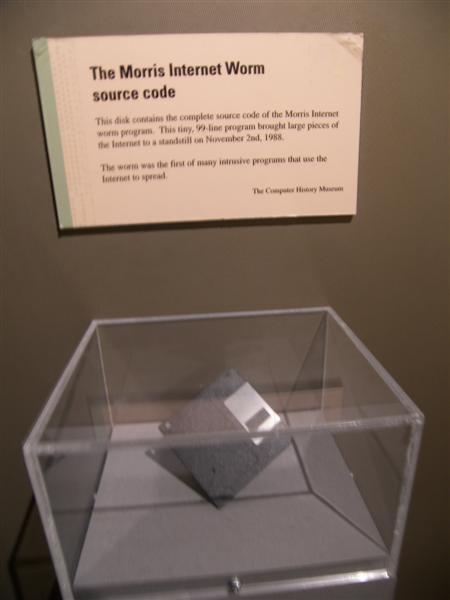 |
| Disc containing Morris Code at Museum of Science |
"Morris sought to program the Internet worm to spread widely without drawing attention to itself. The worm was supposed to occupy little computer operation time, and thus not interfere with normal use of the computers. Morris programmed the worm to make it difficult to detect and read, so that other programmers would not be able to "kill" the worm easily. Morris also wanted to ensure that the worm did not copy itself onto a computer that already had a copy. Multiple copies of the worm on a computer would make the worm easier to detect and would bog down the system and ultimately cause the computer to crash. Therefore, Morris designed the worm to "ask" each computer whether it already had a copy of the worm. If it responded "no," then the worm would copy onto the computer; if it responded "yes," the worm would not duplicate. However, Morris was concerned that other programmers could kill the worm by programming their own computers to falsely respond "yes" to the question. To circumvent this protection, Morris programmed the worm to duplicate itself every seventh time it received a "yes" response. As it turned out, Morris underestimated the number of times a computer would be asked the question, and his one-out-of-seven ratio resulted in far more copying than he had anticipated. The worm was also designed so that it would be killed when a computer was shut down, an event that typically occurs once every week or two. This would have prevented the worm from accumulating on one computer, had Morris correctly estimated the likely rate of reinfection.
"Morris identified four ways in which the worm could break into computers on the network: (1) through a "hole" or "bug" (an error) in SEND MAIL, a computer program that transfers and receives electronic mail on a computer; (2) through a bug in the "finger demon" program, a program that permits a person to obtain limited information about the users of another computer; (3) through the "trusted hosts" feature, which permits a user with certain privileges on one computer to have equivalent privileges on another computer without using a password; and (4) through a program of password guessing, whereby various combinations of letters are tried out in rapid sequence in the hope that one will be an authorized user's password, which is entered to permit whatever level of activity that user is authorized to perform.
"On November 2, 1988, Morris released the worm from a computer at the Massachusetts Institute of Technology. MIT was selected to disguise the fact that the worm came from Morris at Cornell. Morris soon discovered that the worm was replicating and reinfecting machines at a much faster rate than he had anticipated. Ultimately, many machines at locations around the country either crashed or became "catatonic." When Morris realized what was happening, he contacted a friend at Harvard to discuss a solution. Eventually, they sent an anonymous message from Harvard over the network, instructing programmers how to kill the worm and prevent reinfection. However, because the network route was clogged, this message did not get through until it was too late. Computers were affected at numerous installations, including leading universities, military sites, and medical research facilities. The estimated cost of dealing with the worm at each installation ranged from $200 to more than $53,000.
"Morris was found guilty, following a jury trial, of violating 18 U.S.C. Section 1030(a)(5)(A). He was sentenced to three years of probation, 400 hours of community service, a fine of $10,050, and the costs of his supervision."
- U.S. v. Morris, 928 F.2d 504 (2nd Cir. 1991)
Postlude
The Morris Worm also resulted in the creation of multiple new federal projects such as CERT with the mission of researching, thwarting, and alerting the network to new possible threats.
Robert Morris is reportedly a professor at MIT.
Wednesday, July 12, 2017
1962 :: July 12 :: Telstar Satellite Launched
July 12, 1962: The Day Information Went Global, NASA
"Telstar was launched by NASA on July 10, 1962, from Cape Canaveral, Fla., and was the first privately sponsored space-faring mission. Two days later, it relayed the world's first transatlantic television signal, from Andover Earth Station, Maine, to the Pleumeur-Bodou Telecom Center, Brittany, France.
"Developed by Bell Telephone Laboratories for AT&T, Telstar was the world's first active communications satellite and the world's first commercial payload in space. It demonstrated the feasibility of transmitting information via satellite, gained experience in satellite tracking and studied the effect of Van Allen radiation belts on satellite design. The satellite was spin-stabilized to maintain its desired orientation in space. Power to its onboard equipment was provided by a solar array, in conjunction with a battery back-up system.
"Although operational for only a few months and relaying television signals of a brief duration, Telstar immediately captured the imagination of the world. The first images, those of President John F. Kennedy and of singer Yves Montand from France, along with clips of sporting events, images of the American flag waving in the breeze and a still image of Mount Rushmore, were precursors of the global communications that today are mostly taken for granted.
"Telstar operated in a low-Earth orbit and was tracked by the ground stations in Maine and France. Each ground station had a large microwave antenna mounted on bearings, to permit tracking the satellite during the approximately half-hour period of each orbit when it was overhead. The signals from Telstar were received and amplified by a low-noise "maser" (Microwave Amplification by Stimulated Emission of Radiation), the predecessor of the modern laser. After demonstrating the feasibility of the concept, subsequent communications satellites adopted a much higher orbit, at 22,300 miles above the Earth, at which the satellite's speed matched the Earth's rotation and thus appeared fixed in the sky. During the course of its operational lifespan, Telstar 1 facilitated over 400 telephone, telegraph, facsimile and television transmissions. It operated until November 1962, when its on-board electronics failed due to the effects of radiation."
"Telstar was launched by NASA on July 10, 1962, from Cape Canaveral, Fla., and was the first privately sponsored space-faring mission. Two days later, it relayed the world's first transatlantic television signal, from Andover Earth Station, Maine, to the Pleumeur-Bodou Telecom Center, Brittany, France.
"Developed by Bell Telephone Laboratories for AT&T, Telstar was the world's first active communications satellite and the world's first commercial payload in space. It demonstrated the feasibility of transmitting information via satellite, gained experience in satellite tracking and studied the effect of Van Allen radiation belts on satellite design. The satellite was spin-stabilized to maintain its desired orientation in space. Power to its onboard equipment was provided by a solar array, in conjunction with a battery back-up system.
"Although operational for only a few months and relaying television signals of a brief duration, Telstar immediately captured the imagination of the world. The first images, those of President John F. Kennedy and of singer Yves Montand from France, along with clips of sporting events, images of the American flag waving in the breeze and a still image of Mount Rushmore, were precursors of the global communications that today are mostly taken for granted.
"Telstar operated in a low-Earth orbit and was tracked by the ground stations in Maine and France. Each ground station had a large microwave antenna mounted on bearings, to permit tracking the satellite during the approximately half-hour period of each orbit when it was overhead. The signals from Telstar were received and amplified by a low-noise "maser" (Microwave Amplification by Stimulated Emission of Radiation), the predecessor of the modern laser. After demonstrating the feasibility of the concept, subsequent communications satellites adopted a much higher orbit, at 22,300 miles above the Earth, at which the satellite's speed matched the Earth's rotation and thus appeared fixed in the sky. During the course of its operational lifespan, Telstar 1 facilitated over 400 telephone, telegraph, facsimile and television transmissions. It operated until November 1962, when its on-board electronics failed due to the effects of radiation."
Sunday, April 30, 2017
1995 :: April 30 :: NSFNET Decommissioned
April 30th, 1995 marked the end of the wildly successful NSFNET. NSFNET was born out of the desire to expand the Internet community beyond a Department of Defense playground, extending it to the full academic community. It ended with the successful privatization of the Internet, transferring backbone services to commercial networks, and establishing key commercial Internet interconnection sites.
NSFNET gave us the early commercial topology of the Internet, with Tier 1 backbones, Tier 2 regional networks, and Tier 3 local networks. NSFNET gave us our first dedicated backbone and the first mbps backbone. It also gave us the crucial Network Access Points, known today as Internet eXchange Points. The contractors that bid for the opportunity to build and operate NSF's network learned from their experience and launched into the information economy as the leading commercial Internet networks. A government investment of millions of dollars had a Return on Investment of an entire new economy.
 In 1995, MERIT published the NSFNET Final Report, in which it was stated:
NSFNET gave us the early commercial topology of the Internet, with Tier 1 backbones, Tier 2 regional networks, and Tier 3 local networks. NSFNET gave us our first dedicated backbone and the first mbps backbone. It also gave us the crucial Network Access Points, known today as Internet eXchange Points. The contractors that bid for the opportunity to build and operate NSF's network learned from their experience and launched into the information economy as the leading commercial Internet networks. A government investment of millions of dollars had a Return on Investment of an entire new economy.

"Infrastructures, for purposes such as transportation and communication, have long been vital to national welfare. They knit together a country's economy by facilitating the movement of people, products, services, and ideas, and play important roles in national security." p. 4.The report concluded:
"Since the earliest days of the telegraph and the telephone, history tells us that the arrival of each new communications medium has been accompanied by grandiose claims of its potential benefits to society. In order to take advantage of the exciting opportunities afforded by today's technology, it is imperative that policy makers examine the development of the NSFNET and the Internet. We are still far away from a truly open, interoperable, and ubiquitous global information infrastructure accessible to all, "from everyone in every place to everyone in every other place, a system as universal and as extensive as the highway system of the country which extends from every man's door to every other man's door," in the words of Theodore Vail, president of AT&T in 1907. However, the Internet has brought us a giant step closer to realizing the promise of high-speed networking, one of the most revolutionary communications technologies ever created. As part of this phenomenon, the NSFNET backbone service provided a model for future partnerships as well as a legacy of technology for the world." p. 43.
Sunday, April 23, 2017
Wednesday, March 29, 2017
1929 :: March 29 :: Pres. Herbert Hoover Installs First Telephone in the Oval Office
While the first telephone was installed in the White House in 1877, it was not until 1929 for the first telephone to be installed on the President's desk in the Oval Office.
 |
| Presidential Library :: Pres. Herbert Hoover with First Telephone |
Tuesday, January 24, 2017
Monday, January 09, 2017
Sunday, January 08, 2017
1982 :: Jan. 4 :: US Postal Service Launches ECOM, its Email Service
The time was 1977. The country is in a tailspin. Saturday Night Live is singing carols about killing Gary Gilmore for Christmas. President Carter takes the Oval Office and pardons Vietnam War draft evaders. The Clash releases their debut album. And the USPS is scared.
The USPS has learned about this thing called electronic mail and electronic transactions. It occurs to the USPS that if everyone were to use these electronic thingies, First Class mail would get wiped out and so would all that revenue.
While there is disagreement on how fast EMS and EFT may develop, it seems clear that two-thirds or more of current mainstream could be handled electronically, and that the volume of USPS - delivered mail is likely to peak in the next 10 years. Any decline in the volume of mail has significant implications for future postal rates, USPS service levels, and labor requirements.
A key policy issue requiring congressional attention is how USPS will participate in the provision of EMS services, both in the near term and in the longer term. If USPS does not attract and keep a sizable share of the so-called Generation II EMS market (electronic input and transmission with hardcopy output) and conventional (especially first-class) mail volume declines, USPS revenues will probably go down, with the likelihood of an unfavorable impact on rates and/or service levels. If USPS does develop a major role in the Generation II EMS market, and if Generation II EMS costs are low enough, the effect on USPS rates and/or service could be favorable. [USPS, p. ix, 1982]
After some careful strategic planning, the USPS launched an attack on email with a classic pincer movement: on the left flank, the USPS initiated its own email service known as E-COM on January 4, 1982; [USPS, p. 3 1982] [USPS 2008] on the right flank, the USPS considered banning all private email service.
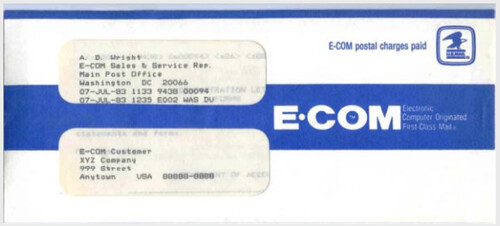
E-COM was a simple concept. The USPS would set up a network where a message would originate electronically. It would then be sent to one of a handful of participating postal offices that had terminals, where it would be printed out.
After arriving at the serving Post Office, the messages were processed and sorted by ZIP Code, then printed on letter-size bond paper, folded, and sealed in envelopes printed with a blue E-COM logo. [USPS 2008]
The hard copy of the message would then be delivered to its destination - essentially in the same manner and with the same speed as first class mail. [ECPA 1985 Report p 45] [USPS, p. 3 1982 (stating that the service was initiated January 1982)]
Before E-COM could get off the ground, it was mired in controversy. [CATO] [USPS, p. 3 1982] The US Postal Commission, the Department of Justice, the Department of Commerce, private companies, and even the FCC, objected. The first objection was that it was against government policy for a government agency to compete with the private sector. [USPS p. 17 1982] Private commercial email services were nascent and promising, and did not think much of a government monopoly using its government bank role to pay for a competing email service. The FCC said, "we have jurisdiction over all wireline and wireless services. That jurisdiction has been interpreted broadly. And there is no dispute that the transmission of a message over a communications network is communications, under the Communications Act, and under our jurisdiction." "Not only that," the FCC was heard to say, "but its common carriage." The FCC stated:
With respect to the relevant judicial decisions defining the nature of common carriage, we note that none of the parties to this proceeding appears to dispute that ECOM service would constitute a common carrier offering if it were to be provided by an entity other than the Postal Service. We also conclude independently that ECOM is a quasi-public offering of a for-profit service which affords the public an opportunity to transmit messages of its own design and choosing. Based on those judicially defined criteria, we find that, in offering ECOM, the Postal Service is engaging in a common carrier activity.
[In re Request for declaratory ruling and investigation by Graphnet Systems, Inc., concerning the proposed E-COM service, FCC Docket No. 79-6 (Sept 4, 1979)] In other words, before E-COM could get launched, the FCC said, "if you are going to do this, then you are under our jurisdiction, and you are going to have to file a tariff for the offering of your common carriage service." The FCC said that email, whether from the USPS or privately offered, is a form of common carriage - they don't say that anymore.
The USPS would not accept "no" for an answer, tinkered with its network in order to weasel out of FCC jurisdiction, and launched E-COM in 1982. A message was priced at 26¢ - and for each email message, the USPS was said to lose around $5 [CATO]. They had apparently estimated that the service would be a raging success; it was not and, with the low message volume, the cost per message was rather high. If you used the service, you had to send at minimum 200 messages. [USPS 2008] The service was one directional; if you got an error message, you would receive it in the mail two days later. When the E-COM messages were printed out, it would take two days more to be delivered. And it cost the same as First Class mail.
In fiscal year 1984, 23 million E-COM messages were sent. E-COM service had 1,046 certified customers, 528 of whom were communication carriers. That year, the Postal Rate Commission responded to the Postal Service's 1983 request for a 31-cent rate for the first page by recommending a rate of 52 cents for the first page and 15 cents for the second page of E-COM messages. The Governors of the Postal Service, who decide rates and postal policies but can overrule a Postal Rate Commission decision only by a unanimous vote, rejected the Commission's recommended decision and asked for reconsideration. The Commission responded in June with a recommendation of a 49-cent rate for the first page and 14 cents for the second page. The Governors rejected these rates as well, essentially because they priced E-COM out the market, and recommended that the Postal Service dispose of the E-COM system by sale or lease to a private firm or firms. [USPS 2008]For some reason, E-COM was a failure (one Senator called it a turkey). On September 3, 1985, three years after service was initiated, USPS terminated the service and tried to sell it off. [Aide p 8] [ECPA Report 1985 p 46] [USPS 2008]
Sunday, January 01, 2017
1984 :: Jan. 1 :: Breakup of Ma Bell
MCI was an innovative long distance company that radicalized the telecommunications market. Started in the 1960s, the business plan was to use radio licenses to provide long distance service between Chicago and St. Louis. MCI's application to provide service was approved by the FCC in 1969. But AT&T and the BOCs didn't like this much, and refused to interconnect with MCI. MCI had difficulty negotiating interconnection with AT&T, hired special counsel skilled in negotiations, and brought the issue before the FCC. In 1973, AT&T threw a curveball by filing interconnection tarriffs in 49 state PUCs, transforming MCI's transaction costs from one interconnection agreement, to 49 different agreements in each jurisdiction. In 1974, AT&T disconnected MCI. Finally, frustrated, in 1974, MCI, along with the Department of Justice, filed an antitrust suit against AT&T. On June 13th, 1980, the Court ruled in favor of MCI, awarding MCI $1.8 billion in damages. Two years later, AT&T would negotiate with DOJ the resolution of their antitrust lawsuit, agreeing to the breakup of the Bell System. The terms of Consent Decree, breaking AT&T up into AT&T long distance and seven Regional Bell Operating Companies, went into effect Jan. 1, 1984.
Scholars have noted that the legal battle with AT&T cost $10m, whereas construction of the network cost $2m. Sterling, Bernt, Weiss, Shaping American Telecommunications, p.133 (2006) According to lore, MCI had more lawyers than land lines. It became known as "a law firm with an antenna on the roof." In 2005, one of the Regional Bell Operating Companies, SBC, would acquire AT&T Long Distance, and emerge from the ashes as a reborn AT&T.
MCI v. AT&T, 708 F.2d 1081 (7th Cir. 1983) recounts the history of the conflict between the two telecommunications services.
Friday, December 09, 2016
1968 :: Dec. 9 :: Douglas Engelbart :: The Mother of All Demos
"The Mother of All Demos is a name given retrospectively to Douglas Engelbart's December 9, 1968, demonstration of experimental computer technologies that are now commonplace. The live demonstration featured the introduction of the computer mouse, video conferencing, teleconferencing, hypertext, word processing, hypermedia, object addressing and dynamic file linking, bootstrapping, and a collaborative real-time editor."
Wednesday, November 02, 2016
1998, Nov. 2: Morris Worm Unleashed on Internet
"In the fall of 1988, Morris was a first-year
graduate student in Cornell University's computer science Ph.D.
program. Through undergraduate work at Harvard and in various jobs he
had acquired significant computer experience and expertise. When Morris
entered Cornell, he was given an account on the computer at the
Computer Science Division. This account gave him explicit authorization
to use computers at Cornell. Morris engaged in various discussions
with fellow graduate students about the security of computer networks
and his ability to penetrate it.
 Morris Internet Worm Source Code by Go Boston Card |
"Morris sought to program the Internet worm to spread widely without drawing attention to itself. The worm was supposed to occupy little computer operation time, and thus not interfere with normal use of the computers. Morris programmed the worm to make it difficult to detect and read, so that other programmers would not be able to "kill" the worm easily. Morris also wanted to ensure that the worm did not copy itself onto a computer that already had a copy. Multiple copies of the worm on a computer would make the worm easier to detect and would bog down the system and ultimately cause the computer to crash. Therefore, Morris designed the worm to "ask" each computer whether it already had a copy of the worm. If it responded "no," then the worm would copy onto the computer; if it responded "yes," the worm would not duplicate. However, Morris was concerned that other programmers could kill the worm by programming their own computers to falsely respond "yes" to the question. To circumvent this protection, Morris programmed the worm to duplicate itself every seventh time it received a "yes" response. As it turned out, Morris underestimated the number of times a computer would be asked the question, and his one-out-of-seven ratio resulted in far more copying than he had anticipated. The worm was also designed so that it would be killed when a computer was shut down, an event that typically occurs once every week or two. This would have prevented the worm from accumulating on one computer, had Morris correctly estimated the likely rate of reinfection.
"Morris identified four ways in which the worm could break into computers on the network: (1) through a "hole" or "bug" (an error) in SEND MAIL, a computer program that transfers and receives electronic mail on a computer; (2) through a bug in the "finger demon" program, a program that permits a person to obtain limited information about the users of another computer; (3) through the "trusted hosts" feature, which permits a user with certain privileges on one computer to have equivalent privileges on another computer without using a password; and (4) through a program of password guessing, whereby various combinations of letters are tried out in rapid sequence in the hope that one will be an authorized user's password, which is entered to permit whatever level of activity that user is authorized to perform.
"On November 2, 1988, Morris released the worm from a computer at the Massachusetts Institute of Technology. MIT was selected to disguise the fact that the worm came from Morris at Cornell. Morris soon discovered that the worm was replicating and reinfecting machines at a much faster rate than he had anticipated. Ultimately, many machines at locations around the country either crashed or became "catatonic." When Morris realized what was happening, he contacted a friend at Harvard to discuss a solution. Eventually, they sent an anonymous message from Harvard over the network, instructing programmers how to kill the worm and prevent reinfection. However, because the network route was clogged, this message did not get through until it was too late. Computers were affected at numerous installations, including leading universities, military sites, and medical research facilities. The estimated cost of dealing with the worm at each installation ranged from $200 to more than $53,000.
"Morris was found guilty, following a jury trial, of violating 18 U.S.C. Section 1030(a)(5)(A). He was sentenced to three years of probation, 400 hours of community service, a fine of $10,050, and the costs of his supervision."
- U.S. v. Morris, 928 F.2d 504 (2nd Cir. 1991)
See more at Cybertelecom :: Morris Worm
Monday, October 24, 2016
Tuesday, September 13, 2016
Tuesday, August 09, 2016
August 9, 1995 :: Netscape IPOs and the Dot Com Bubble is in its infancy
The shadow of the the insanity to come, on August 9th, Netscape exploded out of the gates with its IPO.
WikipediaOn August 9, 1995, Netscape made an extremely successful IPO. The stock was set to be offered at US$14 per share, but a last-minute decision doubled the initial offering to US$28 per share. The stock's value soared to US$75 during the first day of trading, nearly a record for first-day gain. The stock closed at US$58.25, which gave Netscape a market value of US$2.9 billion. While it was unusual for a company to go public prior to becoming profitable, Netscape's revenues had, in fact, doubled every quarter in 1995. The success of this IPO subsequently inspired the use of the term "Netscape moment" to describe a high-visibility IPO that signals the dawn of a new industry.
Mozilla Mascot


Saturday, August 06, 2016
August 6, 1991 :: Sir Tim Berners Lee Releases the World Wide Web
The Internet had been created back in the 1960s to foster sharing amongst academic institutions doing cool things at the edge of the network. It was designed to share information, research, and computer resources.
It was doing a sucky job of it. Well, I mean, not really. The Internet was an explosive success in the academic community. But sharing information generally meant accessing it by FTP or searching for stuff with search engines named Archie and Veronica.
Tim Berners Lee had a better mouse trap. Using hyperlinking and a user interface, he would create a simple application that would present information and link to any other information that happened to be relevant.
On August 6th, 1991, in an online chat room, Tim Berners Lee announced the release of the World Wide Web application and linked to the First web page at Info.cern.ch
 | ||
| Sir Tim Berners Lee |
Tim Berners Lee had a better mouse trap. Using hyperlinking and a user interface, he would create a simple application that would present information and link to any other information that happened to be relevant.
The system had to have one other fundamental property: It had to be completely decentralized. That would be the only way a new person somewhere could start to use it without asking for access from anyone else. And that would be the only way the system could scale, so that as more people used it, it wouldn't get bogged down. This was good Internet-style engineering, but most systems still depended on some central node to which everything had to be connected - and whose capacity eventually limited the growth of the system as a whole. I wanted the act of adding a new link to be trivial; if it was, then a web of links could spread evenly across the globe.Tim Berners-Lee, Weaving the Web, p15-16 (Harper Business 2000)
On August 6th, 1991, in an online chat room, Tim Berners Lee announced the release of the World Wide Web application and linked to the First web page at Info.cern.ch
Subscribe to:
Posts (Atom)