Showing posts with label jurisdiction. Show all posts

Monday, March 20, 2017

In Which I Get Another Excuse to Babble About the "Enhanced Service" / "Telecom Service" Dichotomy :: FTC v. American eVoice

Time to brush the dust off your Computer II notebooks.  Are voicemail, electronic fax, and call forwarding enhanced services or telecom services?

Today's case: FTC v. American eVoice, Ltd, et al, CV-13-03-M-DLC (DC Montana Mar. 14, 2017). See also Stipulated Permanent Injunction.

The FTC brought an action against Defendants claiming that they were engaged in cramming, adding unwanted voicemail, electronic fax, and call forwarding services to consumers bills to the tune of $70 million. Slip at 3. The FTC concluded that this was a violation of Sec. 5 of the FTC Act, which prohibits "unfair or deceptive acts or practices in or affecting commerce." Slip at 3.


Defendants filed a motion to dismiss, arguing that they are common carriers and therefore exempt from FTC jurisdiction. This argument had been successful recently. In FTC v. ATT Mobility (9th Cir. Aug. 2016), the FTC had brought an action against ATT Mobility for data throttling (before the FCC's Open Internet order declaring Internet access service a telecommunications service). The 9th Circuit found that ATT Mobility had the status of a common carrier, therefore the FTC lacked jurisdiction over ATT Mobility. Specifically, Sec. 5 states that the FTC lacks jurisdiction over "common carriers subject to the Acts to regulate commerce."  The term "common carrier" is not defined in Sec. 5. The 9th Circuit conducted an extensive review, concluding that the language applied generally to firms that have the status of being a common carrier, and not specifically only to actions that constitute the provision of common carriage.  In other words, according to the holding of the 9th Circuit, the FTC lacks jurisdiction over ATT Mobility even if ATT Mobility is selling hot dogs out of a push cart because ATT Mobility has the status of common carriage for some other part of its business.

So are Defendants in the case at hand "common carriers" or not?

The Court cites to Computer II authority, for which it gets my thumbs up. But of course Computer II has been superseded by the Telecommunications Act of 1996 which codified definitions for an "information service" (a.k.a. "enhanced services") and a "telecom service." An "Information Service" is
the offering of a capability for generating, acquiring, storing, transforming, processing, retrieving, utilizing, or making available information via telecommunications, and includes electronic publishing... - 47 U.S.C. § 153(20)
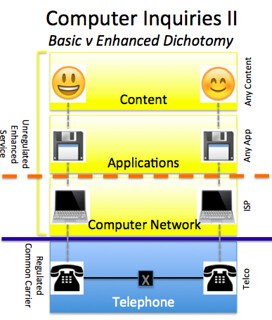
By contrast, a "telecom service"
means the offering of telecommunications for a fee directly to the public 47 U.S.C. § 153(53)
And of course, "telecommunications"
means the transmission, between or among points specified by the user, of information of the user’s choosing, without change in the form or content of the information as sent and received. 47 U.S.C. § 153(50)
As the court states, telecom service is essentially a pipeline. It is the transmission layer of the communications service. It pretty much is someone saying "hi grandma" into a telephone network and "hi grandma" comes out the other end.

Anything more than that is an "information service." This is a bright line test. If "hi grandma" is spoken into the network and "Bonjour Grand-mère" comes out the other end of the network, you gots yourself "a change in the form or content of the information" sent.

The FCC and the courts have been deciphering the distinction between "information services" and "telecommunications services" for more than half a century. There is a bit of precedent here. What we know, according to the court, is that defendants offered "voicemail, electronic fax, and call forwarding." Have previous courts and the FCC passed on whether these are "information services"? Yes they have.


Service
Classification
Authority
Voicemail Information Service CPE Order 2001 ¶ 2; FWD MOOStevens Report, ¶ 73; BOC Petition Order 13770-774, App. A; Computer II Final Decision, ¶ 98; In re Southwestern Bell CEI Plan for the Provision of Voice Messaging Services, DA 88-1469, Memorandum Opinion and Order, 3 FCC Rcd. 6912, 65 Rad. Reg. 2d (PF) 527,  1 (September 29, 1988); Petition USTelecom2013 ¶ 20; Computer III Further NPRM 1998 ¶ 1
Electronic Fax Information Service (actually, the court does not describe what 'electronic fax' is so I am not 100% confident but....) :: Computer III Further NPRM 1998 ¶ 1; Review of Customer Premises Equipment and Enhanced Services Unbundling Rules in the Interexchange, Exchange Access and Local Exchange Markets, CC Docket No. 98-183, Further Notice of Proposed Rulemaking, para 1, n. 20 (October 9, 1998); MOO, Bell Operating Companies Joint Petition for Waiver of Computer II Rules, DA 95-36, 10 FCC Rcd 1724 n.3, 1995 FCC LEXIS 217 **2 (Jan 1995)
Call Forwarding Telecom Service Stevens Report, ¶ 73; Computer II Final Decision, ¶ 98

Whoops. That did not go as planned. "Call Forwarding" is a "Telecom Service"?? According to Computer II
We indicated that 'computer processing applications such as call forwarding, speed calling, directory assistance, itemized billing, traffic management studies, voice encryption, etc., may be used in conjunction with 'voice' service.'  The intent was to recognize that while POTS is a basic service, there are ancillary services [a.k.a. adjunct services] directly related to its provision that do not raise questions about the fundamental communications or data processing nature of a given service. Accordingly, we are not here foreclosing telephone companies from providing to consumers optional services to facilitate their use of traditional telephone service. - Computer II Final Decision, ¶ 98. 
Ah! So now we have to introduce one more concept: adjunct services. According to the FCC, adjunct services are services that may involve something that looks like an information service but facilitates the operation of the telecommunications service. Adjunct services take on the regulatory classification of the facilitated telecom service. Here is a simple example. If you call directory assistance to get a telephone number so that you can make a call, that's an adjunct service and therefore a telecom service. If however you call directory assistance with a reverse lookup, querying with a telephone number and asking for the name, that is an information service because that reverse lookup does not facilitate the operation of the telecom service (you already have the telephone number; getting the name doesn't help set up the call).

The policy behind this exception was that telecom services like ATT and the Baby Bells were prohibited from providing information services pursuant to the 1956 Consent Decree. The FCC wanted ATT to be able to offer services that facilitated operation of the telecommunications service - things like directory assistance, call forwarding, speed dialing, and caller ID. So the FCC classified these very telephone-like things as "adjunct-to-basic" services. The Telecommunications Act codified this as the Telecom Management Exception.

But an adjunct service must be adjunct to something. An adjunct service that is adjunct to nothing - this has no meaning. If ATT offers call forwarding, then this 'enhancement' facilitates the use of ATT's telecom service and therefore takes on the regulatory classification of ATT's telecom service (in other words, the "information service prohibition" would not have blocked ATT Mobility from offering this service). However, a company that just offers call forwarding but does not also offer a telecom service wasn't prohibited from offering information service in the first place and cannot offer an adjunct service to a non-existent telecom service. Thus, a stand-alone enhancement like call forwarding falls within the "information service" bucket and not the "adjunct service therefore telecom service" bucket. 

According to the court, "there is no evidence before the Court that the corporate Defendants operated a transmission pipeline" [a.k.a. telecom service]. Slip at 10. Unlike ATT Mobility which had the status of "common carrier" because some part of that company offers common carrier service (even though other parts of the company do not), no part of Defendants companies were found to offer "telecom service," thus Defendants do not fall within the FTC exception to jurisdiction over common carriers.

Oh, by the way, the Court noted a further problem with Defendants' claim to be "common carriers." According to the Court, they had not registered with the FCC as common carriers; they had not named an agent for service of process as a common carrier; they made no showing that they complied with common carrier obligations like paying into the universal fund. Slip at 11. Adding to the jurisprudence of the Duck Test, the Court concluded that these Defendants don't quack like a duck.

Defendants' Motion to Dismiss on the grounds that Defendants are common carriers outside the jurisdiction of the FTC dismissed.

Sunday, October 02, 2016

Ancillary Jurisdiction

The Communications Act of 1934 gives the Federal Communications Commission jurisdiction over interstate wireline and radio communications. For example, Title II of the Act gives the FCC jurisdiction over telecommunications services. Title III gives the FCC jurisdiction over wireless services.

But communications evolve, and by-and-by the FCC confronts a question not anticipated by the Communications Act. Nascent innovations storm the market and present policy issues prior to Congressional action. The classic example of this is the introduction of CableTV, placing a broadcast signal on a cable and bringing it over the mountain to a community that could not otherwise get reception. There was no Cable Act giving the Commission authority to act. Nevertheless, the FCC promulgated regulations which addressed the geographic footprints of cable TV networks. The Supreme Court upheld the FCC's exercise of jurisdiction, finding that it was reasonably ancillary to the agency's jurisdiction over broadcast TV.

The reach of the Commission's ancillary jurisdiction is not unbounded. While courts have recognized that the Communications Act grants the FCC broad authority, the Commission cannot use ancillary authority to justify anything. According to the courts,
"The Commission . . . may exercise ancillary jurisdiction only when two conditions are satisfied:
(1) the Commission's general jurisdictional grant under Title I [of the Communications Act] covers the regulated subject and 

(2) the regulations are reasonably ancillary to the Commission's effective performance of its statutorily mandated responsibilities."
It has to be interstate communications and it has to be ancillary to something (ancillary to a mere policy statement is insufficient). The FCC exercising jurisdiction over cable TV as ancillary to its Broadcast TV authority - sure, that is sound. But the courts, expressing anxiety that the FCC has no more authority than that which Congress grants it, gets jittering on the boundary of clearly articulated expressions of authority. The further astray the FCC acts from expressed statutory authority, the more anxiety is expressed by the courts. Where it is clear that the FCC is filling in gaps not anticipated by Congress, and which fulfill its mandate for promoting interstate communications, the Courts have tended towards affirming that authority. Where the FCC strains to tie its actions to expressed authority, however, the courts have stated that ancillary jurisdiction is not "unbounded."

Ancillary Jurisdiction
No Ancillary Jurisdiction
  • CableTV: regulation of geographic footprint of cable TV service ancillary to jurisdiction over broadcast TV
  • CableTV: cable TV requirement of creation of original programming ancillary to jurisdiction over broadcast TV
  • Enhanced Service Providers (Internet): Computer Inquiries safeguards ancillary to jurisdiction over telecom service
  • Universal Service: creation of universal service fund ancillary to title II authority to set reasonable interstate telephone rates
  • CableTV: regulations that required cable systems to make certain channels available for public use not ancillary to broadcast TV authority
  • Broadcast Flag: jurisdiction over broadcast flag to protect copyright is post-transmission and not ancillary to FCC authority
  • Broadband Internet Access Service: jurisdiction over BIAS cannot be ancillary to a policy statement


Sunday, July 10, 2016

Internet Means the Death of Borders :: Elvis is Everywhere :: #Nope

In the era of exceptionalism, the Internet was proclaimed as the death of borders.  Kinda like Elvis, the Internet was everywhere all the time.  Plaintiffs' lawyers heard that - and figured that meant any court had jurisdiction over any website ~ because that website was virtually in that jurisdiction.

The courts found the borders; they did not have jurisdiction over any website.

Okay, the facts on this one are straight forward.  Let's got to the video tape: Plaintiffs sell clothes.  Plaintiffs claims that Defendants (all 3343 of them), who are like in China, "sell counterfeit products that violate Plaintiffs' intellectual property rights . . . to consumers within the United States."  Plaintiffs sued in Illinois.

Jumping over a lot in the court's decision to get to the interesting stuff, there was just not a lot alleged that connected defendants to Illinois other than that they had websites.

So, over an individual defendant,  as a rule, a court has your general jurisdiction and your specific jurisdiction.  

As for general jurisdiction, the court sez:
[T]he exercise of personal jurisdiction here is based exclusively upon Defendants' alleged maintenance of interactive websites. Without more (and there is not more here), this fact alone is not enough to support general personal jurisdiction.  See, e.g., Richter v. INSTAR Enterprises Int'l, Inc., 594 F. Supp. 2d 1000, 1009 (N.D. Ill. 2009) ("[R]egardless how interactive a website is, it cannot form the basis for [general] personal jurisdiction . . . unless the contacts through the website are so substantial that they may be considered `systematic and continuous' for the purpose of general jurisdiction."); Euromarket Designs, Inc. v. Crate & Barrel Ltd., 96 F. Supp. 2d 824, 833 (N.D. Ill. 2000) ("Generally, the defendant's mere maintenance of an Internet website is not sufficient activity to exercise general jurisdiction over the defendant.").
As for specific jurisdiction, this means that the defendant had specific transactions and presence within the jurisdiction.  Plaintiffs said that each of the defendants transacted business in Illinois.  A few of the defendants surfaced and said... "um, no we didnt (and by the way, we are Irish not Chinese)."  The court said
jurisdictional allegations are accepted as true, but if a defendant submits evidence in opposition to the exercise of jurisdiction, plaintiff must go beyond the pleadings and submit affirmative evidence to support it) (citing Purdue Research Foundation v. Sonofi-Synthelabo, S.A., 338 F.3d 773, 782-83 (7th Cir. 2003)). Plaintiffs did not provide such evidence
Then plaintiffs' counsel flops back and argued "that he believed personal jurisdiction was proper as to all 3,343 defendants solely because they operated interactive websites that displayed copyrighted images and infringed Plaintiffs' trademarks."

To quote the court, "yeah.... no." Following plaintiffs logic, the court said, "personal jurisdiction would automatically exist in every state and presumably every country."  The court cited two cases where the court indeed found jurisdictions over websites, but the finding of specific jurisdiction was premised on evidence that defendants had in fact transacted business in Illinois. Monster Energy, 136 F.Supp. 3d at 902. State of Illinois v. Hemi Group LLC, 622 F.3d 754 (7th Cir. 2010). "In this case, however, Plaintiffs have not made such a showing. They provided no facts to show that any of the defendants named in the complaint aimed any action at Illinois."

The Internet is not borderless; Elvis is not everywhere.

American Bridal & Prom Industry v a bunch of defendants, NDILL June 29, 2016

Wednesday, September 19, 2007

The Sliding Scale Jurisdiction Test : Sliding toward Jurisdiction : Crummey v. Morgan, et al, 2007 CW 0087 (LA App 1st Cir. Aug. 8 2007)


Judges face hard choices. Do they rule in favor of a defendant or do they rule in favor of a plaintiff. Sometimes the law is well settled, and the role of Judge is easy; just follow precedent (in other words, just decide the same way every judge has before). Sometimes old law confronts new facts that confound judges. When adrift in a sea of uncertainty, judges reach deep in their armory of judicial tools and pull out old faithful: the sliding scale.

Sliding scales help sort out uncertainty. On the one extreme of the slide, cases go one way. On the other extreme, cases go the other way. In the middle, differing factual scenarios are resolved on a case-by-case basis. In other words, the judges fudge it, doing their best to see which way the facts tip – and then the decision slides to the outcome. Another way to describe this is that the judge must balance the differing factors and determine whether on the whole the facts weigh in favor of one party over another. The sea of uncertainty is gray and fuzzy.

When the sliding scale works, time gives the judiciary the opportunity to hammer out differing factual scenarios and create well settled precedent. When the sliding scale tumbles, there is little guidance, and the judiciary becomes overwhelmed with parties seeking elucidation of their predicament. See FCC Computer I.

Jurisdiction in Internet litigation is one of those seas of uncertainties. Old law resolves whether a person in one state can sue another person in another state. As articulated in the classic case International Shoe v Washington, a defendant Beta must have certain minimum contacts with the state Alpha in order to be haled into court in the state of Alpha. In applying this well settled law, the court asks questions such as whether the defendant from Beta purposefully availed itself of the privilege of conducting business in the state of Alpha and invoked the benefits of doing business in Alpha. This purposeful availment of Alpha must be of a nature that the defendant could reasonably be expected to be haled into court in Alpha.

Now comes a tsunami in the sea of uncertainty. If a party goes online, their activity online is accessible to any willing plaintiff anywhere. If I blog, can I really anticipate getting haled into court in Demoine? If I sell 1000 hockey T Shirts to Georgia, have I established minimum contacts with George? What if I sell one T Shirt on eBay to Louisiana?

Faced with this conundrum, the judiciary has created a sliding scale. At the one end of this scale is purely passive sites which simply provide information and offer no level of interactivity (and if you can find any of these “purely passive” sites any more, it belongs in a museum). At the other end of the scale is the fully interactive site such as an ecommerce site where the visitor can interact with an inventory, establish a relationship with the website’s company, purchase goods and services, find the status of those goods pending delivery, and provide a review of how good the product was. In between we have the fudge. If I set up an ecommerce business and sell 1 million books to Salem, Massachusetts, seems like I am purposefully availing myself of that jurisdiction. But if I put up one book for sale for whoever wants it on Craiglist, did I really intend to do business with puritans? The sliding scale is in place because there is a certain degree of ambiguity involved.

According a Louisiana Appellate Court, the analysis does in fact slide – it slides straight towards finding jurisdiction (perhaps the sea of uncertainty froze over). In the recent case Crummey v. Morgan, et al, 2007 CW 0087 (LA App 1st Cir. Aug. 8 2007), defendants placed an ad on eBay to sell an RV. Plaintiff reviewed that ad, purchased the RV, picked it up in Texas, and attempted to drive it home. The court makes a lot of the fact that plaintiff in Louisiana called defendant in Texas to ask questions about the RV and put down a deposit on the RV from Louisiana. Plaintiff picked the RV up in Princeton, Texas and, 40 miles after picking it up, it apparently stopped working. Interestingly enough, the court, which made meticulous note of each phone call and payment plaintiff made from Louisiana, fails to note where the RV was when it went kaput; but according to Google it is much more than 40 miles from Princeton to the Louisiana border, so presumably the gremlins emerged while still in Texas. The court provides no further contacts of defendant with the state of Louisiana.

The Louisiana Court reviewed International Shoe and precedent for the sliding scale. However, when it got to its analysis, the court started by saying eBay is not a mere passive site because sellers can receive payment from buyers – in other words, the court positions the one extreme of the scale as a strawman, and knocks it down. And if it is not the strawman, then it must be the alternative.

The court places a stake in the ground of what it means by “passive” by citing Quality Design and Construction, Inc. v Tuft Coat Mfg., Inc., 05-1712, 939 So2d 429 (La App 1st Cir 7/12/06). Here the court defined a “passive site” as one that is informational only. At this extreme, according to the court, one cannot purchase goods. But what is surprising (shocking?) is that according to the court, one cannot even “download repeated or regular information from the website.” Now that’s passive! Although, apparently, in the Tuft’s case cited by the court, somehow buyers could use the information on the Tufts website to have their names added to the Tufts website and purchase goods from Tufts. It is an unusual stake in the ground – the court seeks to establish that a passive website is one where you can do virtually nothing at all – and yet uses as an example a company in the regular business of selling goods interstate.

Now let’s turn to our defendant who (according to the facts recited by this court) sold one thing once over eBay. The rationale of the court that the sliding scale favors jurisdiction is

  • Defendant’s use of the eBay website is not “merely passive;”
  • The use of eBay permitted defendants’ product to be marketed in Louisiana (and the North Pole for that matter); and
  • Plaintiff called defendant, entered into the contract, and paid the down deposit from Louisiana.

Therefore, “Defendants used a variety of means of electronic communication to advertise, puff, negotiate, and accept payment for its product directed to a Louisiana consumer. Thus sufficient minimum contacts effectuated by electronic communications have been established to maintain personal jurisdiction.

In the same paragraph, in the next words, the Court goes on and declares something that has no relevance to the jurisdictional analysis:

To hold to the contrary would have a chilling effect on ecommerce in that buyers wary of being haled into the home courts of out of state sellers will refrain from purchasing goods on eBay and other similar internet websites should the merchandise they considered purchasing be defective or otherwise not conform to the advertised online representations.

Slip at 12. I wont bother responding to this; the dissenting judges does a marvelously sufficient job:

Lastly, while the majority is concerned that a contrary holding would have a chilling effect on ecommerce buyers wary of being haled into the home courts of out of state sellers, perhaps greater significance lies in how the majority’s holding will affect ecommerce itself on eBay or other internet auction websites. The logical inference from the majority’s holding is that any person or entity placing an item for sale on eBay, bought by any person in any foreign forum, is subject to the personal jurisdiction of that foreign forum. The mere existence of such a rule in ecommerce would clearly inhibit such transactions - more so than any chilling effect on buyers wary of being haled into the home courts of out of state sellers.

While the plaintiff in this case will certainly be inconvenienced by having to go to Texas to assert his claim against the defendants, the plaintiff bought the RV without inspection knowing that it was in Texas. The plaintiff specifically chose to go to Texas to retrieve the RV and the sale of the RV was finalized in Texas. To summon the defendants from Texas into a Louisiana court on this matter and to assert personal jurisdiction over them, when they lack sufficient minimum contacts with this state, offends due process.

Dissent at 10.

The dissent reviews a plethora of eBay jurisdictions cases where other courts - a lot of other courts - found that a single sale on eBay is insufficient to establish jurisdiction. Before the sea of uncertainty, it had been well settled that a single phone call or a fortuitous contact with a state was insufficient to establish long arm jurisdiction. In the eBay cases, as in this case, defendants place for sale something with no intent to market or sell that thing in any particular state. The only intent of the defendant was to sell to the highest bidder. The state where the purchaser happened to be was, entirely, fortuitous. Thus, according to the dissent, it cannot be said that “defendant purposefully availed itself of the privilege of conducting activities with Louisiana, thus invoking the benefits and protections of its laws.” Dissent at 6.

The problem with the slippery slide is that factors can get weighed that actually have no part of the test. In this case, it seems clear that the court took great offense at defendant. The court makes clear that (1) defendants had represented on their eBay page that “everything works great on this RV and will provide comfort and dependability for years to come. This RV will go to Alaska and back without problems,” Slip at 3; (2) Plaintiffs had called for assurance that the RV was in good working order and inspected the RV as much as possible without taking it on the highway, and (3) not more than 40 miles on the road, “the vehicle quit running. Crummey also determined that the dashboard air conditioner did not work and that the RV s generator would not run continuously.” The court’s opinion of defendants may or not be valid, but the resolution of whether defendants were engaged in some level of fraud is not the same as the resolution of whether the court has jurisdiction over defendant.

Let’s spin the Wheel of Morality and learn the lesson of today’s post! “Wheel of Morality, turn, turn, turn - Tell us what lesson we should learn.” [Whirl, Click, Click, Clock]. “One should not play on sliding scales near seas of uncertainty.”

[Disclosure]

Wednesday, April 11, 2007

By the Muddy Waters of Internet Jurisdiction

As you may have heard, the Internet is an information revolution. It is a global market place of ideas that creates the opportunity for anyone anywhere to publish to everyone everywhere. [ACLU v Reno] It also creates the opportunity for anyone to be sued by everyone everywhere. Oh goody!

There are great stories of a reporter in New York City, writing an article which was hosted on a web server in New Jersey, getting hauled into court in Australia. [Dow Jones v Gutnick] Stories like this are enough to cause one to fear the slings and arrows of outrageous Internet fortune, and head for the safe refuge of the couch where the only risk is whether your TIVO captured all four showings of the Simpsons today.

It hardly seems fair. If I, in Texas, want to inform the world of the benefits of mixing Mentos and diet coke, why should I be subject to suit in Ohio, a state in which I have never dared set foot. Mine is just a passive website; if someone in Ohio should read it, follow my example, and cause diet coke to explode all over the basement, should I have to face lawsuit in a state I can’t even find on a map?

Fortunately, recently there has been a plethora of Internet jurisdiction cases that provide perfect clarity on this troubling question; and by perfect clarity I of course mean that the waters are as murky as the mighty Mississippi that blocks the path between Ohio and Texas.

Our story starts in 1954, which would be 15 B.I. (Before Internet) for you young’uns, and an international shoe. Now if I am in Ohio, and you are in Ohio, it’s a pretty easy case that an Ohio court has jurisdiction over the both of us. But what if I am in Texas, and you, in Ohio, want to sue me on the grounds of my lousy hockey playing. In 1954, the Supreme Court stated that a court can have jurisdiction over me, an out-of-state defendant, if I have certain “minimum contacts” with the forum state "such that the maintenance of the suit does not offend traditional notions of fair play and substantial justice." International Shoe Co. v. Washington, 326 US 310, 316 (1945). Then a few years later we learn that this jurisdiction can be specific or general. Specific is where the jurisdiction over me, the defendant, relates specifically to my lousy hockey playing (specifically to the cause of action). General jurisdiction is where I have had “continuous and systematic” ties with the forum state, Ohio, such as say going to school for the last four years at Oberlin – a fact not directly related to my lousy hockey playing (or maybe it is!?!).

If you know this much, you can get an A in first year law school civil procedure; I got a C.

So what about the Internet which is present everywhere all-the-time? If I write a blog in Texas, hosted on a server in New York City, about hockey that is read in Ohio, do I have to face the man in Ohio?

The answer is something called the “Calder Test.” Only some courts call it the “Effects Test.” And other courts call it the “Sliding Scale Test.” You see, we are already off to a bad start. Our story is about Hockey so we will call it the Icing Test.

In the Icing Test, the courts have set out a sliding scale for the effect that a website might have in a forum, as set forth by the Supreme Court in Calder v. Jones. At one end of the scale are those passive websites that have no interactivity that just present information…. Has anyone ever seen one of these?? Even my website, Cybertelecom, which is about the most amateur site in the world, has an email link, a Google Search Button, Google Ads, an RSS feed, and displays a secret message to visitors from Canada. There are court cases which conclude that the mere presence of an email link makes a website “interactive.” So one end of the scale is “passive websites,” but then according to court cases, these websites only exist in mythology. Muddy water.

At the other end of the Sliding-Scale-Effects-Icing test are websites which engage in commercial transactions over the Internet. In these cases, the courts state, “jurisdiction is almost always proper.” Cybersell, Inc. v. Cybersell Inc, 130 F3d 414, 415 (9th Cir 1997). “Almost”? If these cases are “almost always” proper, do we ever get to a point where it is “always always” proper? Is there an end to this scale that gives a definitive answer? Or do we just have more muddy water?

Well maybe it would help if we look at the facts of some of the recent cases (then again, maybe not).

In Columbia Pictures Industries, Inc., v Fysh, Case No 5:06-CV-37, Sec. III.A (WDMi Feb. 16, 2007), Columbia Pictures tried in Michigan to sue Fysh, who was apparently in England where he ran a website that distributed copyrighted material. Fysh’s website reportedly had indexed hash files of movies and television programs that visitors could download, and visitors could upload their own hash files. And visitors could login! The web server of the site was located in Michigan. So it was clear in the Michigan court’s mind that “Defendant's website was interactive to such a degree that it is clear he specifically intended interaction with Michigan residents.”

As you read over these cases, think to yourself about Web2.0. These court cases traditionally deal with judges that are struggling with the notion of website owners subject to jurisdiction everywhere - and that being bad. Judges have attempted to draw this magical line in the sand called “interactive websites.” These are judges who have dealt primarily with Web1.0 where some amateurish websites simply presented information, and other interactive sites sell any book in all of creation. But what about Web2.0, where interactivity of all participants is the norm? What about my hockey blog post in Texas that permits comments, RSS feeds, trackbacks, digs, and has embedded videos. However much the judges wanted to stick fingers in the dyke and hold back universal jurisdiction at “passive websites,” the whole thing comes tumbling down with the interactivity of Web2.0. Under the rules of Web1.0, the blogger, attempting to simply present passive information, could be subject to jurisdiction everywhere all the time.

Anyway, on to the next beacon of clarity: Optimal Beverages Co., Inc., v United Brands Co., Inc., Civil Action No H-06-1386 , Sec. IV (SDTex Feb. 27, 2007). This case involved conflicting diesel. Plaintiff Optimal Beverages out of Houston had an energy drink “Deezel” that it sells nationwide and for which it has a trademark. In the other corner, Defendant United Brands out of California has an energy drink “Diesel” that it also sells nationwide - where nationwide apparently does not include Texas. As seems to be the way in these situations, plaintiff sued defendant.

The Texas court took note that the Defendant has no presence in Texas, and that there was no evidence that Defendant sold its drink in Texas, or that there was any confusion between brands in Texas. The court did note that Defendant’s website was one of those interactive websites where one can come, review defendant’s products, and place orders for defendant’s drinks. Pursuant to the Sliding-Scale-Effects-Icing test, this seems like one of those interactive websites that could be sufficient to get sued everywhere all the time, almost.

This is a case of general jurisdiction, not specific jurisdiction. If it were specific, defendant’s presence in Texas would have to be directly related to the cause of action. But defendant’s only presence in Texas is the website – no one has bought drinks in Texas and apparently no one in Texas is confused (at least with regard to the Diesel drink). So jurisdiction must be general. And defendant has no presence in Texas, hasn’t sold drinks in Texas, and Texas is not confused. The court reviews the Sliding-Scale-Effects-Icing test and some precedent, but comes back to the fact that no one in Texas has bought drinks, and concludes that it has no general long arm jurisdiction over defendant.

This case seems to elucidate the word “almost.” Here we learn that “almost” seems to mean that the existence of the interactive website is irrelevant where the court can look at real word evidence of “minimum contacts.” Interactive or not, this case turned on whether anyone anywhere in the real world of Texas had bought one Diesel Drink.

Well, what if the defendant had one sale in the forum state? This next case reportedly involves an MP3-FM Transmitter thingy for which Plaintiff claimed a patent. Netalog, Inc. v Tekkeon, Inc., No 1:05CV00980 (MD NC Feb. 15, 2007). Defendant allegedly (if I forget to use the word “allegedly,” just assume everything is “allegedly” and I have no idea if it is true – and don’t wanna get sued) had an interactive website and sold an infringing device in the forum of North Carolina. This is a specific jurisdiction case where an infringing product has been sold and delivered in the forum, and therefore the alleged patent infringement occurred in North Carolina. Based on that one sale from the interactive website, this court concluded that the defendant purposefully directed activities at the forum.

What’s the difference between defendant Tekkeon and defendant United Brands? One sale. Is this the factor that helps elucidate “almost” – indicating when interactive websites may be subject to jurisdiction and when they might not? Well, what if the defendant had 17 sales in the forum state? Would that make things clearer?

In this last case – actually decided in 2002 but cited frequently in the collection of recent cases - Plaintiff Oliver “Buck” Revell believed that he had been defamed by Hart Lidov on an online bulletin board operated by Columbia University School of Journalism. Defendant Lidov apparently wrote a lengthy article concerning the bombing of Pan Am Flight 103 which exploded over Scotland. The troubling part of the article was an accusation of conspiracy and cover-up against Plaintiff and one-time Associate Deputy Direct of the FBI Revell. Once again, according to the way these things go, plaintiff sued defendant. Once again, the forum was Texas.

Plaintiff argued that defendant Columbia University ran a highly interactive website where the public can subscribe to the Columbia Journalism Review (17 Texans had subscribed to the journal - but this has nothing to do with this cause of action), purchase advertising (which has nothing to do with this cause of action), or submit an application for admission (which again has nothing to do with this cause of action). Where the interactive website has nothing to do with the cause of action, this falls under “general jurisdiction.” For “general jurisdiction” contacts to be sufficient, they must constitute “continuous contacts” with the forum of the court. Once again citing the rule and looking at a bunch of precedent, the court comes to the gut conclusion that this is just not purposeful continuous contacts and does not qualify for long arm jurisdiction.

Okay, but part of the website was the bulletin board where the offending article was published. What about specific jurisdiction based on the harm caused by that article? First, we have to take off the table the subscribing to the journal, the ordering advertisements, and the submission of applications. They have nothing to do with the cause of action and therefore cannot substantiate a finding of specific jurisdiction. This leaves a “passive” bulletin board website where articles are posted. It is interactive, that’s true, because people can post articles. But the court notes that the article written by the defendant contains no reference to Texas, does not refer to Texas activities of Revell, does not rely upon Texas sources, and it’s not directed at readers in Texas. The Court specifically references the Calder test, concludes that this activity was not aimed at Texas, and therefore the court lacks jurisdiction.

Boy there are so many things you could say about these cases, and the handful of others I did not even get to. See Sayeedi v. Walser, 2007 NY Slip Op 27081 (Civil Court of the City of New York, Richmond County Feb. 27, 2007) (one sale on eBay didn’t constitute minimum contacts to support jurisdiction). An online presence can subject a defendant to litigation anywhere – even if defendant prevails on a motion to dismiss for lack of jurisdiction – the defendant still had to deal with the litigation. Texas (a technology state) seems resistant to over-extending long arm jurisdiction to out of state websites; other states seem to have less of a problem with it. Where the jurisdictional analysis involves a mix of real world and virtual world facts, courts seem to emphasize the meat-space facts. And finally, a jurisdictional analysis which barely gave clarity with Web1.0 gives nothing but muddy water for Web2.0.