Showing posts with label July. Show all posts
Showing posts with label July. Show all posts
Sunday, July 12, 2020
1999 :: July 12th :: The Last Morse Radio Station
The Ship-to-shore telegraph radio station, KFS, at Half Moon Bay, California, goes offline - disrupted by satellite technology. KPH, which is currently a NPS museum, went offline June 30th, 1997.
Cybertelecom :: History Telegraph


Monday, July 23, 2018
Wednesday, July 12, 2017
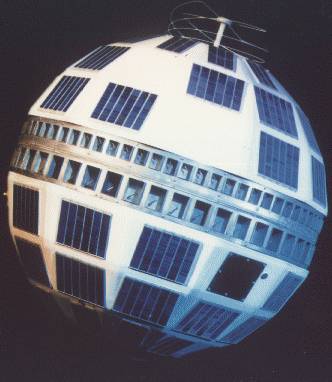
1962 :: July 12 :: Telstar Satellite Launched
July 12, 1962: The Day Information Went Global, NASA
"Telstar was launched by NASA on July 10, 1962, from Cape Canaveral, Fla., and was the first privately sponsored space-faring mission. Two days later, it relayed the world's first transatlantic television signal, from Andover Earth Station, Maine, to the Pleumeur-Bodou Telecom Center, Brittany, France.
"Developed by Bell Telephone Laboratories for AT&T, Telstar was the world's first active communications satellite and the world's first commercial payload in space. It demonstrated the feasibility of transmitting information via satellite, gained experience in satellite tracking and studied the effect of Van Allen radiation belts on satellite design. The satellite was spin-stabilized to maintain its desired orientation in space. Power to its onboard equipment was provided by a solar array, in conjunction with a battery back-up system.
"Although operational for only a few months and relaying television signals of a brief duration, Telstar immediately captured the imagination of the world. The first images, those of President John F. Kennedy and of singer Yves Montand from France, along with clips of sporting events, images of the American flag waving in the breeze and a still image of Mount Rushmore, were precursors of the global communications that today are mostly taken for granted.
"Telstar operated in a low-Earth orbit and was tracked by the ground stations in Maine and France. Each ground station had a large microwave antenna mounted on bearings, to permit tracking the satellite during the approximately half-hour period of each orbit when it was overhead. The signals from Telstar were received and amplified by a low-noise "maser" (Microwave Amplification by Stimulated Emission of Radiation), the predecessor of the modern laser. After demonstrating the feasibility of the concept, subsequent communications satellites adopted a much higher orbit, at 22,300 miles above the Earth, at which the satellite's speed matched the Earth's rotation and thus appeared fixed in the sky. During the course of its operational lifespan, Telstar 1 facilitated over 400 telephone, telegraph, facsimile and television transmissions. It operated until November 1962, when its on-board electronics failed due to the effects of radiation."
"Telstar was launched by NASA on July 10, 1962, from Cape Canaveral, Fla., and was the first privately sponsored space-faring mission. Two days later, it relayed the world's first transatlantic television signal, from Andover Earth Station, Maine, to the Pleumeur-Bodou Telecom Center, Brittany, France.
"Developed by Bell Telephone Laboratories for AT&T, Telstar was the world's first active communications satellite and the world's first commercial payload in space. It demonstrated the feasibility of transmitting information via satellite, gained experience in satellite tracking and studied the effect of Van Allen radiation belts on satellite design. The satellite was spin-stabilized to maintain its desired orientation in space. Power to its onboard equipment was provided by a solar array, in conjunction with a battery back-up system.
"Although operational for only a few months and relaying television signals of a brief duration, Telstar immediately captured the imagination of the world. The first images, those of President John F. Kennedy and of singer Yves Montand from France, along with clips of sporting events, images of the American flag waving in the breeze and a still image of Mount Rushmore, were precursors of the global communications that today are mostly taken for granted.
"Telstar operated in a low-Earth orbit and was tracked by the ground stations in Maine and France. Each ground station had a large microwave antenna mounted on bearings, to permit tracking the satellite during the approximately half-hour period of each orbit when it was overhead. The signals from Telstar were received and amplified by a low-noise "maser" (Microwave Amplification by Stimulated Emission of Radiation), the predecessor of the modern laser. After demonstrating the feasibility of the concept, subsequent communications satellites adopted a much higher orbit, at 22,300 miles above the Earth, at which the satellite's speed matched the Earth's rotation and thus appeared fixed in the sky. During the course of its operational lifespan, Telstar 1 facilitated over 400 telephone, telegraph, facsimile and television transmissions. It operated until November 1962, when its on-board electronics failed due to the effects of radiation."
Saturday, July 16, 2016
1992 :: July 16 :: David Clark Articulates Internet Creed
We Reject: Kings, Presidents, and Voting.
We Believe in: Running Code and Rough Consensus.
 |
| Prof. David Clark |

During his presentation, based on Prof. Clark's slides, he made a number of additional curious observations:
- Our best success was not computing, but hooking people together.
- The hacks of today are the commonplace of tomorrow.
- Security is a CRITICAL problem.
- What we should do: Fix insecure services: PASSWORDS
- The problem is assigning the correct degree of fear to distant elephants.
- If we have a problem it is due to too much success.
Thursday, July 14, 2016
1999, July 14 :: IANA Announces First Allocations of IPv6 Addresses
14 July 1999
From: IANA [iana@ISI.EDU]
Sent: Wednesday, July 14, 1999 12:32 PM
To: iana-announce@ISI.EDU
Cc: 'iana'
Subject: Delegation of IPv6 address space
Internet Community,
After much discussion concerning the policy guidelines for the deployment of IPv6 addresses, in addition to the years of technical development done throughout the Internet community, the IANA has delegated the initial IPv6 address space to the regional registries in order to begin immediate worldwide deployment of IPv6 addresses.
We would like to thank the current Regional Internet Registries (RIR) for their invaluable work in the construction of the policy guidelines, which seem to have general consensus from the Internet community. We would also like to thank the efforts of the IETF community and the support of the IAB in making this effort a reality.
Sunday, July 10, 2016
1962, July 10 :: Telstra I lauched
Wikipedia: "Telstar is the name of various communications satellites. The first two Telstar satellites were experimental and nearly identical. Telstar 1 was launched on top of a Thor-Delta rocket on July 10, 1962. It successfully relayed through space the first television pictures, telephone calls, faximages and provided the first live transatlantic television feed. Telstar 2 was launched May 7, 1963. Telstar 1 and 2, though no longer functional, are still in orbit as of October 2013"
Subscribe to:
Posts (Atom)