Saturday, March 01, 2008

Part 3: Where We Explore Some Philosophy of Law Drivel That Supports this Twaddle

In Episode One, A New Dope, we explored how Part 15 spectrum is an unlicensed commons that cannot be stolen, and how WiFi is a protocol designed to operate in the commons and it itself (as a protocol) can also not be stolen.

In Episode Two, The Lawyers Strike Back, we explored how, where a commons property is proximate to another property, it is incumbent on the owner of the proximate property to provide notice that access is unauthorized. Lacking such notice, an individual accessing the proximate property could not be said to be unauthorized.

Now, in Episode Three, The Return of the Lawyers, we explore some philosophy of law drivel that supports all this twaddle.

The legal question before us is, when a commons network is proximate to another network, and the owner of the proximate network wishes to restrict access to the proximate network, who has the duty: the proximate network owner to disclose this information or the individual seeking access to discover this information. The conclusion in Part II, based on precedent, was that the proximate network owner has the duty to provide notice both of the restriction to access and the boundary between the commons network and the proximate network. Now we will explore two areas of philosophy of law that support this conclusion.

Theory one: Burden on the Holder of Information: Procedural rules generally place the burden of moving on the party with information. If one party has the relevant information and the other party is dependent on that information, then either (a) procedure places the burden on the information holder or (b) procedure provides a means for the first party to obtain the information. The burden may be the burden to move in a proceeding, or it may be the burden to make the persuasive argument. The procedure that provides the ability to obtain the information may be litigation discovery, it could be regulatorily required corporate filings, or it could be the Freedom of Information Act.

There are situations where the burden and the location of information are not in alignment, and this does not work very well. An example of this may be consumer claims where the burden of making the claim lies with the consumer, but the information about an alleged violation lies with a corporation. Without the information, the consumer cannot proceed with a claim, and without a claim, the judiciary can do little. This is a philosophical underpinning of why agencies are given the task of consumer protection, where they are in a better position vis-a-vis the corporation, in requiring information disclosures and building cases thereon.

In our situation, the information is held by the owner of the proximate network: is it public or private – is access restricted or open? Information jurisprudence looks to the network owner to either disclose the information or to have the burden (in this case, the burden would pretty much be the same as disclosing the information; it would be the burden to prove that the individual knew that access to the network was unauthorized).

Theory two: law and economics: Law and economics addresses issues of tort in order to answer - not who is at fault - but who has responsibility. The classic example is a steam train going down the tracks in farm land, with sparks emanating from the engine. Who is responsible for damages caused by crop fire? Is it the train engine which is throwing the sparks, or is it the farmer who built the farm right up to the edge of the tracks? Law and Economics answers this question by asking, which party can most efficiently mitigate the harm? Which would cost less: the train company not throwing sparks… which basically means not running… which basically would not be good for public welfare – or the farmers who could either move the crops back or build a fence? Which ever party can do this more economically is the party blessed with responsibility. After all, the performance of both parties benefits public welfare, and the cheapest solution maximizes welfare where a more costly solution would detract from it.

Just like we economically like trains and farms, we also like networks and end users. Communications networks carry the raw stuff of the new economy: information. The issue before us concerns the information regarding whether the individual’s access to the proximate network is authorized or not. The Law and Economics question asks which party could satisfy this need most efficiently.

The Proximate Network is owned by Network Owner who knows whether it is public or private, restricted or not. The Network Owner’s cost of announcing this information is de minimis and involves configuring the AP to either be open or secure (where “secure” would effectively provide notice that the network is not open).

Let’s make up some arguable facts. If the Network Owner wishes to maintain an open network, the Network Owner would need to configure the network AP to signal this intention. If we assume this will take 15 minutes at a salary of $40 an hour (I am picking this number out of the air, but I will make the salary of the network owner the same as the individual for comparison purposes), then it would cost the network owner $10. This cost is incurred once, regardless of how many people use the network. If the Network Owner wants to terminate access after hours, the network owner can simply turn off the AP. If the Network Owner wants to be more sophisticated, the Network Owner can insert a splash page that announces the terms of access. We will be generous and say that in total the owner had to dedicate an hour to this task during a month, for the cost of $40.

Now let’s examine the individual’s cost of obtaining the information regarding whether the network is open or shut, assuming that the information provided by the AP is insufficient. The individual opens a laptop and detects a network. The individual must then determine the owner of the network and whether it is restricted. If the SSID says “CoffeeShop,” then the individual has a clue that the network is owned by the Coffee Shop (although this is no guarantee). If the SSID says something generic like “Linksys,” then the individual has no clue and must resort to some other method of investigation. Depending on where the individual is sitting, this could be any number of potential network owners. The individual can stand up and walk around, attempting to triangulate the signal. This method could be aggravated where there are multiple networks with the same SSID, causing confusing results. It could also be aggravated by the environment of the individual that does not permit sufficient movement to permit triangulation (such as a doctor’s office waiting area). If the triangulation is successful and the Individual identifies a probable Network Owner, then the Individual must be able to approach the Network Owner. But that may not be possible. It could be a library after hours or a residence that has an open AP. It could be a municipal network with APs hidden in the infrastructure. It could be a busy coffee house where the manager is too busy speaking Pretalian. Next the Individual can attempt to research. If, for instance, the probable Network Owner is a public library, the Individual could get on the Internet, search for the library website, and search for information on the network AUP – hoping that it has been presented in a readily apparent manner. And this goes on. Now multiply this cost by every single user of this network. Let’s say the average time to obtain information about the network is 30 minutes at a cost of $40 per hour resulting in a cost of $20. Now multiple this by hundreds of potential users.

While it might be difficult to obtain a specific figure for this, it is easy to conclude that the cost to the individuals is higher than the cost to the Network Owner. Therefore, Law and Economics would conclude that the responsibility is placed on the Network Owner to announce the terms and restrictions, if any, on access.

This is a sound outcome. If the burden is placed on the individual to acquire the information, there are too many scenarios were the individual cannot reliably obtain that information. Network owners who want to make their networks open will not be able to do so because the individual cannot get that information from them (assume that the Network Owner’s signaling of this information through the AP is considered not sufficient notice). This will thwart any number of potential business models and decreases public welfare. If we start with the assumption that we like networks and end users (if we assume that the use of broadband increases the public welfare), then we will favor those solutions which favor broadband deployment and availability. Placing the burden on the owner through the use of the AP means that the owner can flip on and configure the AP, and the requirement is satisfied. Placing the burden on the individual means that there may be no practical means for owners to reliably get this information to individuals, therefore decreasing broadband availability and thwarting efforts at deployment.

In the end, we face two paradigm shifts. First, the judiciary must get over the notion that WiFi networks can be stolen – they cant be stolen. Second, the judiciary and law enforcement must get over the anxiety of how to keep people out of networks. Part 15 and WiFi were not designed to exclude individuals; they were designed to facilitate the spread of advanced telecommunications to all Americans.

When a Network Owner elects to place a network proximate to a commons network, then placing the burden on the proximate network owner to provide notice of boundary and restriction is sound in terms of legal precedent, philosophy of law, and broadband policy. You cant steal Wifi!


[Disclaimer]

Thursday, February 21, 2008

Steal More Wifi, part 2.

See Part 1: Where It is Concluded that Part 15 Spectrum and Wifi are part of the Commons and Cannot be Stolen

We have two spaces. One is a commons; the other is . . . well, we don’t know. We’ll call it the proximate space. These two spaces exist next to each other. But where is the boundary? It’s not visible; it’s not detectable; there are no sign posts. As the individual moves from the commons space to the next space, how is the individual to know that a boundary has been crossed.

And this proximate space, the individuals lacks knowledge as to the nature of this space. Is it a public or a private space? Is access open or restricted?

The individual can move between the common space and the proximate space easily without knowledge that a boundary has been crossed. Indeed the Internet was designed not to announce boundaries between networks but to eliminate them.

What does it mean for an individual to move from the common space to proximate space? Specifically, what does it mean to say that the access to the proximate space is “unauthorized?”

It has been suggested that the proper way to analyze this is a Trespass to Chattels analysis. There is Trespass to Real Property where the issue is unauthorized access to land, and there is every other deprivation of property – such as “borrowing” someone’s Ferrari 250 GT California. Since computer networks aren’t real property (aka land), then, the argument goes, the analysis must be Trespass to Chattels.

But access to a network that is proximate to a commons network is not a deprivation issue; the individual is not backing a box truck up the back of a coffee house and hauling away the network equipment. This is an access issue and if the question is access, then the proper analysis is real property. We want to be able to answer the question, “I am here; am I allowed to be here?”

Real Property Law

In general, the owner of real property must provide notice to exclude would be trespassers. This notice can come through actual notice communicated directly to the individual (ie, “Hey, you kids! Getouttahere!”) or through posted notices (such as Piglet’s “Trespassers Will”).

The tort of trespass to real property is intentional; an individual generally cannot be said to be trespassing unless the individual has knowledge and intent. Lacking knowledge that one is on private land and that access is restricted, the individual generally is not trespassing.

These principals particularly come into play where an owner wishes to restrict access to private property which is somehow proximate to public or common property (for example, a public shopping mall with private offices attached). The boundary where the common space becomes restricted space generally must have clear notice such that the individual can identify the boundary and the restriction.

With WiFi networks, there is a network in a commons space where no one has ownership rights, no one can be excluded, and no one has supreme claims to anyone else - proximate to an unknown space - the same predicament as the real property situation.

When can it be said that crossing from this commons to this proximate space is “unauthorized?”

Presented in this framework, the answer is clear. The owner of the proximate space must provide notice of boundary and restriction. Lacking notice, the individual can soundly assume that access to the space is not unauthorized (oh no! a double negative!).

This might be difficult when using a network, the Internet, which by design eradicates boundaries. Fortunately, with the WiFi protocol, there is an easy means for the network owner to provide notice. WiFi Access Points can inform potential interacting individuals with the information of whether the network behind the AP is open or secure, and what the SSID is. If the AP informs the individual that it is secure (that while the individual and the AP can interact with each other, the individual cannot interact with the network on the other side of the AP which is outside of the commons space), then the individual knows that the AP is the boundary and that what lies beyond is restricted.

If the AP informs the individual that the network behind the AP is open, and here is the SSID, then the individual has not been informed that access is unauthorized, and the individual is not even sure that the AP is a boundary (the AP could simply be a node with both networks connected in the commons). The precedent establishes the sound policy that the owner must provide notice of boundary and restriction, and lacking notice, the individual’s access cannot be said to be unauthorized.

Based on the notice provided by the AP, the individual can now answer the question, “I am here; is my access authorized?”

Next: Part 3: Where We Explore Some Philosophy of Law Drivel That Supports this Conclusion

Photo: Wikipedia. [Disclaimer]

Saturday, February 09, 2008

TPRC Call for Papers

TPRC Presents
The 36th Research Conference on Communication, Information, and Internet Policy
Hosted by the Center for Technology and the Law, George Mason University Law School, Arlington, Virginia
Friday, September 26, 2008 through Sunday, September 28
www.tprc.org


TPRC is an annual conference on communication, information, and internet policy that convenes international and interdisciplinary practitioners and researchers from academia, industry, government, and nonprofit organizations together with policy makers. The purpose of the conference is to acquaint policymakers with the best of recent research and to familiarize researchers with the knowledge requirements of policymakers and industry. The conference will consist of papers selected from reviewed, submitted abstracts, student posters, and selected panel submissions.

TPRC is now soliciting abstracts of papers, student papers, panel proposals, and student posters for presentation at the 2008 conference. Proposals should be based on current theoretical or empirical research relevant to communication and information policy, and may be from any disciplinary perspective. TPRC seeks submissions of disciplinary, comparative, multidisciplinary or interdisciplinary excellence.

Subject areas of particular interest include, but are not limited to the following (for more detailed descriptions see http://www.tprc.org):

1. Network Competition, Policy and Management
2. Next Generation and all-IP Networks: Policy, Regulatory, Architectural and Societal Issues
3. Spectrum Management and Wireless Futures: Anywhere, Anytime Communications and its Implications
4. Societal Issues: Universality and Affordable Access; ICTs for Development and Growth
5. The Transformation and Future of Media in an Age of User- and Community-Produced Creativity
6. The Transformation and Future of Intellectual Property and Digital Rights
7. Privacy, Security, Identity and Trust
8. Internet Governance and Institutional Strategies for Information Policy
9. Other Emerging Topics

Submissions are due by May 2, 2008. Please see the guidelines for authors for additional information.

Abstracts, panel proposals and poster submissions must be submitted electronically at http://www.tprc.org. For posters and abstract, please identify the methods, central ideas, and outcomes (obtained or expected) of the research. A secondary classification of the method used in the research will be requested upon submission to assure appropriate review. Abstracts are not to exceed 500 words. Poster sessions will be available to enable the display of current student work.

Responses will be made by May 30, 2008. Selected papers will be due to TPRC on August 15th and authors are expected to present the accepted submission.

Students are encouraged to submit papers for the student paper competition (see the Student Call for Papers for complete details). Full Student papers must be submitted by May 2, 2008. Students only are recommended to enter the poster competition.

We welcome industry-specific but not vendor-specific panels.

Thursday, February 07, 2008

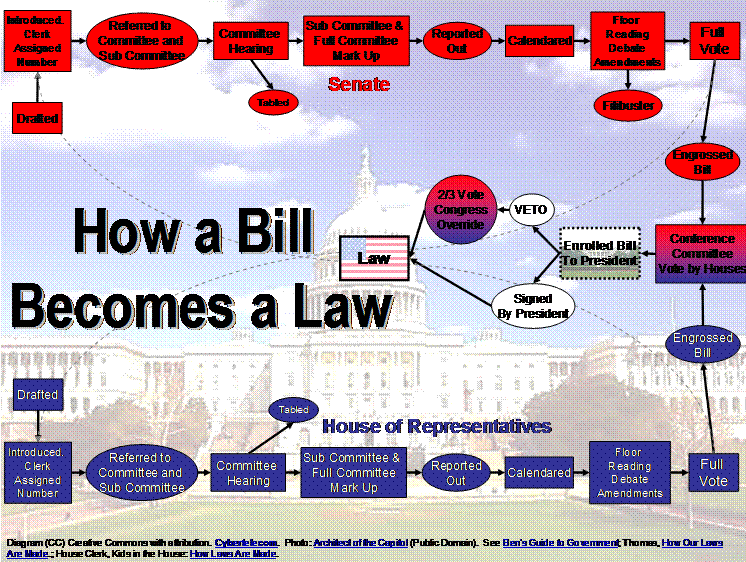
How a Bill Becomes a Law

"I'm Just a Bill, Up on Capitol Hill...." All us old farts know the song. Someone asked me how a Bill becomes a law. I looked for a good diagram. I assumed that there must be one. And did not find one. So with my great artistic talent, I gave it a go. Well, its something. I never claimed to be a great graphic artist.

Wednesday, January 30, 2008

Steal More Wifi!

So what about all those folk who have been busted for stealing Wifi. You know, those nefarious dudes in long black trench coats that congregate outside coffee houses, checking their emails and whether their tech stocks have tanked.

Misconception for today: “You can steal Wifi.”

This misconception has been repeated numerous times in the media and popular culture. See Mark Rasch, WiFi High Crimes, Security Focus (May 3, 2004) (discussing whether using someone else’s WiFi wireless signal could constitute a felony); Hale, Robert V., "Wi-Fi Liability: Potential Legal Risks in Accessing and Operating Wireless Internet," Santa Clara Computer and High Technology Law Journal, Vol. 21, p. 543, 550 (2005) (discussing “unauthorized” use of WiFi); John C Dvorak, The Right Analogy for Wireless Signal Spill, PC Magazine (August 1, 2005) (discussing wifi signal theft or poaching) . The just released suspense thriller Untraceable teases potential audiences with the somewhat credible tech-savvy FBI agent exclaiming that the bad guy “got into my wireless network.”

Hokay. The problem here is that a whole bunch of different stuff is muddled. We have confused concepts of property and conflated what it is that is being stolen.

Let’s deconstruction the crime scene.

First, the Way-Back Machine: The Federal Communications Commission was given authority by Congress in 1927 to regulate the radio spectrum as a scarce resource in order to avoid interference between transmitters. In the birth of the radio era, the right to use spectrum was largely first-come first-serve. And that worked for a while - until jerks figured out that they could juice up their transmitters, blow out their competitors, and reach a greater audience. So the right to use spectrum and the avoidance of interference moved from first-come first-serve, to a licensing process based on the merit of the applicant (which became widely criticized as FCC beauty contests that unjustly rewarded those who could best manipulate the bureaucracy, and led to licensing based on auctions). Without one of those FCC stamped pieces of paper, you had no right to use the spectrum and you could not interfere with others use of the spectrum.

In the 1990s, the folks at Apple and other places got it into their heads that computers had become powerful enough to deal with interference issues on its own without relying on a licensing regime. From a computer company point of view, the objective was to construct Local Area Networks (LANs) using low powered, short range transmissions to connect boxes, without the administrative inefficiency of obtaining a license simply to transmit a few meters from a Macintosh to a printer. Apple argued for the creation of an Unlicensed National Information Infrastructure (U-NII) where everyone could use the spectrum without a license, no one could exclude anyone else, no one has a superior right to use the spectrum, and any issues of interference would be handled through computing power.

In 1997, the FCC was persuaded, and created new Part 15 rules. Equipment would have to be certified as compliant with the specifications in the rules. Otherwise, those who used the spectrum need not have a license, could use the spectrum freely, but had no claim of right to the spectrum and could not exclude anyone else.

In 1998, Prof. Yochai Benkler presented a paper at the Telecommunications Policy Research Conference which concluded that the UNII Band “creates a legal space for the first broadband infrastructure commons.” The concept of a commons is a particular notion of property that goes back to discussions of cattle grazing on public land, or commons, in England. In contrasting the commons with other types of property, common property has the characteristics of being publicly available where the users of the property cannot exclude other users, but their use is rivalrous (in this situation, the user of the common property captures a gain from the use of property that exceeds his cost, creating an incentive to continue or increase use the property until the property is depleted for all – creating what is known as the tragedy of the commons… but the tragedy of the commons is a subject for another time).

The conception of Part 15 spectrum as a commons is not a notion that emanated from the FCC (the FCC has neither accepted nor rejected this classification). It is, however, compelling. Part 15 is a communications space where the property rights are distinct. As opposed to the licensing paradigm where the owner of the license has a superior right to occupy the space and can exclude other users, with Part 15 U-NII, all may be in this space, no one may exclude others, and no one can claim a right to superior use. They just have to deal with lots of people sharing the commons.

Well how do we deal with multiple people entering the commons and not interfering with each other? There must be some protocol for who can talk at any given moment and who cannot. And if we create a protocol controlling who can talk, we also want to build in how to listen. The IEEE set to work on this and created 802.11a,b, and g, otherwise known as WiFi. Wifi is simply one protocol for how radios know how-and-when to talk and listen while avoiding interference; there are others (and many others are colloquially referred to as WiFi even though they are not). But WiFi has become a wildly popular and successful. WiFi is the protocol for the computer handling interference issues in lieu of a licensing regime.

Right. Now back to the crime scene. The owner of a Coffee House has decided to offer Internet access over Wifi for free as a loss leader, hoping that it will encourage guys in black trench coats to purchase cheapest refillable cups of coffee, and refill them ten times as they sit in the coffee house for three hours writing blog posts. The Coffee Shop owner decides to purchase a certified WiFi access point that will transmit in the Part 15 spectrum commons. The Coffee Shop owner attaches this access point to a telco DSL line which the owner pays for. The WiFi access point broadcasts in the Part 15 spectrum its SSID name so that potential coffee drinkers know the SSID name necessary to talk with that access point pursuant to the Wifi protocol.

Now Charlie the Unicorn pulls up into the coffee house parking lot in his convertible Mustang (what else would he be driving), uses his WiFi certified laptop to detect a WiFi signal, and connects to the Internet over the Part 15 Spectrum using the Wifi protocol. Charlie checks craigslist to see if he can find a new kidney that he so desperately needs.

Law School Exam Question: What law, if any, did Charlie break? Please discuss, citing relevant authority; you have 30 minutes.

Well, today let’s just ask one small part of the question: has Charlie “stolen the Wifi signal.” Has Charlie used the Coffee House’s Wifi?

Hopefully at this point we are pretty much beating on a dead unicorn. Hopefully you get the point I am trying to make. But for you hockey players out there who have been hit in the head a few too many times, let’s spell it out.

Charlie cannot steal the spectrum. The spectrum is an unlicensed commons. It belongs to no one; it belongs to everyone. You cannot exclude people from this spectrum; you cannot claim a superior right to use of this spectrum.

WiFi is a protocol designed for this spectrum to resolve interference issues and establish how different radios can connect to each other. The WiFi protocol is designed to operate in the spectrum commons. These WiFi radios are, by designed, constructed to freely talk with each other and establish who will talk with whom without interference. They must be a part of the commons in order to achieve their purpose. The WiFi protocol, this handshake, signaling and sharing of signals back and forth that the radios do, cannot be stolen.

Now the coffee house has connected their WiFi access point to a private telco DSL line that connects with the Internet. What is the significance of attaching private property to commons property; and how would Charlie know whether he may enter the private property. This is a question for another time; the import point for now is to realize that there are two things here: (1) a private computer network attached to (2) Part 15 commons spectrum. These are two separate property spaces that necessitate two separate analyses. The connection of a private computer network does not contaminate the commons spectrum and transform it into something private.

Not persuaded. Let’s go for the metaphor – only it’s not a metaphor, it is simply a different protocol in the Part 15 unlicensed commons: walkie talkies. In this scenario, the coffee house is using walkie talkies to communicate with staff that the front counter is facing a critical biscotti shortage. Charlie pulls into the parking lot with a walkie talkie, hears the conversation over his radio, and then uses his radio to speak pretalian and ask the coffee shop how much a Triple Muy-Gordito is. Did Charlie “steal the walkie talkie”? Did Charlie steal the Part 15 spectrum? Was Charlie’s use of the Walkie Talkie to talk with the coffee house unauthorized? If you don’t laugh at this question, you need to go back and study communications law for a good long time. The Walkie Talkie Spectrum cannot be stolen by definition.

Well what if the Coffee House connected the Walkie Talkies to VoIP? Again, not the question that needs to be answered today, as long as you understand that the use of the Walkie Talkie spectrum is not the same as the use of the VoIP to which it is connected.

What difference does all this make? A poorly framed legal or policy question results in a poorly framed answer. Today we struggle to get the question right. People are contorting themselves struggling to determine whether WiFi can be stolen (or poached or piggy backed) because they start with the assumption that the WiFi, like everything else, is private property. It is not - and it cannot be stolen.

Tomorrow, we ponder what this might mean.

[Disclaimer]


Photo: John Swords (cc)

Thursday, January 03, 2008

A Shot in the Dark :: eBay Long Arm Jurisdiction

Marschke v Wratislaw, No. 24218 (SD Sup Ct Dec. 5, 2007) is yet another in a long series of eBay jurisdiction cases. In this case, the court asks the eternal question, does a “one shot deal” create sufficient contacts with a forum to sustain a finding of jurisdiction. Plaintiff clearly thought so and therefore took a Shot in the Dark and sued defendant.

Somehow this court’s use of the phrase “one shot deal” gave me the image of Peter Sellers as Inspector Clouseau bungling a purchase on eBay and subsequently blaming entirely the wrong person when the deal goes awry.

This eBay jurisdiction case involves, what else but, a purchase of a car. Plaintiff in South Dakota engaged in a quest to obtain the car-of-his-youth, a Fiat 850 Spider (must have been a good youth!). In April 2005, he found one for sale on that galactic garage sale, eBay, listed by Defendant Wratislaw’s Montana Muscle and Classics. In the ad, Defendant listed his phone number and linked to his website.

Plaintiff, however, did not purchase the car through eBay. Instead, he decided to leave South Dakota, go to Illinois, and call defendant from there. An agreement was made for the transaction, defendant sent a purchase agreement to Plaintiff, Plaintiff signed the agreement while in South Dakota, and Plaintiff arranged for the down deposit to be wired from a bank in Wisconsin to defendant. Plaintiff paid the balance of the car and then “executed the agreement at the office of Montana Muscle” in Montana. The car was shipped by Plaintiff. After receiving the car in South Dakota, plaintiff “decided that it was not in the condition that he expected.”

Plaintiff decided to sue Defendant and decided that South Dakota would be an okay forum in which to sue Defendant.

We’ve been over long arm jurisdiction in previous posts. This is where a court in one state has jurisdiction over a resident of another state. General long arm jurisdiction can occur where there continuous contacts with the court’s state. Specific jurisdiction can occur where there may not be continuous contact, but the cause of action arises from limited contact and the limited contact is sufficient that “assertion of personal jurisdiction does not offend ‘traditional notions of fair play and substantial justice.’”

Okay, so what we care about is the Internet aspect. Plaintiff based his argument that the court has jurisdiction over defendant in part on defendant’s Internet presence. But then, plaintiff did not actually use the Internet to make the deal; Plaintiff just learned about the availability of the car from the Net - just like one might pick up any advertising magazine that lists cars for sale. And the court had already dealt with Deals on Wheels concluding that such print advertising by itself is insufficient for jurisdiction.

Plaintiff responds, well what about all this other stuff: the negotiations, the mailing of the agreement, and the paying of the money.

The court was not persuaded, concluding in the alternative that this appeared to be a “one shot deal.” The court noted that there were no other contacts of defendant with South Dakota on the record. Indeed, it was Plaintiff that initiated the negotiations (from Illinois). The only contact initiated by defendant with South Dakota was mailing the purchase agreement to Plaintiff there. The Court concludes that this “one shot deal” does not constitute sufficient contact for South Dakota to extend its long arm around Defendant.

Defendant - 1; Plaintiff - 0.

In the immortal words of Inspector Clouseau, “There is a time to laugh and a time not to laugh, and this is not one of them.”

Inspector Clouseau in A Shot in the Dark


[Disclaimer]

Wednesday, January 02, 2008

Get Your DTV Converter Coupon Today!


Not quite Internet policy or law - but the Department of Commerce has initiated its coupon program for those who will need converter boxes for their analog TVs, so that those analog TVs can receive digital. 
QUOTE
Congress created the TV Converter Box Coupon Program for households wishing to keep using their analog TV sets after February 17, 2009. The Program allows U.S. households to obtain up to two coupons, each worth $40, that can be applied toward the cost of eligible converter boxes.

A TV connected to cable, satellite or other pay TV service does not require a TV converter box from this program.

Consumers have a variety of options. Options to explore include:
  1. Keep your existing analog TV and purchase a TV converter box. A converter box plugs into your TV and will keep it working after Feb. 17, 2009, or
  2. Connect to cable, satellite or other pay service, or
  3. Purchase a television with a digital tuner.
/QUOTE
It is recommended that if you want to take advantage of this offer, do so promptly.

Wednesday, December 19, 2007

Who was the true father of the Internet?


Pop quiz: Who said:
It is from this paper that the rumor was started that the Internet was created by the military to withstand nuclear war. This is totally false. Even though this Rand work was based on this premise, the ARPANET and the Internet stemmed from the MIT work of Licklider, Kleinrock and Roberts, and had no relation to Baran's work.
We've been focusing on history lately. On November 29 & 30, in Washington DC was an NSFNET Celebration. It was an oral history project. Lots of the primary folk from the primary organizations (NSF, MERIT, IBM, MCI) were present, retelling the NSFNET Story. It was fascinating. It was, like so many things, like looking a picture in black and white, and then seeing the same picture in color. So much was added to the history. Things like - the "network of network?" - that was NSFNET. NSFNET established the network hierarchy and "tiers." Where NSF's "cooperative agreements" came from and how that created the foundation of future policy struggles. This was not, after all, a simple R&D and transfer of technology project that NSF funded. This was, as the NSFNET Final Report stated, communications infrastructure, vital to the success of our economy and culture.

All this led to significant revisions to CT's history section. Take a look; give feedback!

BTW, the lead-in quote was by Larry Roberts, the head of ARPANET in the late 1960s, who has a pretty decent first hand perspective on why he built the ARPANET (aka Internet) the way that he did.

Friday, November 16, 2007

Caselaw Construing 47 USC 230 Immunity is Surprisingly Scant

At least according to one Arizona Superior Court: Children of America v. Magedson, CV 2007-003720 (AR Superior Court Oct. 31, 2007).

The court's order itself is "surprisingly scant," thus we know little of the facts surrounding this case. What we do know is that once again it involves Ripoffreport.com. Jinkees! The Sec. 230 caselaw for this one defendant is surprisingly robust. Ripoffreport.com must have some well paid attorney on retainer that does little more than mash the print button for the proforma Sec. 230 Motion to Dismiss form... merely taking a bit of time to scrawl in the name of the latest plaintiff.

Of course, if the court's law clerks are too busy researching water rights cases, we are glad to refer them to our "surprisingly scant" list of Sec. 230 cases.

Anyway, we here at Cybertelecom are likewise into automation and have developed our proforma blog post for these Ripoffreport.com cases. Here it is:
Some plaintiff [FILL IN BLANK] got irked by what some disgruntled third party wrote about them at Ripoffreport.com. Ripoffreport.com "is a worldwide consumer reporting Web site and publication, by consumers, for consumers, to file and document complaints about companies or individuals." Ripoffreport.com did not write the disgruntled comment. Ripoffreport.com filed a Rule 12(b)(6) Motion to Dismiss pursuant to 47 USC § 230. The Court granted the motion and dismissed the complaint as against defendant Ripoffreport.com.
Of course it never goes proforma, does it.

Plaintiff apparently alleged that Ripoffreport.com either edited or authored the headline of the disgruntled comment - and that headline could be actionable. The court has to take the facts as alleged by plaintiff as true for a motion to dismiss (the court is merely deciding whether there is a potential claim for which relief can be granted -- it is not deciding the merits of the case as to whether in fact relief should be granted - it's like if I sued you in court for being short - while this may be true, it is not a cause of action for which relief can be granted). Therefore the court dismisses the complaint against Ripoffreport for the disgruntled third party comment, but denies the motion to dismiss with regard to the headline. But the Court made clear, if plaintiff cant prove that Ripoffreport authored the disgruntled headline, then plaintiff will face pretty much the same outcome as the rest of the complaint.

So what's cool about all this. I go looking at Ripoffreport.com for a bit of deep research in preparation for this post, and I find a page entitled Want to Sue Ripoff Report? The page states:
If you are considering suing Ripoff Report because of a report which you claim is defamatory, you should be aware that to date, Ripoff Report has never lost such a case. This is because of a federal law called the Communications Decency Act or "CDA", 47 U.S.C. § 230. Because this important law is not well known, we want to take a moment to explain the law, and to also explain that the filing of frivolous lawsuits can have serious consequences for those who file them, both parties and their attorneys. The CDA is part of our federal laws.An excellent Wikipedia article discussing the history of the law can be found here. In short, the CDA provides that when a user writes and posts material on a website such as Ripoff Report, the site itself cannot, in most cases, be held legally responsible for the posted material.
Do the plaintiff's in these cases get to file RipoffReport.com disgruntled comments about their attorneys who advised them to file these pointless complaints?

Wednesday, November 14, 2007

What's Google Upsidedown???

According to Dylan Stephen Jayne, it's his social security number. Kinda-a-bummer, if true. Dylan certainly thought it was a bummer, so he sue Google - for $5 Billion - for a civil rights violation pursuant to 42 USC s 1983. Dylan Stephen Jayne v Google Internet Search Engine Founders, No 3:07cv1677 (MDPA Sept 27, 2007).

The case was filed by Dylan on September 18. The court dismissed the action on September 27 on its own - it didnt even give Google the chance to respond!

A Sec. 1983 action is a civil rights action that protects us from the government doing bad things:
Every person who, under color of any statute, ordinance, regulation, custom, or usage, of any State or Territory or the District of Columbia, subjects, or causes to be subjected, any citizen of the United States or other person within the jurisdiction thereof to the deprivation of any rights, privileges, or immunities secured by the Constitution and laws, shall be liable to the party injured in an action at law, suit in equity or other proper proceeding for redress . . . .
42 USC 1983. The problem here is that as big as Google is - it's not a state - it's not the government. So whatever "Google" spells upsidedown, there is no cause of action against Google as a state. Dylan has "failed to state a claim for which relief can be granted."

What's really cool? Dylan has managed to get his own Wikipedia page out of this. And Dylan has gotten a fair share of attention in the blogosphere. Stupid Man from Pennsylvania Sues Google for $5 Billion, Gizmodo.

And, er, ah, if anybody out there is wondering, Cybertelecom upsidedown spells "Jagr is a weenie!" and we are pretty sure that Cybertelecom is not a state actor either (So dont sue us Jaromir!).

[Disclaimer]

Monday, November 12, 2007

Fomento de Construcciones y Contratas Believes “FCC” Violates its Trademark

This case is just too great not to review!

Some guy in the United States has a website FCC.COM where he displays information relevant to the Federal Communications Commission. FCC.COM describes itself as “the place for all news and information regarding the Federal Communications Commission.” November 11th’s top FCC related articles included China Vows Major Doping Crackdown [1 vote], Clinton Says Immigrant Licenses Depends on State [1 vote], and Black Fence Sparks Dispute [1 vote] .

Fomento de Construcciones y Contratas in Spain took issue with FCC.COM and brought a claim before WIPO under the Uniform Dispute Resolution Policy. FCC Fomento de Construcciones y Contratas, SA v. “FCC.COM”, Case No. D2007-0770 (WIPO October 7, 2007).

Now Cybertelecom has not done a lot of work around the UDRP, and this does not exactly involved federal Internet law or policy - - but com’on, a domain name dispute involving “FCC.” This I have to review!

Before we unpack how a company in Spain could claim that a Yankee’s use of FCC.COM for FCC related news violates its Spanish trademark, let’s review the video tape and see who’s registered what:

In literary terms, this is the setting of our conflict. “FCC” are the initials of a US federal agency, the Federal Communications Commission. Punch “FCC” into Google and the Federal Communications Commission is the first search result shown. FCC.COM is the ninth search result shown. After 10 pages of search results (about 100 search results), producing many organizations using the abbreviation “FCC” including Families with Children in China, Farm Credit Canada, and Frontier Community College, no search result for Fomento de Construcciones y Contratas were observed (I set my language preference to any language and my region preference to any region, and I was not logged into Google).

Fomento de Construcciones y Contratas appears to hold more “FCC” second level domain names than anyone else, including the US Federal Communications Commission. Of the five FCC domain names found (there may be more) that Fomento de Construcciones y Contratas registered, only FCC.ES resolved to a webpage. FCC.COM.ES, FCC.INFO, FCC.MOBI, FCC.EU, and FCC.BIZ produced “Server Not Found” error messages when I tried to access them (6 pm EST November 10, 2007).

Now to the conflict. On May 25, 2007, Fomento de Construcciones y Contratas filed a complaint before the WIPO Arbitration and Mediation Center. Apparently the complaint was deficient, and on June 11, Complainant filed an amended complaint. On July 25, Complainant requested a suspension of proceedings on the grounds that the parties were negotiating a resolution. However, on August 27, Respondent said, “negotiations, what negotiations? What are you talking about?” (I paraphrase.)

So back to the conflict. According to the UDRP, for the Complaint to succeed, the Complainant must prove that:

“(i) The Domain Name is identical or confusingly similar to a trademark or service mark in which the Complainant has rights; and

(ii) The Respondent has no rights or legitimate interests in respect of the Domain Name; and

(iii) The Domain Name has been registered in bad faith and is being used in bad faith.”

If any one element fails, then the complaint fails.

The three-member review Panel focused on the second and third elements, and therefore waived its hands at the first. The Panel has noted that Complainant’s trademarks incorporate “FCC” (see the logo here) but Complainant has “no registration of the letters FCC simpliciter.” Nevertheless, the Panel concludes,

the Panel is content to deal with this issue solely on the basis of the Complainant’s registered trademarks and finds that the Domain Name is identical or confusingly similar to a trademark in which the Complainant has rights.

The problem, according to the Panel, is that Respondent clearly has a legitimate interest in the domain name. The Respondent has developed a website displaying news and information relevant to the US Federal Communications Commission. A simple review of Respondent’s website makes this clear. Such a review, however, was problematic because Complainant neither included a print out copy of Respondent’s website nor described Respondent’s website in Complainant’s Complaint. And this is a problem, the Panel notes, because even though WIPO panels are reviewing domain name disputes, some WIPO panels “restrict their consideration solely to the papers before them” and never bother to check the Internet. They never go online to check whether there is a legitimate website or other Internet resource associated with these domain names in question. That definitely would present a problem!

Anywho, Respondent successfully demonstrated that he has a legitimate use of the domain FCC.COM and that there was no issue of bad faith (indeed it is an undisputed part of the record that Respondent had never even heard of Complainant). The Complaint therefore fails on the second and third elements.

But it doesn’t end there.

Respondent fires back. Respondent complains of attempted reverse domain name hijacking on the part of Complainant. “Reverse Domain Name Hijacking is defined in paragraph 1 of the Rules as meaning ‘using the Policy in bad faith to attempt to deprive a registered domain name holder of a domain name.’” Respondent characterizes this whole little escapade as a “significant and wholly avoidable trouble and expense” – and the Panel agreed. The Panel breaks from its methodical disposition of the proceeding to expound on

the inexplicable failure on the part of the Complainant to exhibit a print-out of the Respondent’s homepage or, failing that, to include within the body of the Complaint a description of the content of that homepage.

And then,

Anyone examining the Respondent’s website could see that it was a genuine site and that anyone launching a complaint was bound to fail.

The exasperation of the Panel crescendos with

The Complaint makes clear that the Complainant had visited the Respondent’s website. The Complainant mentions the fact that the Respondent’s website features revenue earning advertisements, but does not identify the nature of the advertisements; moreover, the Complainant uses the fact of those revenue earning advertisements (i.e. commercial gain) as a basis for its bad faith claim. The Panel is in no doubt that it was incumbent upon the Complainant in the circumstances of this case, noting in particular the nature of the domain name in question, to provide the Panel with sufficient detail of the Respondent’s website to enable the Panel to make a fair assessment.

The Panel finds that the Complainant’s failure to do so, irrespective of whether or not the failure was intentional (as to which the Panel makes no finding), constitutes an abuse of the Administrative Proceeding. The Reverse Domain Name Hijacking allegation succeeds.

Ouch!

Oh, but the reason why this quibble was interesting is the FCC connection. So, just in case you are wondering, the Panel courteously clarifies - in its only footnote - that even though Complainant’s claim was an abuse of process, if it were the US FCC that had brought the claim, things might - uh - be different:

This is not to say, of course, that the Federal Communications Commission for example would in such a situation necessarily be found liable to a finding of reverse domain name hijacking.

What?! Huh?! Where?! Does the FCC even have a trademark for “FCC?” As far as the FCC is concerned, “trademark issues properly should be addressed by the courts under the trademark protection and unfair competition laws, rather than by the Commission." In Re Toll Free Service Access Codes, Fourth Report and Order and Memorandum Opinion and Order, FCC CC Docket No. 95-155, Para 7 (March 31, 1998). Uh… Yeah… Uh… what the Commish said!

[Disclaimer]

Sunday, November 11, 2007

Proceeds from Cybertelecom

Proceeds from Cybertelecom go to support different stuff :: October's Proceeds went to support the Humane Society of America.
The Humane Society of the United States

Tuesday, November 06, 2007

The Right to Whine :: Global Royalties, Inc., v Xcentric Ventures, LLC, (DAR October 10, 2007)

The Good Samaritan provisions of Sec. 230 the Communications Decency Act hold water over the water – where water means overseas international judgments – and where overseas in this case means the dirt road leading north guarded by Canadian Mounties. Between a Canadian judgment for defamation which involved third party content, and the safeguards of Sec. 230 of the Communications Decency Act, the Good Samaritan wins the smack-down.

So here’s the dirt. This week’s spat is Global Royalties, Inc., v Xcentric Ventures, LLC, No. 07-956-PHX-FJM (DAR October 10, 2007). Defendant Xcentric Ventures runs a whine-website called Ripoff Report. A disgruntled third party visited defendant’s website and expressed disgruntledness in three separate posts. Plaintiff Global Royalties took offense in the disgruntledness and ended up suing defendant and disgruntled party in Canadian court. Defendant never showed up. The court issued an injunction requiring defendant to remove all of disgruntled party’s posts from its website, prohibiting defendant from posting any further comments about plaintiff, and pushed the dispute to trial court for talk about damages.

Plaintiff brought the judgment South-of-the-Border down to Arizona seeking enforcement, and also called defamation on defendant. The court said, wait a minute, we don’t just enforce Canadian-hockey playing court orders as a matter of course. And as to “defamation,” the comments in question were written by a third party and not defendant, and therefore pursuant to the Good Samaritan clause of the CDA, the defendant is not liable. 47 USC § 230.

Wait a minute, argued plaintiff, defendant never took down the comments as ordered by Dudley Do Right, and therefore plaintiff has “adopted” the disgruntled statements.

Sorry, responded the court, but it is well established that notice to a website owner of some problem with someone whining does not morph the whining into the website’s own speech. This aint the DMCA.

Which led the judge to do a little whining of his own: With no risk or liability for third party content, a website owner has no incentive to take down that content where it flusters some plaintiff. If it was an unintended consequence of the CDA to render plaintiffs helpless against website operators who refuse to remove allegedly defamatory content, the remedy lies with Congress through amendment to the CDA.”

Poor poor helpless plaintiffs (that hire attorneys who haven’t read Sec. 230 case-law).

One of the truly great innovations of the Internet and specifically Web 2.0 is the interactive features that permits disgruntled third party’s to visit review web sites and whine about the failings of their least favorite companies. You can find out how horrible your plumber is, how horrible your teacher is, or how horrible Bruce Willis’ latest movie is (and if you believe every review or comment you read on the Internet, I have a nice investment in Nigeria to recommend to you). International treaties and fear of the Dudley Do-Right cannot thwart this. It’s good to know that your right to whine holds water over the water (even where the water is a frozen hockey pond).

[Disclaimer]

Wednesday, October 10, 2007

A Perfectly Clear Long Arm Jurisdiction Case :: Weldon-Francke v. Fisher, 06CV0386 (14th Texas Court of Appeals Sept. 11, 2007)

I love Internet long-arm jurisdiction cases: they are a mire of how the judiciary deals with a defendant that has made itself available in every forum everywhere all the time all over the globe. No matter how judges grapple with notions of due process, you always are left with the feeling that one party or another got screwed. And it is wonderful to watch old school judges who grew up driving VWs grapple with this new environment, flipping through one failed metaphor after another in an attempt to pigeon-hole what would be “fair” on the Internet. There are no easy or clear cases on the sliding scale of Internet long arm jurisdiction.

Except this one.

When last we visited Internet long arm jurisdiction, we reviewed a case where a Louisiana court concluded that the advertisement on eBay by a Texas residence of a vehicle, which was delivered in Texas, and which broke down in Texas, and where defendant had no further described contacts with Louisiana other than a couple of phone calls to plaintiff, was sufficient to sustain minimum contacts required for long arm jurisdiction (in contrast to most other eBay jurisdiction cases which conclude that minimum contacts are lacking). This time it’s Texas’ turn.

It would be interesting to attempt to do a correlation between what portion of a state’s GDP comes from high technology, and the outcome of cases such as these. I’ll just throw out the wild unsubstantiated thesis that the greater a state’s economy can be attributed to high tech, the more high tech friendly the jurisdiction common law is. Louisiana’s GDP for computer and electronic product manufacturing for 2005 was apparently $88m while Texas’ was $18,164m. Hum!

Today’s case is Weldon-Francke v. Fisher, 06CV0386 (14th Texas Court of Appeals Sept. 11, 2007). Plaintiff* believed that defendant* had done a poor job on a trust, and filed suit in a Texas court. Here are the geographic facts: plaintiff contacted defendant, a New Hampshire attorney, in NH, requesting that defendant draw up a trust for a NH property, the work on the trust was conducted in NH, the trust was delivered to plaintiff in NH, and the bill for the legal work was mailed to a NH address. Let’s see, did I cover all the contacts with the state of Texas? Yip, that was pretty much it.

Eight years after the NH trust was drawn up, plaintiff had some concerns about the trust, hired a Texas lawyer, and that Texas lawyer contacted defendant. Defendant obtained permission from plaintiff to talk to the Texas lawyer, and discussed the trust with the Texas lawyer by phone and in a letter.

In specific jurisdiction cases, a court can have jurisdiction over an out-of-state defendant where the dispute arises from defendant’s contact with the state in which the court resides. In this case, plaintiff attempts to argue that defendant’s contact with Texas was that defendant knew that Plaintiff was a Texan. You can almost hear the appellate court judge holding back laughter in rejecting this (got any good caselaw supporting your argument, counselor?).

Next, plaintiff argues that the phone call and letter eight years later was the basis of jurisdiction. Well, at least there was a contact here. But the court concludes “the undisputed evidence shows that [defendant] engaged in these telephone calls and sent these letters to answer questions and respond to requests from the [Plaintiff] and their Texas counsel regarding her 1998 legal services.” Defendant is responding to plaintiff’s query; defendant did not purposefully avail itself of the forum of Texas. The court goes on to note that defendant was not paid for the work involved in responding to the Texas lawyer, nor was defendant engaging in any new legal representation. This dispute involved the trust from eight years ago which was conducted entirely in NH. The Court tosses out specific jurisdiction.

But this blog is dedicated to Internet law. We have not even mentioned the Internet yet. So here it goes: in a feeble attempt to establish general jurisdiction (continuous and systematic contacts with a forum), plaintiffs say, “oh, and defendant has a website that can be read in Texas.” Note interestingly enough that there is no evidence on the record that plaintiff ever actually viewed or relied upon, while in Texas, defendant’s website – just that defendant has a website. Also note that evidence indicates that defendant had no other contact with Texas.

The court sets forth the sliding scale test for long arm jurisdiction which slides from passive websites that just provide information to interactive websites where visitors can do business. The court notes that defendant’s website does not provide for any level of “exchange of information” or “transaction of business” between visitors and the law firm. The defendant’s website merely provides background and promotional information. “But . . . but,” plaintiff argues, the website “extols the Law Firm’s professional experience in federal estate and gift taxation law. Raise your hand, those of you who think this was a persuasive argument.

Outcome: a passive website which provides background information and no interactivity (and where there is no evidence that plaintiff ever read or relied upon the website) is not sufficient minimum contacts with a state to sustain general long arm jurisdiction.

You would think that this provides a certain level of clarity in the sea of uncertainty over Internet long jurisdiction. Here is the paradigm example of the “passive website” along the sliding scale of jurisdiction. On this ground, we know attempted litigation would be frivolous (right?). But remember, this is an appeal. The lower court had managed to conclude that it had both general and specific jurisdiction over defendant!

I wonder if the lower court judge drives a VW?

- - - - - -

*I cheated and simply referred to the plaintiffs and the defendants in the singular.

[Disclaimer]

Wednesday, October 03, 2007

What's on TV?

There have been a number of news articles and blog posts lately suggesting that this is the TV season that broadcasters finally get the Net - that broadcasters are making their content available online. [US networks to stream online free, FT; Do Broadcasters Finally 'Get' the Internet?, Internet News; NBC Cuts Out Video Middleman - NBCDirect will launch in November, DSLReports] So I decided to do a back of the envelop survey of what is out there. Okay, I admit it, I wanted to see if I could find any live hockey feeds. Well, minor league hockey is available on the B2 Network, but not the NHL. While there is a lot of content out there now, probably the big exception is live sports. [Update: NHL Center Ice provides a season subscription to live Windows Media webcasts of all out-of-market games for ~$169. Of course MLS provides a similar season subscription for $10.]

Survey was conducted September 29 - October 3, 2007. Based on what was readily apparent at websites based on a brief visit. Sampled programs where plugin was already embedded, but did not install new plugins. Please feel free to provide additional information. Listed programs represent a quick sampling of what was found.

I am sure there is lots more out there. Drop me a note and tell me what to add to the list - or any corrections that need to be made. This information will be maintained somewhere on the Cybertelecom website.

In 1961, then FCC Chair Newton Minow made his famous speech:

"But when television is bad, nothing is worse. I invite you to sit down in front of your television set when your station goes on the air and stay there without a book, magazine, newspaper, profit and-loss sheet or rating book to distract you--and keep your eyes glued to that set until the station signs off. I can assure you that you will observe a vast wasteland."
Wonder what he would say about the Internet?

Channel Price Plug-In Screen What's Available (sample) Comment
A&E Free Flash Embedded, Scalable Full Episodes: SWAT, Private Sessions, A Man Called Dog, Dog Views Choice. Clips: Sopranos, Faith of my Family, King of South Beach, Two Coreys, Wedding Wife
ABC - Disney Free - Advertisements Move Media Player

Clips: News. Full Episodes: The Bachelor Brothers and Sisters Dancing with the Stars Desperate Housewives Dirty Sexy Money Fashionista Diaries Grey's Anatomy Lost Men In Trees GH Night Shift October Road Private Practice Ugly Betty Voicemail

Only available in US - Also available on AOL Video
- - Disney Channel DXD Free - Advertisements Flash Scalable but not full screen Select Full Episodes: Hannah Montana, American Dragon, Suite Life of Zack and Cody, Emperor's New School, That's So Raven, Kim Possible, The Replacements, Cory in the House
- - ESPN - ESPN Video beta Free - Advertisements Flash Scalable but not full screen ESPN Clips Also available on AOL Video
Animal Planet


See Discovery Channel
BET

Free

Flash Embedded player Black Carpet, Hell Date, Quickie, Comic View, Rap City, Sunday Best, Coming to BET, 106 & Park, Hip Hop Awards, Socially Offensive Behavior Download difficulties
Bravo Free Flash Embedded and Full Screen Clips
Cartoon Network Free - Advertisements Flash Embedded and Full Screen Select Full Cartoons: Ben 10, Bernard, Camp Lazlo, Class 3000, Code Lyoko, KND, Courage, Cow and Chicken, Dexters Labratory, Ed Edd and Eddy, Fosters Home, Grim Adventures, IMP, Johnny Bravo, My Gym Partners a Monkey, Powerpuff Girls, Storm Hawks, Time Squad, Totally Spies, Robot Jones
CBC
Flash Embedded and Full Screen Full Saturday Night Hockey - Clips : News - Features
CBS - Innertube Free - Advertisements Flash Embedded and Full Screen Full Select Episodes: Armed & Famous, As the World Turns, Big Bang Theory, Big Brother, CSIs, Guiding Light, How I Met Your Mother, Jerico, Kid Nation, NCIS, Numb3rs, NCIS, Papdits, Pirate Maker, Power of 10, Rules of Engagement, Shark, Survivor, The Unit, Young and Restless. Clips: Late Late Show, Late Show, Each show appears to have only one or two episodes available - Also available on AOL Video
CNN Free - Advertisements Flash Embedded Clips Popup ads
Comedy Central
Flash Embedded Clips: Jon Stewart, Colbert Report, South Park, Sarah Silverman, Drawn Together Also available on AOL Video
CSPAN Free RTSP - Real and Windows
Full programs We had difficulty downloading programs
CW
Move Media Player
Full Episodes: Wild Bunch, Opposites Attract, Girls Go Cruisin,
Discovery Free & $1.99 downloads Move Media Player
Full Episodes: Dirty Jobs, Meerket Manor, LastOneStanding. Clips. Downloads
Fox - Video Central Free Flash
Clips Full Episodes available on AOL Video
History Channel Free - Advertisements Flash Embedded Clips Full Episodes available on AOL Video
Lifetime TV
Flash Embedded and almost full screen Full Episodes: Blood Ties, Lisa Williams, Gay Straight or Taken, Lovespring Intl, Spotlight 25 - Clips
MSNBC Free - Advertisements Flash
Clips
MTV Free - Advertisements Flash Embedded and scales Clips. Full Episodes.
NBC Free - Advertisements
Embedded and Full Screen Full Episodes: 30 Rock, Age of Love, Andy Barker‚ PI, The Black Donnellys, Friday Night Lights, Heroes, Last Comic Standing, Late Night with Conan O'Brien, Miss Teen USA 2007, NBC Primetime Preview, Raines, Victoria Beckham: Coming to America Clips: News, Sports
Nickelodeon $1.99 Downloads Flash Embedded and Full Screen Full Episodes: Avatar, Blues Clues, Danny Phantom, Dora, Fairly OddParents, Invader Zim, Jimmy Neutron, Zoe 101 Also available on AOL Video
PBS Free (sponsors logos visible) Real Player or Windows Media Player Embedded Ad Hoc Clips that are not organized in any coherent manner Some PBS shows are available DOD iTunes
Sci-Fi

Embedded and Full Screen Classic Movies. Clips.
TNT
Flash Embedded (Full Screen failed) Full Episodes: Charmed, Closer, Saving Grace - only a few episodes available We experienced download problems which crashed our browser
TV Land Free - Advertisements Flash Embedded Clips. Full Episodes: Andy Griffith Show, Gunsmoke (a few episodes)
Univision Free Flash Embedded Clips
VH1 Free - Advertisements Flash Embedded and Scales Clips, Shows
Weather Channel Free - Advertisements Flash Embedded and Scales Clips
NBA Free - Advertisements Flash Embedded Clips Dowloaded with difficulty
NFL Free - Advertisements Flash Embedded and Full Screen Clips
MLB Subscription Based

Every out-of-market game.
NHL - Versus Free - Advertisements - Flash Embedded NHL Clips - Versus Clips - See CBC
Hockey Minor League AHL $6 per game Windows Media Player
Minor League B2 Networks - Full Games
AOL Video Free and $1.99 and other downloads
Embedded and Full Screen 20th Century Fox, A&E, ABC, AOL, AXN, Biography Channel, CBS, CMT, Comedy Central, FOX, FX, History Channel, In2TV, MTV, Nickelodeon, QVC, Sony, Speed, Spike, TBS, TNT, VH1, WB ,
iTunes
iTunes


YouTube Free Flash Embedde and Full Screen Amateur Video
Google Video Free Flash

Embedded and Full Screen

Clips and Full Episodes Difficult to find what is there
Yahoo Video Free Flash

Embedded and Full Screen

Videos and Clips
TV.com


Clips
Veoh


Amateur Video
Joost Paid downloads Proprietary Download
Wide variety of content Unable to sample video
Amazon Unbox Free and paid downloads Flash Embedded and scalable A&E, ABC, Adult Swim, Animal Planet, BBC, Biography Channel, Bravo, Cartoon Network, CBS, Comedy Central, CMT, CW, Discovery Channel, E!, FOX, FOX Sports, FX, History Channel, MTV, National Geographic, NBC, NHL, Nickelodian, PBS, Scifi Channel, Sony, Speed, Spike, TNT, TV Land, USA Network, VH1 Note that a downloaded video was not tested


[Disclaimer]